Arizona Governor 2026 Race Guide: Katie Hobbs Defends a Razor-Thin Hold Against Andy Biggs
She won in 2022 by 0.6 points. He won his primary by 60. November will land somewhere in the vast territory between those two numbers.
Arizona has a way of making political forecasters look foolish, and the 2026 governor's race is shaping up to keep that tradition alive.
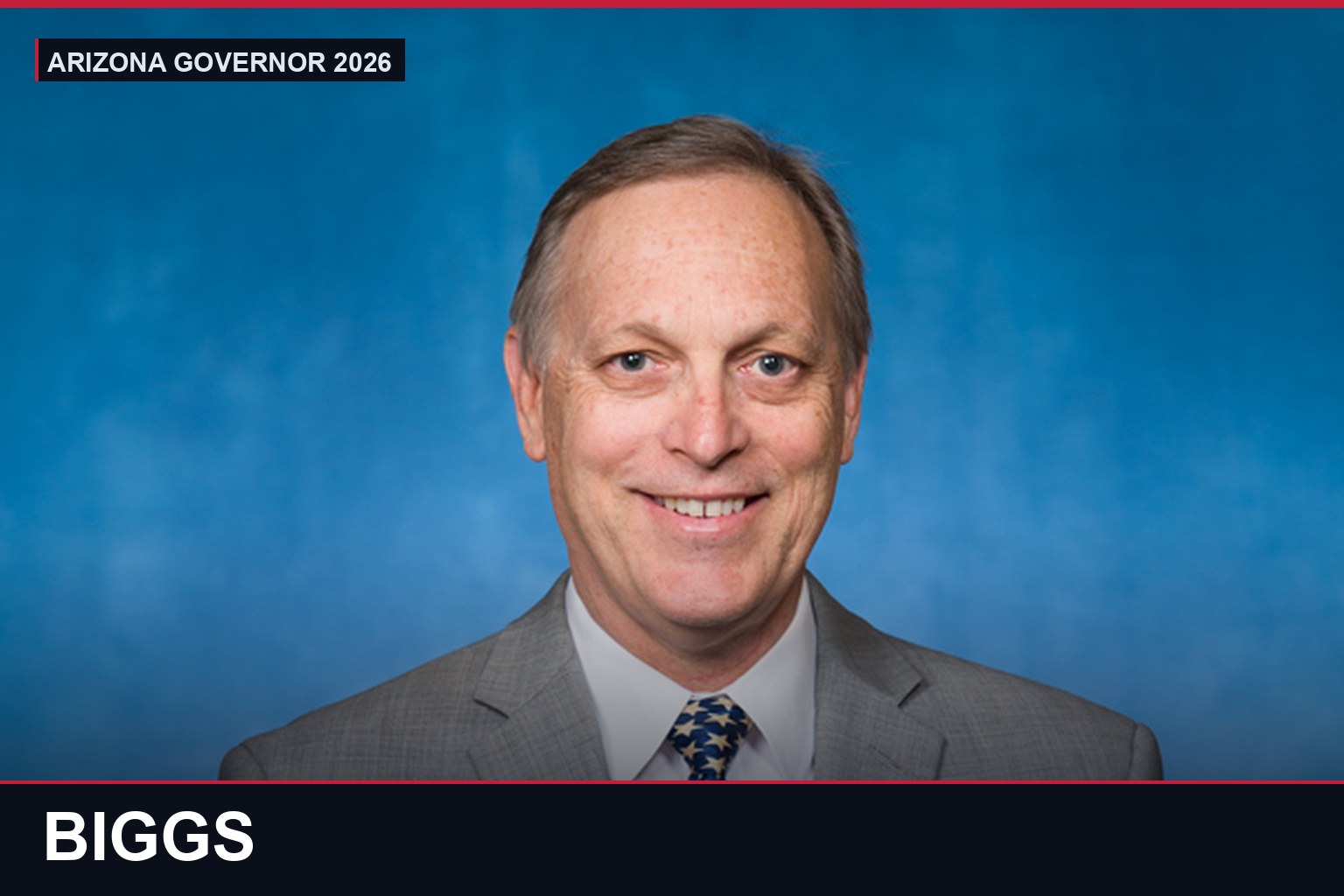
With Republican Andy Biggs winning his party's primary on July 21 — capturing roughly 74 percent of the vote over a divided field that included Rep. David Schweikert and two lesser-known challengers — the general election matchup is now set. Democratic incumbent Katie Hobbs will defend a seat she won in 2022 by six-tenths of a percentage point. A state that Donald Trump carried by more than five points in 2024. Against a congressman whose core constituency has been the most conservative wing of the Republican Party.
On paper, this looks like a genuine tossup — possibly tilting Democrat. Most public polling shows Hobbs with a small but consistent advantage. Forecasters rate the race Lean Democratic. But Arizona consistently produces results at least a few points tighter than pre-election models suggest, which makes every decimal here worth watching.
The 2022 Baseline: A Near-Death Experience
Katie Hobbs became Arizona's governor in January 2023 after winning one of the closest statewide races in the country that cycle. She defeated Kari Lake, the MAGA-aligned candidate backed by Donald Trump, by 50.3 percent to 49.7 percent — a margin of roughly 17,000 votes out of nearly 2.6 million cast.
Hobbs ran as a steady, pragmatic Democrat in a state with a complicated recent political history. Arizona's suburban Maricopa County, which surrounds Phoenix, has been trending Democratic at the presidential level while simultaneously producing competitive down-ballot results. Her 0.6-point win was smaller than many expected given Lake's polarizing profile, but it was enough — and it established Hobbs as an incumbent governor in a state that has recently shown it can produce dramatic ticket-splits.
The context matters for 2026: Hobbs does not have the luxury of a weak, election-denying opponent this time. Andy Biggs, whatever his vulnerabilities in a general election, is a career politician who knows how to run a primary and will have the institutional support of the national Republican Party behind him.
Andy Biggs: Ideology, Strengths, and the Name-Recognition Gap
Biggs's primary performance was dominant. He cleared 74 percent of the Republican vote against three opponents — a rout that gave him a clean, well-funded path to November without the divisive intra-party wounds that often hobble primary survivors in competitive states.
A former Arizona House Speaker who went on to represent Arizona's 5th Congressional District, Biggs has built his political identity around fiscal conservatism, immigration enforcement, and skepticism of federal authority. He is closely associated with the hardline wing of the House Republican caucus — a profile that plays extremely well in GOP primaries and carries real risks in a statewide general election that will be decided by independent voters in the suburbs of Phoenix and Tucson.
His biggest structural challenge heading into November is awareness. Noble Predictive Insights polling conducted in May 2026 found that 37 percent of Arizona registered voters had no opinion of Biggs or had never heard of him — an unusually high number for a sitting congressman in his home state, and a sign that the general election will partly function as an introduction.
On favorability among those who do have an opinion, Biggs runs net-positive: 34 percent favorable, 29 percent unfavorable, per the same survey. The months between now and Election Day will do a lot to sharpen that image — in both directions.
Katie Hobbs: Incumbency, Approval, and the Governing Record
Hobbs enters the general with the advantages that come with the office — name recognition, the power of incumbency, and an established record to run on and against.
Her job approval numbers are mixed. Emerson College Polling found a 39 percent approval / 40 percent disapproval split among Arizona voters in late 2025, a slightly underwater number that suggests she hasn't sealed the race on the strength of her record alone. But her personal favorability — net +9 points in the May 2026 Noble Predictive Insights survey (48 percent favorable vs. 39 percent unfavorable) — runs meaningfully ahead of her job approval, suggesting voters separate how they feel about her as a person from their evaluation of her performance.
Those numbers, combined with the state's partisan landscape, explain why she leads in the polls without having locked down the race.
The Polling Picture
Multiple surveys taken across 2025 and 2026 show Hobbs with a consistent but narrow edge:
- Noble Predictive Insights (May 5–7, 2026): Hobbs 41%, Biggs 37%, Independent Hugh Lytle 5%, 16% undecided. Margin of error ±3.1 percentage points.
- Emerson College Polling (November 8–10, 2025): Hobbs 44%, Biggs 43%, 13% undecided. Margin of error ±3.3 percentage points.
- Noble Predictive Insights (February 23–26, 2026): Hobbs 42%, Biggs 35%.
The multi-poll average as of early August puts Hobbs ahead by approximately four to five points — a lead that sits outside the margin of error in most individual surveys but is far from safe in a state capable of the swings Arizona regularly produces.
A key variable: 16 to 20 percent of voters remain undecided in most surveys. That pool is disproportionately younger voters (18–29), women, and independents — a group that, based on demographic patterns, should tilt toward Hobbs but has not been captured by current polling.
The Gender Gap Is the Story
If there is one structural feature of this race that stands out, it is the pronounced gender gap that shows up consistently across pollsters.
In Noble Predictive Insights data from May 2026:
- Women back Hobbs 45 to 30 percent — a +15 Democratic margin.
- Men back Biggs 44 to 39 percent — a +5 Republican margin.
A fifteen-point gender gap in a race that's otherwise within single digits means the outcome will hinge significantly on which side turns out more of its base. Arizona has competitive voter registration, a large independent bloc, and a history of absentee and mail voting that can complicate late swings.
Hobbs's path to re-election runs directly through the gender gap: hold Democratic turnout, win women by double digits, and claw back enough undecided voters in the Phoenix suburbs. Biggs's path involves closing the gap with men, consolidating Republican voters who supported other candidates in the primary, and overperforming with older voters — a demographic where he shows consistent strength.
Arizona's Shifting Electoral Map
The macro backdrop for this race is a state in genuine political flux. Donald Trump carried Arizona by an estimated five-plus points in 2024 after losing it by 0.3 points in 2020 — a nearly six-point shift toward Republicans in a single presidential cycle, driven largely by movement among Hispanic working-class voters in communities along the I-10 corridor and by continued population growth in the Republican-leaning outer ring of Maricopa County.
But governor and senator races in Arizona have consistently underperformed the Republican presidential number. Hobbs's 2022 win came the same year Democrats underperformed Biden's 2020 presidential margin everywhere, yet she still won by holding enough moderates in Scottsdale and Chandler and running up margins in Pima County (Tucson). Biggs needs those same moderates to move toward him, and his ideological profile makes that harder than it would be for a candidate with a more centrist general-election record.
Arizona is also home to a substantial independent voter registration bloc — historically one of the largest in the country on a percentage basis — which means party base mobilization alone cannot decide statewide races. Independent candidates like Hugh Lytle, who polled at roughly 5 percent in pre-primary surveys, could become a factor if the race tightens, though candidates polling at that level rarely sustain their share through November.
Maricopa County: The Only Scoreboard That Matters
Maricopa County casts more than 60 percent of Arizona's statewide vote. It is the largest county in the United States by registered voters and has been the decisive battleground in every competitive Arizona statewide race for the past decade.
In polling through May 2026, Hobbs held a modest lead in Maricopa — not the blowout margins that would signal an easy win, but enough to matter. Republican strongholds in Yavapai, Mohave, and the rural east will favor Biggs by wide margins. Pima County will favor Hobbs. Everything comes back to how many votes separate them when Maricopa's totals are in.
Biggs's primary support ran strongest in the eastern and rural districts he has represented in Congress, but a statewide general election requires a very different coalition. He will need to perform significantly better in suburban precincts than his congressional district profile would suggest he can.
What Markets Are Watching
The race for Arizona's governorship does not exist in isolation — it is part of a broader 2026 midterm landscape that has direct implications for Senate and House control. Control of multiple competitive states' governors' mansions also shapes the 2028 redistricting and presidential electoral college cycle.
The Arizona governor's race trades directly on prediction markets:
The outcome here feeds into a broader 2026 midterm landscape with direct implications for Senate and House control. The Senate specifically remains one of the most-traded election markets in the country:
A Democratic hold in Arizona reinforces the structural narrative that the 2026 environment is more favorable to Democrats than recent presidential cycles suggested.
November Outlook
Forecasters currently rate Arizona's governor race Lean Democratic, reflecting Hobbs's consistent polling lead, her incumbency advantage, and the structural difficulty Biggs faces in winning over the independent voters who decide Arizona statewide elections.
That said, "Lean" means genuinely competitive — not safe, not likely to be called early on election night. Arizona in 2022 took more than a week to fully resolve. The state's mail ballot infrastructure means large vote banks are processed overnight on election night and in the days following, and races within two or three points routinely feel uncertain for 48 to 72 hours after polls close.
For Hobbs to win, she needs:
- Hold Maricopa County by at least three to four points
- Run up margins in Pima County
- Sustain the gender gap that has anchored her polling lead
- Keep undecideds, especially younger voters and women, from breaking heavily toward Biggs
For Biggs to win, he needs:
- Perform significantly better with suburban moderates than his primary profile suggests
- Consolidate the ~26 percent of Republican primary voters who backed other candidates
- Benefit from an unusually strong national Republican wave that overrides Arizona's individual candidate dynamics
- Close the gender gap by at least five to seven points from current polling
Either outcome is plausible. That's what makes this race worth tracking every poll cycle between now and November 3.
Quick Answers
Who won the Arizona Republican governor primary? Rep. Andy Biggs won the July 21, 2026 primary with approximately 74 percent of the vote. Rep. David Schweikert finished second at 14.4 percent.
What are the latest polls showing? Hobbs leads Biggs by approximately one to five points in surveys through May 2026, with a polling average around D+4. The race is rated Lean Democratic by major forecasters.
When is the Arizona general election? November 3, 2026.
How did Hobbs win in 2022? She defeated Kari Lake by 50.3 to 49.7 percent — a margin of roughly 17,000 votes.
Why is the gender gap important? Women back Hobbs by 15 points; men back Biggs by 5. That asymmetry, in a race this close, makes female voter turnout the single most important turnout variable on either side.
Sources: Emerson College Polling, Arizona 2026 Governor survey (November 2025); Noble Predictive Insights, "AZGOV: Biggs Benefits from Field Consolidation, Hobbs Holds Early Edge" (March 2026); ABC15 Arizona, Arizona governor polling coverage (May 2026); KTAR News, "New poll: Andy Biggs has big lead in GOP primary for Arizona governor" (May 2026); Newsweek, "GOP's Andy Biggs' chances of defeating Katie Hobbs in Arizona governor race" (July 22, 2026); The New York Times, "Arizona Primary 2026: Live Election Results" (July 21, 2026); Noble Predictive Insights, Arizona governor general election polling (May 2026); Ballotpedia, "Arizona gubernatorial and lieutenant gubernatorial election, 2026."