

August 11 Primary Results: South Carolina Senate Heads to Runoff as Minnesota Sets Historic Nominees
South Carolina's 10-candidate Senate special primary delivered a runoff between Trump-backed Darline Graham (32.7%) and Ralph Norman (24.6%). In Minnesota, House Speaker Lisa Demuth upended both Trump's pick and the GOP's convention choice to win the governor nomination. Lt. Gov. Peggy Flanagan routed Angie Craig by nearly 20 points in the Senate primary. Senate control is now a coin flip.
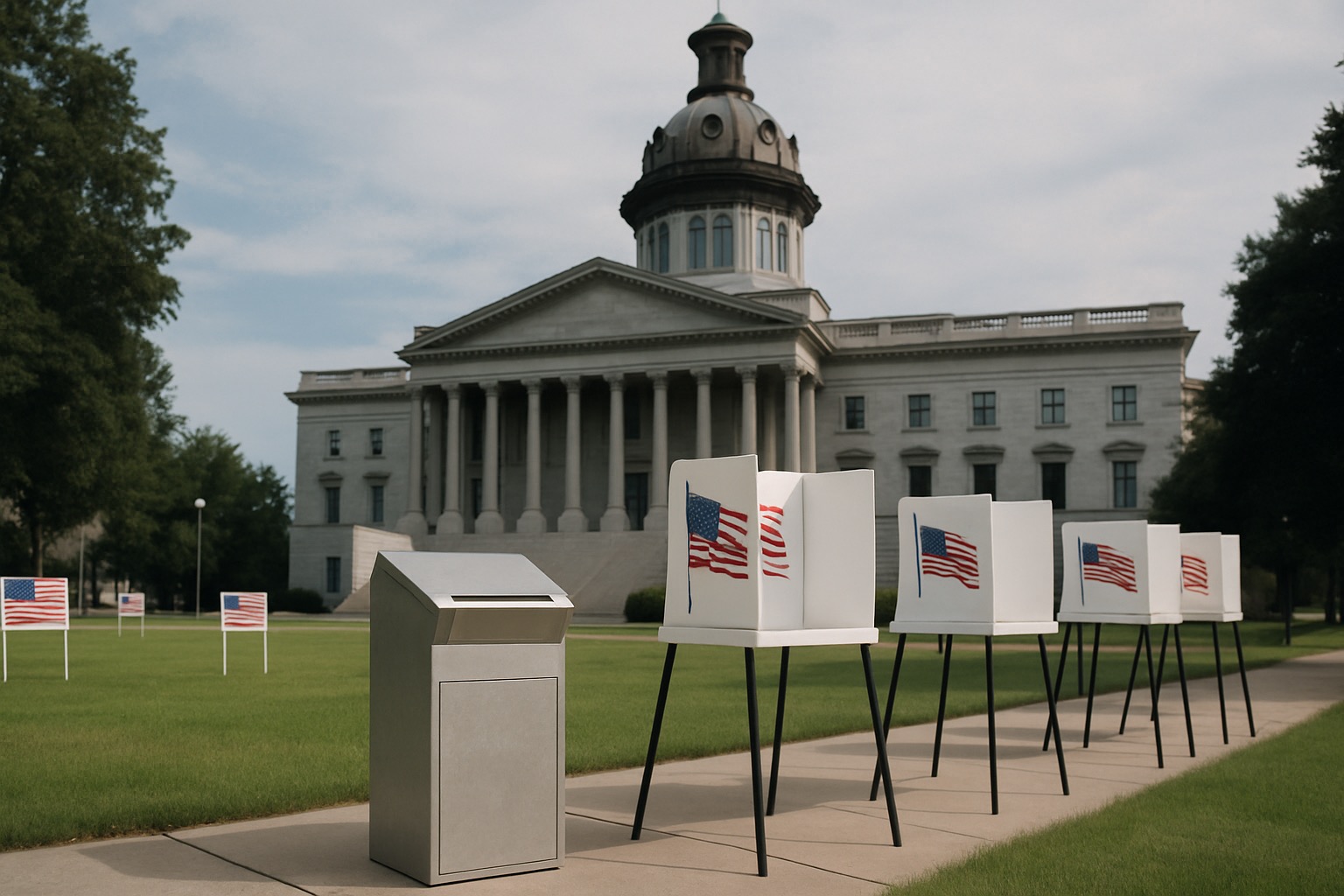
The primary elections of August 11, 2026 settled a series of critical nominations — and left at least one race unresolved for two more weeks. South Carolina's crowded Senate special primary ended without a majority winner, sending Trump-backed appointed Sen. Darline Graham and Rep. Ralph Norman to an August 25 runoff. Minnesota Republicans defied both the president and their own party convention by nominating House Speaker Lisa Demuth for governor over Trump's endorsed candidate Mike Lindell. Lt. Gov. Peggy Flanagan demolished Rep. Angie Craig by nearly 20 points in Minnesota's Democratic Senate primary. And in Wisconsin, moderate Milwaukee County Executive David Crowley edged democratic socialist Francesca Hong for the Democratic governor nomination.
Here is what the results mean — and what prediction markets are saying this morning.
South Carolina: A Runoff on August 25
The race to succeed late Sen. Lindsey Graham ended exactly as the market had anticipated: no candidate cleared 50 percent in a ten-person field, triggering a head-to-head runoff scheduled for August 25.
Darline Graham, the appointed incumbent and Lindsey's sister, led with 32.7 percent of roughly 334,880 ballots cast. Ralph Norman, the veteran Upstate congressman and Freedom Caucus member, finished second at 24.6 percent. Russell Fry, who had been within a point of Norman in some late surveys, fell to 19.6 percent and was eliminated. Former Gov. Mark Sanford — who attracted national attention by hiking the Appalachian Trail as a final-days campaign stunt, a callback to his infamous disappearance as governor — ended at roughly 14.9 percent.
Lindsey Graham won his regular Republican primary in June. His unexpected death on July 11 triggered South Carolina's compressed special-primary process, giving the Republican Party just three weeks to settle on a replacement nominee. Trump quickly encouraged Darline Graham to enter the race and later endorsed her, giving her a built-in organizational and fundraising edge — but not enough to win outright.
The August 25 runoff is a direct test of Trump's endorsement power. Darline Graham, a political newcomer thrust into the race by circumstance and presidential backing, will face Norman, a well-funded congressman with deep roots in Greenville and Spartanburg counties that delivered him his second-place finish on Tuesday night.
The prediction market on the runoff winner gives Darline Graham a 73-cent edge over Norman's 28 cents — reflecting her first-round lead, her incumbency, Trump's active support, and the general advantage that front-runners carry into two-candidate runoffs. On election night, Trump told reporters Graham had called him after advancing and said he planned to call her back. "It's great that she's doing so well," he said. "She's a very good woman."
Norman's path to the nomination requires consolidating the anti-Graham vote from Fry, Sanford, and the field's remaining candidates. Sanford's coalition — a mix of libertarian-leaning Republicans and Trump skeptics — is the key variable. Some Sanford voters may cross over to Graham, viewing her as more electable in November; others may see Norman as the more experienced legislative option.
Whoever wins the runoff will face Democrat Annie Andrews, a Charleston pediatrician who secured the Democratic nomination in June. Cook Political Report rates the general election Solidly Republican. South Carolina has not sent a Democrat to the Senate since 1998.
Minnesota Governor: Demuth Beats Both the Party Pick and Trump's Pick
The sharpest result of the night came from Minneapolis. House Speaker Lisa Demuth — who was passed over for endorsement by the Minnesota GOP convention in May and then passed over by Trump in July — won the Republican governor nomination anyway, defeating both of their preferred candidates.
With essentially all votes counted, Demuth finished at 43.4 percent. Trump-endorsed Mike Lindell — the MyPillow founder and prominent figure in the 2020 election-denial movement — came in at 32.5 percent. Kendall Qualls, the businessman and Army veteran who held the official state GOP endorsement, finished third at 21.4 percent.
The result ended a three-decade streak of Republican convention-endorsed candidates winning the Minnesota primary and marked a clear break with both the national and state party establishments. Lindell had led in limited public polling heading into primary day, including pre-primary surveys that showed him ahead of Demuth. He refused to concede Tuesday night, saying he would wait until every vote was counted.
Demuth will now face Democratic Sen. Amy Klobuchar, who romped in her DFL primary, in November. The matchup is historic: for the first time in Minnesota history, both major-party nominees for governor are women. According to the Minnesota Star Tribune, Demuth becomes the first woman to win the Republican nomination for governor in the state's history and the first Black woman nominated by a major party for the office. Klobuchar was the first woman to win the DFL gubernatorial nomination.
Polling entering the primary showed Klobuchar with a substantial lead. A Minnesota Star Tribune survey found Klobuchar at 48 percent to Demuth's 40 percent among likely voters. All major forecasters — Cook, Sabato's Crystal Ball, and Inside Elections — rate the general election Solidly or Safely Democratic. Minnesota has not elected a Republican governor since 2006.
The general-election question is whether Demuth — viewed by many Republicans before the primary as the party's most electable candidate — can translate her primary coalition into a November upset. She will make that case with roughly 83 days until Election Day.
Minnesota Senate: Flanagan Routs Craig, Faces Tafoya
The Democratic Senate primary for retiring Sen. Tina Smith's open seat wasn't close. Lt. Gov. Peggy Flanagan, a progressive backed by Sen. Bernie Sanders and endorsed by Smith herself, defeated Rep. Angie Craig by nearly 20 percentage points. The final tally: Flanagan 59.0 percent, Craig 39.4 percent, with a minor candidate taking the remainder across roughly 697,780 ballots.
The margin was a significant surprise. Pre-primary surveys had shown the race close. Flanagan's campaign — whose slogan was "the many versus the money" — successfully turned Craig's substantial fundraising advantage into a liability, framing it as evidence of corporate influence at odds with Democratic voters' priorities. Craig was backed by House Minority Leader Hakeem Jeffries and former Transportation Secretary Pete Buttigieg; Flanagan had endorsements from Sanders and progressive labor organizations.
Craig conceded gracefully Tuesday night, offering Flanagan her "full and complete support" and asking her supporters to unite behind the Democratic nominee. Some Craig backers told reporters they were not immediately ready to back Flanagan, though the intraparty fracture appeared modest compared to other contested primaries this cycle.
In her victory speech, Flanagan pledged to fight for Medicare for All, tear apart ICE, and end U.S. military involvement in Iran. She faces Republican Michele Tafoya, the former NFL and NBA sports broadcaster who won the GOP primary with 52.1 percent over Adam Schwarze (24.0 percent) and Royce White (11.2 percent), in the November general election.
The general matchup sets a clear ideological contrast. Tafoya has positioned herself as a conservative voice on immigration, education, and cultural issues and carries NRSC support. If Flanagan wins in November, she would become the first Native American senator from Minnesota, according to the Washington Post. All major forecasters rate the seat Solidly or Safely Democratic; Tina Smith won re-election in 2020 by nearly 11 points.
Wisconsin: Crowley Defeats Hong for Democratic Nomination
Across the border in Wisconsin, Democrats resolved their contested governor's primary with Milwaukee County Executive David Crowley defeating democratic socialist Francesca Hong. The race was close for much of election night before Crowley pulled ahead — a contrasting outcome to the Flanagan victory in Minnesota, where the progressive wing of the party prevailed.
Crowley will face Republican Rep. Tom Tiffany in a general election that Cook, Sabato, and Inside Elections all rate as a Toss-Up. The Wisconsin governor's race, opened by Gov. Tony Evers' retirement, is among the most competitive statewide contests of the 2026 cycle.
What the Markets Are Saying
The most significant market signal following primary night is the Senate control reading. The prediction market on which party controls the Senate next January is at a near-perfect coin flip — 51 percent Democrats to 49 percent Republicans — on combined volume of more than $10.5 million across Kalshi and Polymarket.
The tightness reflects how evenly matched the map now looks with nominations clarified in several key states. South Carolina's runoff winner — expected to be a Republican in November — is now a cleaner two-candidate question: Darline Graham at 73 cents, Norman at 28 cents. Minnesota's DFL Senate seat (Flanagan vs. Tafoya) is rated Solidly Democratic by forecasters, meaning it is unlikely to move the majority needle significantly. Wisconsin's Crowley-Tiffany Toss-Up remains genuinely unresolved.
The seats that will determine the majority are clustered in a handful of competitive states: Michigan, Alaska, Iowa, Nevada, North Carolina, and Texas. Primary results in those states have clarified the matchups; the general-election dynamics are just beginning to take shape. With roughly 83 days until November 3, the Senate control coin is still in the air.
Sources: AP results as reported by The New York Times, NPR, Washington Post, NBC News, and Fox Carolina; Trafalgar Group poll (Aug. 8–10) via WJCL; Minnesota Star Tribune on historic milestones; Washington Post on Flanagan and Native American history; MPR News on MN Senate primary; CBS News Minnesota on MN governor primary. Market data from electionpredictions.us cross-platform consensus.