

August 18 Primary Preview: Alaska's Top-Four Wild Card, Florida's Democratic Senate Pick, and Wyoming's Open-Seat Race
Three states vote Tuesday: Alaska's top-four primary, Florida's Democratic Senate pick, and Wyoming's open-seat race. What prediction markets say heading in.
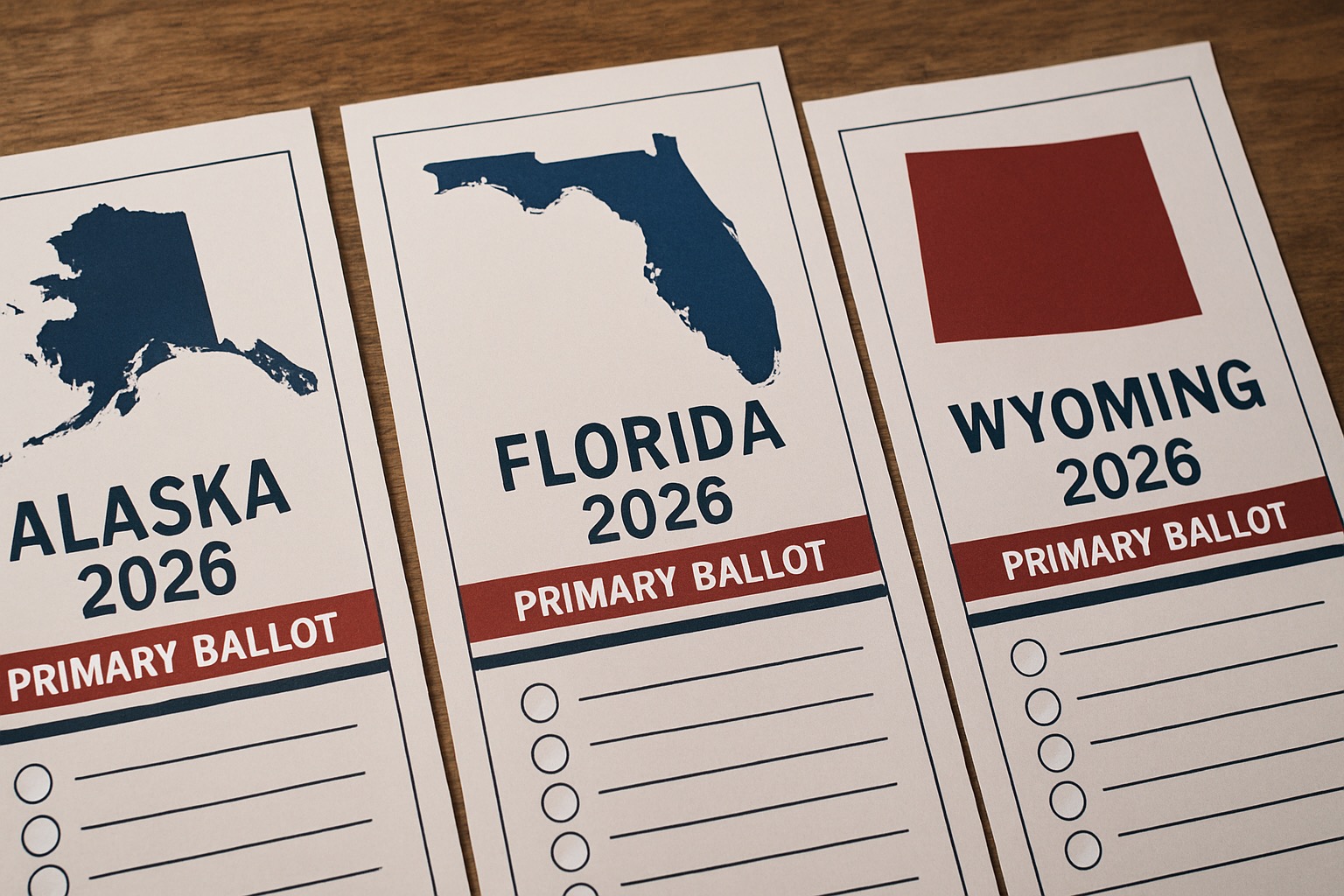
Three states go to the polls on Tuesday, August 18, 2026 — and while Wyoming's contest is largely a formality, two of the three carry real stakes for which party controls the United States Senate in January 2027.
In Alaska, an unusual top-four nonpartisan primary will sort a 16-candidate field down to the four who advance to a ranked-choice general election in November. The two dominant candidates — Republican incumbent Sen. Dan Sullivan and Democratic challenger Mary Peltola — will advance easily, but which other candidates join them on the November ballot could determine Peltola's mathematical path to 50 percent. In Florida, Democrats are choosing between a high-profile national figure and a progressive with deeper in-state roots to face appointed Republican Sen. Ashley Moody in one of the few Sun Belt contests that hasn't been written off entirely. And in Wyoming, Rep. Harriet Hageman is expected to win the Republican primary to inherit an open Senate seat, a stepping-stone contest that carries no meaningful drama for November.
Prediction markets currently price Senate control as a near-perfect coin flip — 50 percent Republican, 49 percent Democratic — with more than $10.7 million in traded volume. Tuesday's results don't decide the majority, but they shape the map that will.
Alaska: The Top-Four Gambit and the Harris Wrinkle
Alaska's primary system is genuinely unlike anything else on the 2026 Senate map. Voters approved a Top-Four nonpartisan primary in 2020, replacing traditional party primaries with a single all-candidate ballot. The four highest vote-getters advance to the general election regardless of party affiliation, where a ranked-choice ballot decides the winner. Tuesday will be the third cycle under this system, according to FairVote, which has analyzed each Alaska primary since the law took effect.
Sen. Dan Sullivan is seeking a third term. He has closely aligned himself with President Trump throughout this cycle. Democratic challenger Mary Peltola, a former one-term House member who lost her seat to Republican Nick Begich in 2024, entered the Senate race in January and has been the most prolific fundraiser in the history of Alaska Senate contests. Federal Election Commission filings through July 29 show Peltola raising $18.5 million to Sullivan's $11.7 million — a $6.8 million edge in total receipts — though Sullivan entered the final stretch with more cash on hand: $7.3 million compared to Peltola's $4.6 million after she outspent him nearly 3-to-1 during the April-June reporting period, according to Alaska Public Radio.
Both candidates will easily advance to November. The 16-candidate field includes a slate of underfunded Republicans, Democrats, a Libertarian, a Green Party member, and several nonpartisan candidates, none of whom have reported significant fundraising on their own.
The Super PAC Spoiler Game
In the week before the primary, political action committees poured more than $2 million into elevating fringe candidates — a deliberate attempt to game the top-four structure, according to Alaska Public Radio's reporting from August 13. The PAC "Fair Deal Alaska," whose funders have not yet been publicly disclosed, spent roughly $770,000 supporting Carol Hafner, a Democrat based outside Alaska, and Richard Grayson, a Green Party member also registered in the Lower 48.
The apparent logic: if Hafner and Grayson advance to November, they could siphon second-choice ranked-choice votes that would otherwise consolidate behind Peltola. The strategy would essentially manufacture a split in the anti-Sullivan vote without Peltola being able to campaign directly against it.
Anchorage Daily News reported that Sullivan and Peltola have both criticized the outside spending. Peltola's campaign noted more than 10,000 Alaska volunteers signed up for ground operations.
The Harris Complication
One day before Tuesday's vote, Peltola's campaign moved quickly to distance her from an unsolicited fundraising appeal sent by former Vice President Kamala Harris's political action committee. The email urged donors to "stand behind Mary," describing Alaska as a "must-win" for Senate Democrats. Peltola's campaign told The New York Times she "did not approve the message" and "isn't seeking endorsements from anyone from the Lower 48." The Guardian reported Friday that Peltola's spokesman said her focus "is and always will be Alaska."
The episode illustrates the tightrope Peltola walks: she needs to consolidate the Democratic base while maintaining the cross-partisan appeal that Alaska's ranked-choice system structurally rewards. Harris lost Alaska by 14 points in 2024. Sullivan has run on his alignment with Trump, who won the state by a comparable margin.
Where the Polling Stands
The general election remains a genuine toss-up. Alaska Survey Research's most recent survey, conducted August 2–5 among 1,371 likely voters (±3.0%), showed Peltola leading Sullivan 51–49 percent in the final ranked-choice round. A New York Times/Siena University poll from June 15–29 showed Sullivan ahead 47–45 percent among likely voters. Both surveys place the race within the margin of error — a position that has remained remarkably stable despite millions in outside spending.
Sabato's Crystal Ball rates the race a Toss-Up. Cook Political Report rates it Lean Republican. Tuesday's primary doesn't change the general election matchup between Sullivan and Peltola — but the third and fourth candidates who advance to November will determine whether Peltola's RCV second-choice path is viable.
Florida: Vindman vs. Nixon, and What It Means for November
Florida's August 18 primary is the first round of a special election to fill the final two years of Marco Rubio's Senate term after Rubio resigned in early 2025 to serve as Secretary of State. Gov. Ron DeSantis appointed then-Attorney General Ashley Moody to the seat; she is running to win it in her own right and faces three nominal Republican challengers, none of whom has mounted a credible campaign. Moody's primary is effectively uncontested.
The Democratic primary is where Tuesday's drama lies.
Alex Vindman, a retired Army lieutenant colonel and former National Security Council official who became a nationally prominent figure as a witness in President Trump's first impeachment proceedings in 2019, entered the race in January. He has raised $14.5 to $16.7 million — an unusually large sum for a Florida Democratic Senate primary — and has built a national small-dollar donor base, according to Florida Phoenix and WLRN, South Florida's NPR affiliate.
Angie Nixon, a progressive state representative from Jacksonville, has raised approximately $625,000 — a fraction of Vindman's total. She has countered with her Florida credentials, labor endorsements from UNITE HERE Local 5 and the International Brotherhood of Electrical Workers, and a grassroots organizing operation. She has criticized Vindman for declining to debate her and argued that her working-class economic message is better suited to the general electorate.
A Change Research survey of likely Democratic primary voters conducted July 9–11 showed Vindman ahead 34–24 percent, with an unusually high 41 percent still undecided. A more recent University of North Florida poll (July 8–17, 848 likely voters, ±3.8%) showed the two Democrats running comparably against Moody in general-election matchups: Moody led Nixon 50–42 and led Vindman 50–40, according to coverage by WLRN and Florida Phoenix.
UNF's Public Opinion Research Lab faculty director Sean Freeder noted that despite the candidates' different ideological profiles, "the party's internal debate over whether to move left or stay centrist may not much affect the behavior of voters — or at least that they aren't paying attention yet."
The Uphill General Election
Whoever wins Tuesday will face steep structural odds in November. Florida went Republican by 13 points in the 2024 presidential election. Decision Desk HQ's polling average has Moody leading approximately 47–40. The RealClearPolitics average shows Moody ahead by 8.4 points across all public general-election surveys.
But Moody's support has consistently sat below 50 percent in every public poll, and she loses independent voters by double digits in surveys that have tested the matchup. Decision Desk HQ noted in an August 9 analysis that Florida is "more likely to remain in Republican hands" — but also calculated that a Democratic flip here would give Democrats "an 84 percent chance of capturing the Senate." Most forecasters currently rate the race Likely Republican, with Florida not among the top-tier Senate toss-ups.
Wyoming: An Open Seat, a Known Outcome
Wyoming's August 18 Senate primary is the most predictable race on Tuesday's map. Republican incumbent Cynthia Lummis declined to seek a second term, opening the Class II Senate seat. Rep. Harriet Hageman — best known nationally for defeating Rep. Liz Cheney in the 2022 Republican primary with former President Trump's endorsement — is the clear Republican frontrunner, backed by Trump, Sen. John Barrasso, and Lummis herself, according to Ballotpedia's candidate filing records.
Hageman faces Jimmy Skovgard, Jill Edwards, and John Holtz in the Republican primary. Holtz, a retired circuit court judge, has run for Senate or House in Wyoming in 2018, 2020, and 2024 without cracking 10 percent of the vote in any cycle, according to Ballotpedia's historical results. On the Democratic side, James Byrd and Billy Benavidez are competing for the nomination that will go to November, where the Democratic Senate nominee has not exceeded 25 percent of Wyoming's statewide vote in a Senate race since 2018.
Trump won Wyoming by approximately 47 percentage points in 2024. The general election here is, for all practical purposes, decided on Tuesday. Hageman moving to the Senate from the House would vacate Wyoming's at-large House seat — a safe Republican district that will also hold a primary Tuesday.
The Bigger Picture: August 18 and the Senate Map
Tuesday's primaries are a reminder that Senate control in 2026 will not be settled by a single night or a single state. The coin-flip market pricing on Senate control reflects a genuinely uncertain map: Democrats need a net gain of five seats to reach a majority, and the path runs through states as different as Alaska's ranked-choice toss-up, Michigan's post-primary general, and Montana's three-way spoiler math.
In Alaska, the true test comes November 3, when Sullivan and Peltola meet in a ranked-choice general election that polling has consistently placed within the margin of error. In Florida, the Democratic primary produces a nominee who will need to outrun the state's structural lean by at least six points to win — a heavy lift, but not without precedent in strong national Democratic environments. In Wyoming, Hageman adds a Senate seat while vacating a House one, a lateral move for Republicans that doesn't shift the majority math.
The House, meanwhile, has broken away. Markets currently price Democratic control of the House at 86 percent — a gap that has widened as the summer progressed.
Frequently Asked Questions
What states are holding primaries on August 18, 2026? Alaska, Florida, and Wyoming are holding primary elections on August 18, 2026. All three states have Senate races on the ballot. Alaska also has a governor and at-large House race; Florida has a governor and 28 House seats; Wyoming has its at-large House seat.
How does Alaska's top-four primary work? Alaska uses a nonpartisan top-four primary system, in which all candidates — regardless of party — appear on a single ballot. The four candidates who receive the most votes advance to the general election, where a ranked-choice ballot determines the winner. Voters approved the system in 2020.
Who is favored to win the Alaska Senate race? Alaska's Senate general election is one of the closest on the 2026 map. Most forecasters rate it a Toss-Up or Lean Republican. The most recent independent poll (Alaska Survey Research, August 2–5) showed Peltola narrowly ahead in the final ranked-choice round, 51–49 percent, within the margin of error.
Who will win the Florida Democratic Senate primary? Alex Vindman entered Tuesday's primary with a substantial fundraising advantage over state Rep. Angie Nixon. Polls of likely Democratic primary voters have shown Vindman ahead, though with a high share of undecided voters. The winner faces Republican Sen. Ashley Moody in the November special election.
Why is Wyoming's Senate primary less competitive than Alaska and Florida? Wyoming is one of the most Republican states in the country. The Democratic Senate nominee has not exceeded 25 percent of the statewide vote in Wyoming since 2018. The August 18 primary in Wyoming determines the Republican nominee — almost certainly Rep. Harriet Hageman — who is the strong favorite to win November's general election.
Sources: Anchorage Daily News (July 20 and August 13, 2026); Alaska Public Radio (July 16 and August 14, 2026); Politico (April 13, 2026); Newsweek (August 11, 2026); The New York Times (August 14, 2026); The Guardian (August 15, 2026); FairVote (August 12, 2026); Florida Phoenix / WLRN (July 20, 2026); Ballotpedia, United States Senate elections in Alaska, Florida, and Wyoming, 2026; Federal Election Commission campaign finance filings; Alaska Division of Elections, elections.alaska.gov; NPR 2026 Election Calendar.