The Last 24 Hours: South Carolina's Senate Runoff Sits at 69¢, Oklahoma's Governor Race at 78¢ — and Trump's Endorsement Record Is on the Line in Both
South Carolina's Senate runoff sits at 68 cents Graham, Oklahoma's governor race at 78 cents Mazzei — and Trump's endorsement record is on the line in both.
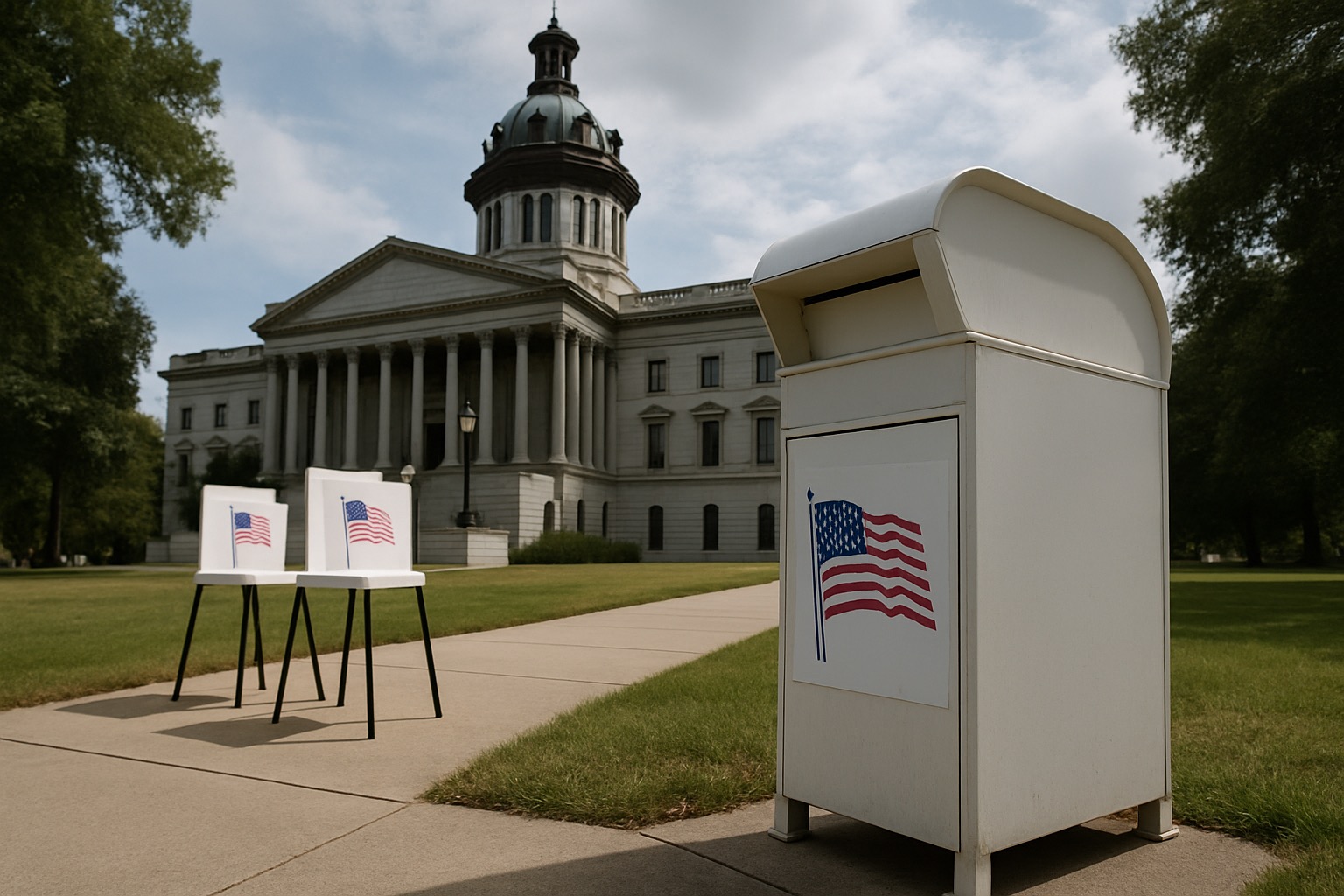
Tomorrow, August 25, Republicans in two states head back to the polls for primary runoffs that will shape both the 2026 Senate map and the Republican Party's internal debate over who controls it.
In South Carolina, Senator Darline Graham faces Representative Ralph Norman in a special Republican primary runoff that will almost certainly decide who represents the state in the United States Senate — the general election against Democrat Annie Andrews is expected to be a formality in a state Donald Trump won by more than 14 points in 2024. In Oklahoma, Attorney General Gentner Drummond and former state Senator Mike Mazzei are fighting to the wire for the Republican gubernatorial nomination, with the winner set to face Democrat Cyndi Munson in November.
The prediction markets see the races differently from each other — and, in Oklahoma's case, very differently from the polls. South Carolina prices Graham at 69 cents on the dollar, a market that was sitting at 89 cents before a single debate moment reoriented the race. Oklahoma prices Mazzei at 78 cents, despite public polling showing a dead heat. In both cases, the polls are close enough that the outcome could diverge sharply from the odds.
South Carolina: The Taiwan Moment That Moved a Market 20 Cents
The August 25 South Carolina runoff is the fourth Republican election in the state in eleven weeks — a compressed sequence triggered by the unexpected death of Senator Lindsey Graham on July 11, less than five weeks after he had won his party's regular primary nomination for a fifth term. Governor Henry McMaster appointed Graham's younger sister, Darline Graham, to hold the seat while the special primary process played out.
She entered an unusual position: a sitting senator who had never held elected office, running in a compressed special primary against a sitting congressman with nine years in the House.
Darline Graham won the August 11 special primary with 33 percent of the vote in a ten-candidate field, with Norman finishing second at approximately 25 percent, according to state Election Commission data reported by the South Carolina Daily Gazette. Because no candidate received a majority, the top two advanced to Tuesday's runoff.
The race entered a new phase on August 18, when the two candidates met at the Newberry Opera House for their only scheduled debate. Most of the evening tracked predictably — Norman pressed Graham on her inexperience; Graham attacked Norman's congressional record and pointed to his failed run for governor earlier in the cycle. Then came the question about Taiwan.
Asked whether Taiwan and the South China Sea represent national security interests for the United States, Graham hesitated. "I'm just going to be honest here," she said. "I'm not on national security — I'm not that informed on national security. But I do support the military."
Gasps and boos followed in the hall. The moment landed with particular force because it arrived in the shadow of her late brother's legacy. Lindsey Graham had spent more than two decades as one of the Senate's most prominent voices on foreign policy and national security. The Associated Press reported that her answer spread widely, with critics describing it as proof of unreadiness for a Senate seat defined by global engagement.
Norman answered the same question with precision, explaining the Taiwan-U.S. trade relationship and the strategic importance of maintaining deterrence against China. "She's running for the United States Senate," he told reporters after the debate. "You need to get fully versed in what issues you're going to be dealing with," the AP reported.
Former South Carolina Governor Nikki Haley, who endorsed Norman, was sharper. "Lindsey Graham was well informed on the United States' national security. Darline Graham admits she's not. This is not something you inherit," she posted, as reported by The Hill. Politico quoted a state representative supporting Norman calling Graham "woefully underprepared" for the role.
CNN reported that at least one Republican lawmaker who had endorsed Graham before the debate called her performance "eyebrow-raising" and said it "didn't inspire confidence." The report noted Trump himself made no public comment on the gaffe.
The prediction market moved. Graham had been priced above 89 cents before the debate. By Sunday evening, electionpredictions.us had the market at 68 cents — a 21-cent swing on a single debate exchange.
What Norman Needs
The endorsement ledger for the South Carolina runoff maps the Republican Party's internal divisions precisely. In Graham's column: President Trump, Senator Tim Scott, Representative Russell Fry, Senator Tom Cotton, and Lieutenant Governor Pamela Evette. In Norman's column: Nikki Haley, former Senator Jim DeMint, Senator Mike Lee, Representative Nancy Mace, and — arriving just hours before Trump's Friday night Myrtle Beach rally for Graham — former Governor Mark Sanford.
Sanford's endorsement was notable for its timing. Politico reported that it landed as Trump prepared his highest-profile intervention yet in the race. Trump held the Myrtle Beach rally on August 21; Graham used the occasion to frame her debate stumble as evidence that she was "not a polished politician," per PBS NewsHour. Norman continued his closing argument on the ground, holding a voter outreach event at a North Charleston GOP cookout on Saturday.
Norman's path to winning runs through the approximately 42 percent of voters who chose neither candidate in the August 11 primary. His campaign has consistently leaned into an experience-versus-endorsement argument: the Senate demands preparation that cannot be inherited by appointment. Graham's campaign, backed by the full weight of the White House, is betting that Trump's direct involvement — the rally, the surrogate network, the name endorsement — mobilizes low-propensity voters who sat out the first round.
One additional dynamic: the debate itself featured Graham hitting Norman on his initial resistance to the president's legislative agenda. "It's my understanding that you were the holdout on the big beautiful bill and Trump had to call you in and convince you to sign it," she said. Norman disputed the framing, saying his objection was to energy subsidies he believed were bad policy and that he improved the bill before supporting it. Norman's consistent reply to Graham's attacks: "It's silly season, folks."
Graham's strongest moment came in her closing statement: "Fact is, I've done more in 20 days than you have done in 20 years," per CNN. Whether that argument lands with a low-turnout runoff electorate — in a race with no public polling to calibrate expectations — is what Tuesday's results will answer.
Heading into Election Day: 68 cents Graham, 32 cents Norman on electionpredictions.us, on volume of more than $17.85 million.
Oklahoma: Where the Polls Say One Thing and the Market Says Another
Two thousand miles away, Oklahoma Republicans are choosing between Gentner Drummond and Mike Mazzei in a race that has produced one of the sharpest divergences between poll-based and market-based probability estimates in the 2026 cycle.
The two candidates emerged from a nine-person June 16 primary in essentially a dead heat: Drummond finished at 26.3 percent (105,832 votes) and Mazzei at 26.0 percent (104,629 votes), per NBC News primary results data. Trump endorsed Mazzei ahead of the primary and has continued backing him vocally — calling Drummond a "FAKE Republican" in an August 18 post, as reported by The Hill.
The independent polling tells a more contested story. Cole Hargrave Snodgrass & Associates — an Oklahoma firm not affiliated with either campaign — surveyed 600 likely Republican runoff voters and published results showing both candidates at 44 percent, with 12 percent undecided. The firm's data, published at chs-inc.com, showed that removing "leaners" from the sample gave Drummond a two-point edge.
The CHS data revealed a structural divide running along party-identity lines. Among the 38 percent of likely runoff voters who identify as "Trump Republicans," Mazzei led 62-22. Among the 56 percent who identify as "Traditional Republicans," Drummond led 60-30. KFOR's reporting on the poll quoted the firm's president noting that something shifted at the debate: "We saw Mazzei with a lead for those that were interviewed before the debate. And for those after the debate, we saw Drummond ahead by one" — a five-point swing in Drummond's direction.
The gender gap runs in opposite directions: Drummond leads among women by roughly seven points; Mazzei leads among men by six. Urban areas break toward Drummond; rural counties break toward Mazzei — a geographic split that mirrors the Trump-versus-traditional Republican divide in the electorate.
The race has crystallized around a specific controversy: the Inola smelter project, an industrial facility that has become a defining flashpoint in state politics. KOSU's election preview noted that Mazzei, who had previously criticized the project, now supports it — in part because it carries Trump's backing. Drummond's campaign has pointed to the reversal as evidence that Mazzei adjusts positions to track presidential preferences. The smelter's environmental footprint and economic promises have energized voters on both sides.
The Associated Press, in its Decision Notes filed this morning, assessed the structural tension in the race directly: "Trump's picks overall in 2026 have had a strong record at the ballot box, but his endorsement is not a guarantee of victory, especially in gubernatorial primaries."
The math the AP is gesturing at: Traditional Republicans outnumber Trump Republicans in Oklahoma's likely runoff electorate by 18 percentage points, per the CHS survey. Drummond wins that larger group by 30 points. For Mazzei's endorsement advantage to overcome Drummond's coalition, the Trump-aligned slice of the electorate would need to turn out at dramatically higher rates than traditional Republicans — the same structural challenge Trump-backed candidates have faced in several 2026 governor's races.
The market currently disagrees with that framing: 78 cents Mazzei, 22 cents Drummond on electionpredictions.us, on volume of more than $1.65 million. Whether the market is pricing in information the polls haven't captured, or whether it is simply reflecting the weight of the presidential endorsement signal without fully accounting for electorate composition, is the live question.
The winner faces Democrat Cyndi Munson in the November 3 general. Oklahoma last elected a Democratic governor in 2010.
The Larger Frame: Trump's Endorsement Power on the Ballot Twice
Tuesday's runoffs arrive at a moment when the president's endorsement record in Republican primaries has become one of the most-watched metrics of the 2026 cycle. His backed candidates have won high-profile matchups and lost others. In Wyoming on August 18, his endorsed candidate for governor lost to Tom Barlow — who ran without a presidential endorsement, funded overwhelmingly by in-state donors, and won the primary by a wide margin.
South Carolina and Oklahoma present different versions of the same test. In South Carolina, the question is whether a presidential rally, a unified surrogate network, and a family name can survive a debate moment that exposed a candidate's inexperience on the exact issue that defined her predecessor. In Oklahoma, the question is whether the endorsement signal can pull enough Traditional Republicans out of Drummond's column, when those voters already outnumber Trump Republicans in the runoff electorate by nearly 20 points.
Neither state's runoff winner will change Senate composition — both produce Republican nominees in states where November general elections are not expected to be competitive. But both add data points to the question that has defined the Republican primary season: how far does the president's influence extend, and where does it meet its limits?
The Senate control market prices Republicans at 52 cents entering the final stretch of the 2026 cycle — Republican control of the chamber remains the consensus. Democrats, meanwhile, are heavily favored to win the House at 87 cents on electionpredictions.us, pointing toward a split-chamber outcome as the most likely path to November. The overall contours of November will be shaped by the contested Senate and governor's races still ahead, not by Tuesday's runoffs. But how those runoffs resolve will add to the picture of how Republican voters are weighing endorsement versus experience in a midterm cycle defined by both.
What to Watch on Election Night
South Carolina (polls close 7 p.m. ET): Watch the Upstate counties — Spartanburg, Greenville, Cherokee — that went heavily for Norman in the August 11 primary, and track whether runoff turnout there significantly exceeds the approximately 11 percent rate from the first round. If Norman can push Upstate participation while Graham's coalition, energized by the Myrtle Beach rally, defends its Lowcountry and Midlands margins, the market's 69-31 spread will be tested. The 42 percent of primary voters who chose neither candidate are the decisive variable; where those voters break will determine whether the Taiwan moment was a race-defining gaffe or a speed bump that the Trump endorsement absorbed.
Oklahoma (polls close 8 p.m. ET): Tulsa County split nearly evenly between Drummond and Mazzei in the primary. Oklahoma County (Oklahoma City) leaned slightly toward Drummond. Rural counties broadly favored Mazzei. A Drummond victory requires his metropolitan-area strength to outperform Mazzei's rural margins at high enough turnout to counterbalance the Trump endorsement's mobilization effect among dedicated MAGA voters. An early lead for either candidate in Tulsa County will be telling.
Frequently Asked Questions
Who is Darline Graham? Darline Graham is the younger sister of the late Senator Lindsey Graham, appointed by South Carolina Governor Henry McMaster to fill the Senate seat after Lindsey Graham's death on July 11, 2026. She has never previously held elected office.
Why is there a South Carolina Senate runoff? South Carolina held a special Republican primary on August 11 to select a replacement nominee after Lindsey Graham's death. Because no candidate received a majority of votes, the top two finishers — Darline Graham (33%) and Ralph Norman (~25%) — advanced to a runoff on August 25.
Who does the South Carolina Senate runoff winner face in November? The Republican nominee will face Democrat Annie Andrews in the November 3 general election. South Carolina is a heavily Republican state; the general election is not expected to be competitive.
What is the Inola smelter controversy in Oklahoma? The Inola smelter is an industrial project in Rogers County, Oklahoma, that has become a central issue in the Republican governor's runoff. Drummond has raised concerns about its environmental impact; Mazzei, who previously criticized the project, now supports it, partly because it has received backing from President Trump. The reversal has become a flashpoint in the race.
Who does the Oklahoma governor's runoff winner face in November? The Republican nominee will face Democrat Cyndi Munson in the November 3 general election. Oklahoma is a deep-red state; no major forecaster rates the general election as competitive.