California Governor 2026 Race Guide: Xavier Becerra vs. Steve Hilton and the Open Seat for America's Most Populous State
California's first open governor's race since 1998 pits Democrat Xavier Becerra against Trump-endorsed Republican Steve Hilton.
California hasn't held an open governor's race since 1998. Gavin Newsom's term expires in January 2027, and state law bars him from running again. What followed his exit announcement was the most expensive gubernatorial primary in American history — a 61-candidate field, more than $316 million in total ad spending, and a billionaire who spent $213 million of his own money finishing in third place.
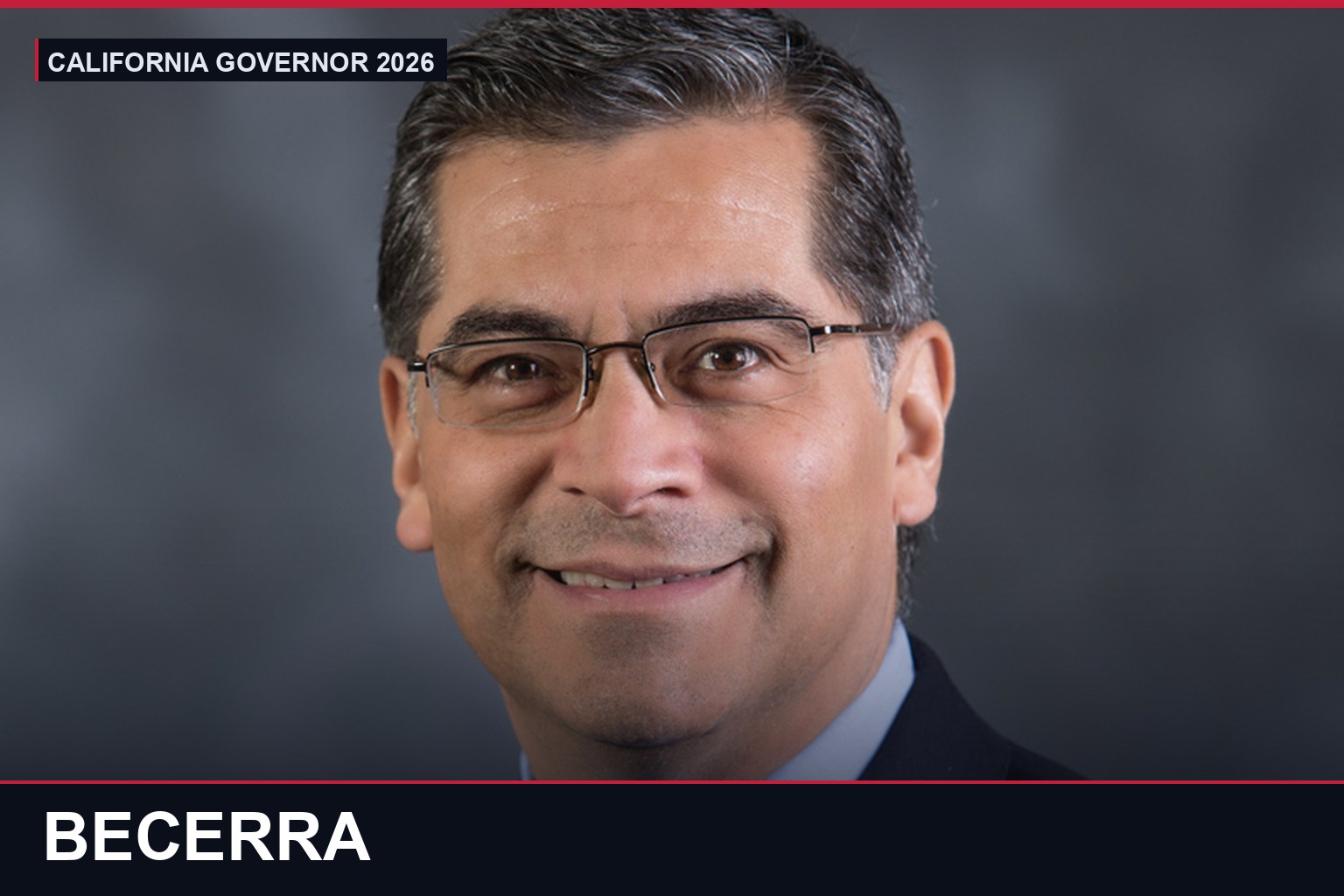
The November 3 general election will settle on two candidates who emerged from that chaos: Democrat Xavier Becerra, the former Biden administration Health and Human Services Secretary, and Republican Steve Hilton, a British-born former Fox News commentator endorsed by President Trump. Both advanced through California's nonpartisan top-two primary on June 2, 2026. The contest heads into its final stretch with Becerra holding a clear polling lead in a state that has not elected a Republican governor since Arnold Schwarzenegger's re-election in November 2006 — nearly twenty years ago.
The Primary That Rewrote the Expectations
Going into June 2, most political observers expected the race to revolve around three Democrats — Becerra, billionaire climate activist Tom Steyer, and former Rep. Katie Porter — and two Republicans, Hilton and Riverside County Sheriff Chad Bianco. What happened surprised nearly everyone.
Steyer spent $213 million, the single largest expenditure by an individual candidate in California primary history, according to data from AdImpact cited by USA Today. It wasn't enough. Corporate interests opposing him — including Chevron, DaVita, and others — poured roughly $55 million into opposition advertising, the largest-ever primary opposition spend against a single candidate in California, per Steyer's own concession statement on primary night. Bianco, who had polled competitively as late as February, faded badly; Porter raised $16.5 million but never broke out of single digits with likely voters. Matt Mahan, the San Jose mayor, spent roughly $30 million in Silicon Valley money and finished below 4%.
When counting concluded, Becerra led with 27.98% of the vote (2,591,857 ballots) and Hilton placed second with 24.59% (2,277,318 ballots), per California Secretary of State returns. Steyer finished third at 22.79% and was eliminated. Becerra told supporters in Los Angeles he had defied the odds after being outspent and, in some quarters, advised to exit. "Becerra bounced back from the fringes," read the USA Today recap, citing California Democratic Party chair Rusty Hicks on how Becerra had consolidated Democratic-leaning, Latino, and no-party-preference support.
Candidate Profiles
Xavier Becerra — Democrat
Born in Sacramento to Mexican immigrant parents and raised in East Los Angeles, Becerra, 68, brings one of the longest public service résumés in the race. He graduated from Stanford University and Stanford Law School before launching a legal career in the California Department of Justice.
From 1993 to 2017 he served in Congress representing parts of Los Angeles — 24 years, during which he rose to chair the House Democratic Caucus. Governor Jerry Brown appointed him California Attorney General in January 2017; Becerra was subsequently elected to full terms in 2018 and won re-election in 2022. President Biden selected him as Secretary of Health and Human Services in 2021, a position he held through the end of the Biden term in January 2025, overseeing federal COVID-19 response, Medicaid expansion, and the defense of the Affordable Care Act through multiple court challenges.
On the campaign trail, Becerra's platform centers on lowering the cost of living — specifically housing and utility prices — through executive emergency declarations to freeze insurance and utility rates, a housing state of emergency to fund 40,000 already-approved affordable units, and expanded down-payment assistance for homebuyers. He has also framed his candidacy heavily as a counterweight to the Trump administration's federal policies, citing the administration's withholding of $867 million in Medicaid payments to California as a live example. His favorability stood at 49% favorable / 43% unfavorable among likely voters in the Berkeley IGS August poll, according to the LA Times.
Becerra entered the general election deliberately keeping a low profile. Per the Sacramento Bee's August 6 reporting, his campaign's stated summer strategy was fundraising and coalition building, with active electioneering timed to begin around Labor Day. He confirmed to reporters he would debate Hilton; details on timing and format had not been finalized as of the Bee's filing.
Steve Hilton — Republican
Steve Hilton, 46, was born in Budapest to British parents and raised in England. He attended Oxford University and built a career in British Conservative Party politics, serving as a senior policy advisor to Prime Minister David Cameron before departing to the United States. He became a Fox News contributor and hosted the weekend program "The Next Revolution" for several years before leaving the network to pursue his own political ambitions.
Hilton received President Trump's endorsement, a significant asset in the Republican primary and a significant liability in the general election in a state where Trump's approval ratings have remained deeply unfavorable. His platform emphasizes cutting state spending and bureaucracy, reducing homelessness through mandatory shelter policies, and rolling back what he describes as regulatory overreach in California's business and energy sectors. On artificial intelligence, Becerra and Hilton are sharply divided: per Tech Times reporting from August 15, Becerra supports AI regulation at the state level, while Hilton opposes state-level AI restrictions, arguing they would harm California's tech industry.
Hilton has been the more visible campaigner through the summer months, barnstorming the state with a steady stream of events and media appearances while Becerra kept a lower profile. His favorability, however, was underwater in the most recent polling: 39% favorable, 50% unfavorable among likely voters, per the Berkeley IGS / LA Times August poll.
The General Election Math
California's partisan registration arithmetic presents a structural challenge for any Republican statewide candidate. Democrats outnumber Republicans by roughly 20 percentage points in voter registration statewide, according to California Secretary of State data. No Republican has won a statewide race since Schwarzenegger's re-election two decades ago.
The August 3–9 Berkeley IGS / LA Times poll of 2,310 likely voters found Becerra leading Hilton 55% to 37%, with 8% undecided. The PPIC survey of likely voters conducted June 29–July 6 showed an even wider gap — 61% Becerra, 36% Hilton. A Kreate Strategies poll in mid-June put the margin at 58% to 33%. Across polls conducted since the June 2 primary, Becerra's lead among likely voters has ranged from 18 to 25 percentage points.
The partisan breakdown in the August IGS poll illustrates why: 88% of Democrats back Becerra, 91% of Republicans back Hilton, and no-party-preference voters — who constitute close to a third of California's registered electorate — lean Becerra by 58% to 30%. The last figure is particularly significant. In California, NPP voters cannot be assumed to split predictably; their nearly 2-to-1 tilt toward Becerra effectively extends the Democratic structural advantage. IGS Poll Director Mark DiCamillo noted in the LA Times write-up that "Democrats outnumber Republicans by 20 points in the state, and that gives the Democratic candidate a huge advantage."
Cook Political Report and Sabato's Crystal Ball both classify the race as Safe or Solid Democratic, per Newsweek's August 13 coverage.
The Spending Story
Total contributions to the Becerra for Governor 2026 committee stand at $22.37 million with $6.24 million cash on hand, per California FPPC data via Transparency USA. Hilton's campaign has raised $12.875 million (including a $100,000 loan), with total expenditures of $14.825 million across the cycle.
Those figures tell only part of the story. During the primary, outside groups supporting Becerra spent roughly $18.7 million through independent expenditure committees, according to the California Target Book, as reported by the LA Times. Key contributors included Chevron, McDonald's, DaVita, Meta, and AirBnB, each contributing substantial sums to pro-Becerra PACs. Labor unions added additional support. Against Hilton, opposition-aligned groups spent approximately $1.8 million during the primary. The full cycle total for the race exceeds $275 million in contributions, per Transparency USA's tally.
The money dynamic heading into the fall is standard for a California general: the Democratic candidate holds structural advantages that reduce the marginal impact of spending differences, while the Republican faces an incentive to keep the race in the headlines through earned media.
Key Issues
Housing and Cost of Living: California's housing crisis — driven by structural supply constraints, restrictive zoning, and high construction costs — remains the single most consistent issue in state polling. Becerra proposes emergency-declaration authority to unlock housing units and crack down on cities blocking development. Hilton argues the state's regulatory environment is itself the primary driver of costs.
Structural Deficit: The incoming governor will inherit a projected deficit of up to $35 billion within a few years, according to state fiscal projections cited by KQED. Both candidates have promised to address the shortfall, though their approaches diverge sharply: Becerra through revenue protection and prioritized spending, Hilton through broad budget cuts.
Homelessness: Highly visible in major metros, homelessness tests both candidates. Becerra would create a continuous state funding stream for rental assistance and proposes a dashboard to track state-funded housing units. He stops short of supporting arrest for those who refuse shelter. Hilton favors a stricter approach, arguing people should not be permitted to voluntarily remain on the street when shelter is offered.
Federal Resistance vs. Federal Alignment: Becerra frames the election in part as a choice between a governor who will defend California's interests against the Trump administration and one who, as Trump's endorsed candidate, would align with Washington. Hilton rejects that framing, arguing the state's relationship with the federal government has been unnecessarily adversarial and costly under Democratic governance.
AI Regulation: A newly prominent fault line. Becerra favors state-level regulation for AI safety and accountability. Hilton opposes it, positioning himself as a defender of the technology sector's ability to operate without state-level constraints that he argues would push innovation out of California.
House Control and California's Congressional Delegation
California sends 52 members to the U.S. House — the largest state delegation in the country. The balance of that delegation will be shaped in part by the same November 3 ballot that decides the governor's race. Several California House seats are rated as competitive by forecasters, and the question of which party controls Congress next year runs directly through California's congressional map.
Forecast
Every major forecaster — Cook Political Report, Sabato's Crystal Ball — rates this race as Safe or Solid Democratic. California's structural partisan advantage, Becerra's double-digit polling leads across multiple independent surveys, Hilton's underwater favorability, and the state's 20-year streak of Democratic statewide wins collectively set a high bar for any Republican path to victory.
That does not make the race without analytical interest. Hilton's debate challenge, whether and when Becerra accepts, could be the most significant variable between now and Labor Day. A wide and nationally watched debate exchange in a deeply polarized media environment is the most plausible mechanism for a narrative shift — though the structural math would need to move significantly for that shift to translate into a competitive November outcome.
The next major data point will be the Q3 fundraising reports, filed after September 30, which will reveal whether Becerra's declared post-primary fundraising push has translated into cash advantages heading into the final advertising sprint.
For now, the California governor's race sits where forecasters placed it before the primary: a Democratic structural hold in the most populous state in the country, contested by a well-funded and nationally prominent Republican who is running in difficult terrain.
Frequently Asked Questions
When is the California governor election?
November 3, 2026. California uses a top-two nonpartisan primary system; the primary was held June 2, 2026.
Who is running for California governor in 2026?
Democrat Xavier Becerra, former Biden administration HHS Secretary and former California Attorney General, and Republican Steve Hilton, a former Fox News commentator endorsed by President Trump.
What happened in the California governor's primary?
Becerra (27.98%) and Hilton (24.59%) advanced from a 61-candidate field. Billionaire Tom Steyer, who spent $213 million, finished third at 22.79% and was eliminated.
Is California a competitive state in the governor's race?
Multiple independent polls show Becerra leading by 18 to 25 percentage points among likely voters. Cook Political Report and Sabato's Crystal Ball both classify the race as Solid or Safe Democratic. California has not elected a Republican governor since Arnold Schwarzenegger's re-election in 2006.
What are the candidates' positions on California's housing crisis?
Becerra would declare a housing state of emergency to unlock 40,000 already-approved affordable units and crack down on cities that block residential development. Hilton argues that state overregulation is the primary driver of housing costs and proposes deregulation.
Sources: UC Berkeley IGS / LA Times polls (June and August 2026); PPIC Statewide Survey (June–July 2026); California Secretary of State (primary results); USA Today primary results coverage; CalMatters voter guide and money coverage; California FPPC / Transparency USA campaign finance data; Sacramento Bee (Aug 6, 2026); Tech Times (Aug 15, 2026); NBC News primary results; Newsweek (Aug 13, 2026).