

Colorado Senate 2026 Race Guide: Hickenlooper Defends in a State Republicans Haven't Won Statewide Since 2016
John Hickenlooper defends against Republican Mark Baisley in 2026. Full race guide: candidates, polling, race ratings, and Senate control market implications.
The prediction markets currently price Republican control of the U.S. Senate at 55 cents — 45 cents for Democrats. That spread reflects dozens of contested races across the map, but one thing it does not reflect is meaningful uncertainty in Colorado.
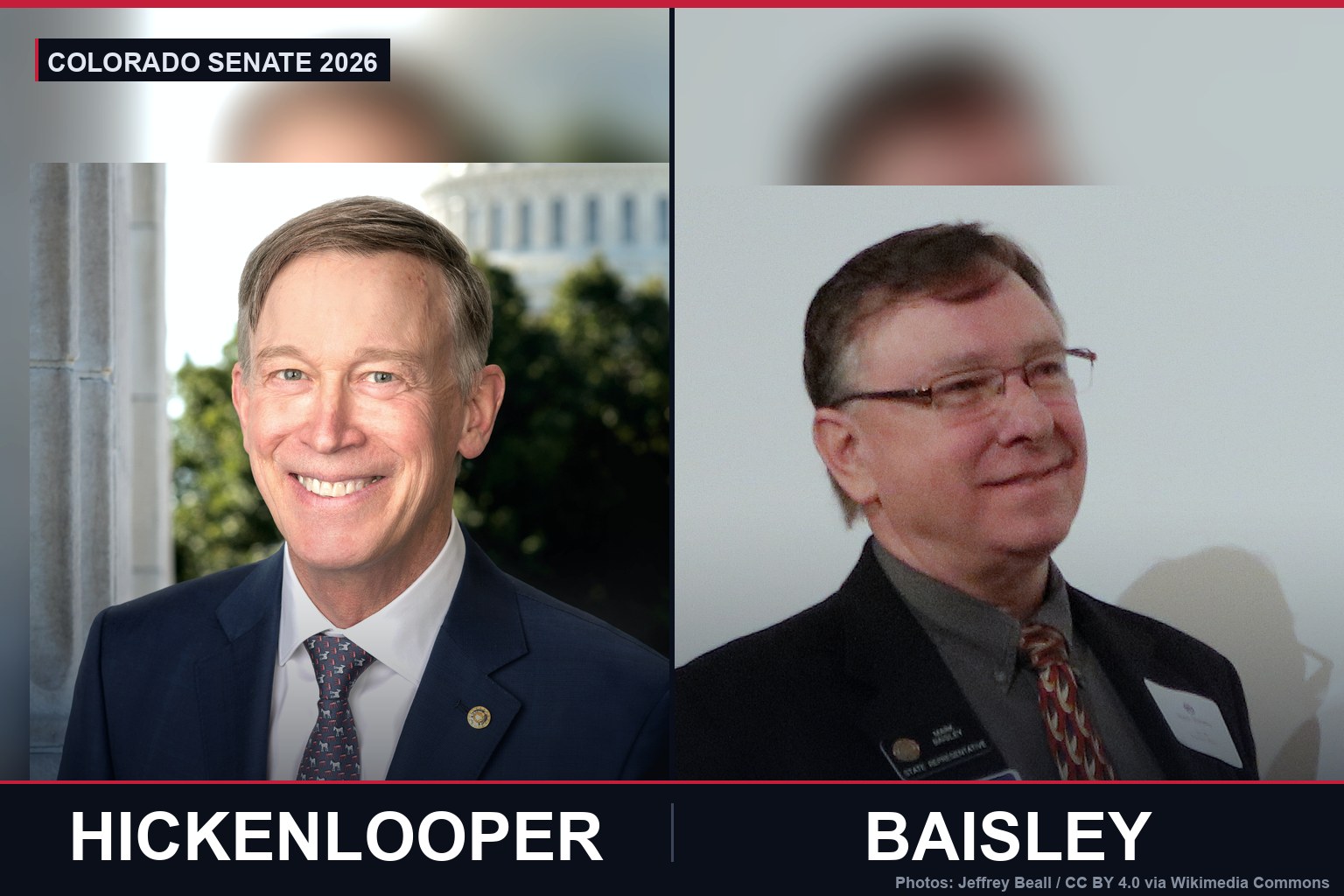
On November 3, 2026, Democratic incumbent John Hickenlooper faces Republican state Sen. Mark Baisley in what the Cook Political Report rates Solid Democratic and Sabato's Crystal Ball rates Safe Democratic. Colorado is a state that was genuinely purple as recently as 2014 and has spent the decade since moving firmly into the Democratic column. Understanding the trajectory — and what a trade on Senate control implies about Colorado's role in it — is the lens that makes this race worth studying even when the outcome appears settled.
The Candidates
John Hickenlooper (D — Incumbent)
John Hickenlooper brings one of the more eclectic biographies in the U.S. Senate. Born in Narberth, Pennsylvania in 1952, he earned a bachelor's degree in English and a master's in geology from Wesleyan University, worked as a geologist in Colorado's oil and gas sector, and in 1988 co-founded the Wynkoop Brewing Company in Denver's LoDo neighborhood — one of Colorado's first brewpubs, and widely credited with helping anchor the revitalization of what was then a derelict warehouse district.
From that entrepreneurial base, Hickenlooper built a political career. He served as Mayor of Denver from 2003 to 2011, a tenure that coincided with significant downtown development and expansion of the city's transit network. He then won two terms as Governor of Colorado, serving from 2011 to 2019. A brief 2020 presidential campaign ended before any votes were cast; he pivoted to the Colorado Senate race and in November 2020 unseated Republican incumbent Cory Gardner by 9.1 percentage points in what had been considered a competitive contest.
Hickenlooper has said publicly that this will be his final campaign for elected office. He is running on his Senate record — particularly on water policy, clean energy development, housing, and healthcare — and on his positioning as a centrist Democrat capable of working across party lines. His base is the coalition that has delivered Democratic victories statewide: Front Range suburbs, college-educated voters, and the growing unaffiliated bloc that now makes up more than 40 percent of Colorado's registered electorate.
Mark Baisley (R)
Mark Baisley, born in 1955, represents Colorado's 4th Senate district from his base in Woodland Park, on the eastern flank of Pikes Peak. He runs Slipglass, Inc., an engineering software company based in Littleton. A Republican with a background in computer information systems and business administration — he earned dual degrees from Columbia College in Missouri in 1993 — Baisley was first elected to the state House in 2018 and moved to the state Senate in 2022.
He entered 2026 as a candidate for the Republican gubernatorial nomination in what was shaping up to be a crowded field. In January 2026, he switched to the Senate race — citing state Sen. Julie Gonzales's progressive primary challenge to Hickenlooper as a sign the incumbent might be more vulnerable than his statewide record suggested. At the Colorado Republican Party Assembly in Pueblo on April 11, 2026, Baisley secured the GOP nomination, the only candidate to clear the 30 percent threshold required to advance to the primary ballot. He subsequently ran unopposed in the June 30 Republican primary.
Baisley's platform centers on constitutional conservatism, Second Amendment rights, border enforcement, and economic competitiveness. He has argued that Colorado's affordability crisis reflects the consequences of one-party Democratic governance in Denver and Washington, and that the state needs a senator willing to push back on federal spending and regulation. His campaign has drawn support from the conservative and Trump-aligned wing of the Colorado Republican Party.
The Democratic Primary: Closer Than Anticipated
Before Hickenlooper could turn to Baisley, he had to survive a competitive intra-party challenge that proved more demanding than his fundraising advantage and incumbency might have suggested.
State Sen. Julie Gonzales of Denver entered the Democratic primary with backing from the Working Families Party, Indivisible, and progressive organizations arguing that Colorado Democrats deserved a senator more willing to confront the Trump administration head-on. The pitch resonated, particularly with younger and more left-leaning Democratic primary voters.
Pre-primary polling showed the race tighter than Hickenlooper's profile suggested. A Colorado Community Research poll of 796 likely Democratic primary voters conducted May 17–28, 2026 — commissioned by Colorado Community Research and published June 9 — showed Hickenlooper leading Gonzales 41 to 34 percent, with 25 percent undecided. An earlier Data for Progress survey (February 20–25, 739 likely voters) showed him ahead 45 to 13 percent, but with substantial undecided voters and significant room for movement.
The Colorado Polling Institute also found, in a bipartisan March 2026 survey, that Hickenlooper's favorability had reached a rough equilibrium: 43 percent favorable, 43 percent unfavorable — a narrower net-positive than his 2020 positioning and a sign of the headwinds incumbents across the board were facing, according to Colorado Public Radio's reporting on the data.
On primary night, June 30, the Associated Press called the race for Hickenlooper shortly after polls closed at 9 p.m. MT. When CPR and NBC News reported final results, Hickenlooper had secured roughly 53 to 57 percent of the vote, depending on the count snapshot, to Gonzales's 43 to 47 percent. The margin was decisive but not dominant — a clear signal that the progressive wing of the Colorado Democratic Party had found a real following, even if it fell short.
"A couple of those polls made it look a little bit challenging there for a while," Hickenlooper said in his victory speech, before turning his attention to the November contest against Baisley.
Colorado's Political Transformation
To understand why the Cook Political Report has never wavered from a Solid Democratic rating for this race, you have to understand the structural changes that have reshaped Colorado politics over the past decade.
Not long ago, the state was the definition of purple. In 2014, Cory Gardner — then a four-term congressman from the Eastern Plains — defeated incumbent Democratic Sen. Mark Udall in a race that served as a national bellwether for Republican strength in Obama's second midterm. As recently as 2016, competitive statewide races were the rule, not the exception.
The shift since then has been striking and multidimensional.
Front Range urbanization. The Denver metropolitan area — anchored by Denver proper but extending through Boulder, Aurora, and the suburban counties of Jefferson, Arapahoe, and Douglas — has grown substantially and moved sharply toward Democrats. Suburbs that once reliably produced Republican margins have become competitive or lean Democratic in federal races. Harris carried Colorado by 10.5 percentage points in 2024; Biden had carried it by 13.5 points in 2020.
The unaffiliated voter factor. Colorado's electorate is structurally unusual: more than 40 percent of registered voters are unaffiliated with either major party. These voters can participate in party primaries — a rule that shapes both parties' nomination contests — and in general elections they have broken consistently toward Democratic candidates in federal races in recent cycles. Any Republican candidate for statewide federal office must peel off a meaningful share of these voters, and the nationalized campaigns of recent Republican federal candidates in Colorado have repeatedly failed to do so.
Educational composition. Colorado ranks among the most highly educated states in the country by share of college-degree holders, concentrated particularly along the Front Range corridor. This demographic has trended strongly toward Democrats in the post-2016 environment.
Migration patterns. Sustained in-migration, especially from coastal metropolitan areas, has altered the state's political composition, particularly in the Denver suburbs, Boulder County, and mountain resort communities.
The result: Democrats now hold both U.S. Senate seats, the governorship, and strong majorities in both chambers of the Colorado General Assembly. Republicans have not won a statewide general election in Colorado since 2016. That is the structural backdrop against which Baisley is running.
Race Ratings and the Fundraising Landscape
The Cook Political Report assigned this race a Solid Democratic rating at the outset of the 2026 cycle and has not moved it. The rating reflects both the state's partisan lean and the absence of a Republican challenger with demonstrated crossover appeal or the resources to mount a serious statewide campaign.
Hickenlooper holds a significant fundraising advantage in the general election phase of the contest, benefiting from his incumbency, his donor network built across multiple statewide campaigns, and Democratic enthusiasm. Baisley, making his first federal campaign, faces the substantial challenge of building a donor base capable of funding a competitive statewide race in a state with expensive media markets. The Republican Senate Campaign Committee has not publicly committed resources to Colorado, consistent with the non-competitive ratings.
Colorado's media markets — particularly Denver — are among the pricier in the interior West, meaning advertising costs impose a meaningful burden on any candidate without a well-funded war chest.
The Issues Driving Colorado Voters
Water. Colorado sits at the headwaters of the Colorado River and is bound by the 1922 Colorado River Compact and subsequent agreements that have come under severe stress as drought and demand have squeezed the basin. Water is not an abstract policy issue here — it affects agriculture, municipal planning, energy production, and recreation. Hickenlooper's Senate record on infrastructure investment and his experience navigating these disputes as governor are central to his general-election positioning.
Climate and clean energy. Colorado's economy bridges two worlds: fossil fuel extraction on the Western Slope and the San Juan Basin, and a rapidly expanding clean energy sector along the Front Range. Both candidates address energy; they diverge sharply on pace and regulatory approach. The tension between these sectors shapes debates over federal leasing policy, state environmental regulation, and the pace of the energy transition.
Housing and affordability. Colorado Polling Institute surveys consistently identify affordability as the top concern among Colorado voters across party lines. Home prices in the Denver metro and in mountain resort communities have surged. Rents have risen. The cost of living has become a central issue cutting across the partisan divide in a state where incomes, while above the national median, have struggled to keep pace with housing costs.
Immigration and economic policy. Colorado Public Radio's May 2026 voter guide cited polling showing 67 percent of Colorado voters are concerned about ICE enforcement practices. Simultaneously, concerns about tariff impacts on Colorado's agricultural sector and the broader national economy have registered in polling. These tensions reflect the complexity of an electorate with significant rural, agricultural, and suburban components alongside a large urban core.
What Would It Take for Republicans to Win?
The honest answer, per analysts tracking this race: a set of conditions that have not materialized.
A competitive Colorado Senate general election would require a national political environment shifting dramatically toward Republicans beyond current forecasts — and a uniquely strong Republican candidate capable of winning the unaffiliated voters who determine Colorado's general election outcomes. Baisley has not offered a profile that independent assessments have found likely to achieve that.
His positioning within the Colorado Republican Party — as a movement conservative aligned with the Trump wing of the party — is well-suited to winning a GOP assembly in Pueblo. It is a harder sell in the Denver suburbs and mountain communities that determine statewide outcomes. Republicans attempting to win Colorado's unaffiliated voters have historically needed to project a more centrist or business-focused image.
ColoradoPols, a long-running insider publication tracking state politics, estimated in its July 2026 "Big Line" update that Hickenlooper's probability of winning in November is 90 percent — not the reflection of any inherent bias for the incumbent, they noted, but of the structural realities of the state.
The Market Angle
Prediction markets aren't pricing a Colorado Senate race directly — there is no active general-election market for this seat as of early August 2026. What markets are pricing is the aggregate control question: which party controls the Senate after the November 3 votes are counted.
That contract currently sits at 55 cents for Republicans, 45 cents for Democrats. In that broader framing, Colorado is treated as a near-certain Democratic hold. A state where the prediction-market consensus believes Hickenlooper wins, all else equal, simply does not move the needle on Senate control.
What should alert a prediction-market trader to recalibrate their view of Colorado? A credible general-election poll showing Baisley within single digits would be the clearest signal, particularly if it showed him pulling unaffiliated voters in meaningful numbers. No such poll has emerged as of this writing. Absent that data, the broader Senate control price reflects the assumption — built into the structure of the 2026 map — that Colorado stays blue.
Key Facts
- Election date: November 3, 2026
- Democratic nominee: John Hickenlooper (incumbent, first term, elected 2020 by 9.1 pts)
- Republican nominee: Mark Baisley (state senator, Woodland Park; runs engineering software company)
- Race ratings: Solid D (Cook Political Report) / Safe D (Sabato's Crystal Ball)
- Presidential lean: Harris +10.5 pts (2024); Biden +13.5 pts (2020)
- Last Republican to win a Colorado statewide general election: 2016
- Democratic primary result: Hickenlooper def. Gonzales, ~53–57%, June 30, 2026
- Unaffiliated voters: More than 40% of Colorado registered voters
Sources: Colorado Public Radio (primary results, voter guide) · NBC News (primary live blog, results) · Cook Political Report (race rating) · Colorado Politics (Baisley Senate announcement) · Baisley for Senate (GOP assembly announcement) · Colorado Newsline (primary result) · Colorado Sun (Republican field, July 2025) · ColoradoPols (Big Line, July 14, 2026)