

Florida Senate Special Election 2026: Ashley Moody vs. Angie Nixon and the Long-Shot Race That's Rewriting the Map
Nixon beat Vindman 56–44% with a 17-to-1 fundraising gap. Now she faces Sen. Ashley Moody in a state that hasn't elected a Democrat to the Senate since 2012.
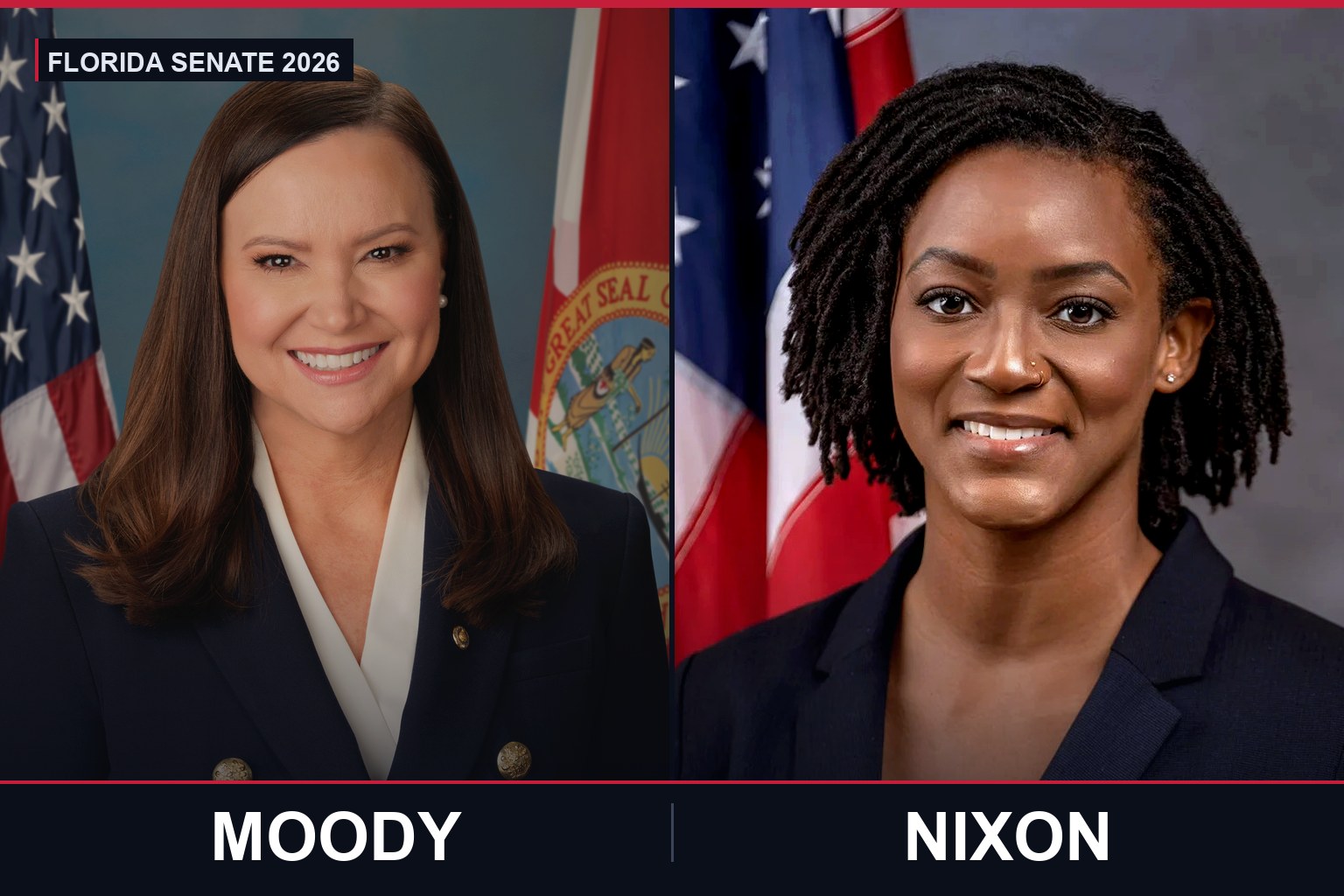
By 2:00 PM on August 19, the general election for Florida's U.S. Senate special election was official — and it arrived with a jolt that no one in the political world saw coming.
State Rep. Angie Nixon, a Jacksonville Democrat and member of the Democratic Socialists of America, defeated former Army Lt. Col. Alexander Vindman in Tuesday's Democratic primary, 56.1% to 43.9%, according to the Associated Press. She did it with a fraction of Vindman's resources — raising approximately $975,000 to his $16.3 million, a 17-to-1 funding disadvantage that made her victory one of the most surprising primary upsets of the 2026 cycle.
On November 3, 2026, Nixon will face incumbent Republican Sen. Ashley Moody, who dispatched three lesser-known challengers in the GOP primary with 79.6% of the vote. The winner will serve the final two years of the Senate term former Sen. Marco Rubio won in 2022 before leaving to become Secretary of State.
Full Senate control odds are near a coin flip heading into November — which means every seat, including long-shot Florida, gets scrutinized.
The structural headwinds facing Nixon are steep. Forecasters moved quickly: Sabato's Crystal Ball upgraded the race from "Likely Republican" to "Safely Republican" within hours of the AP projection, citing Nixon's limited financial resources entering the general election. The Cook Political Report rates the race "Solid Republican." Florida has not sent a Democrat to the Senate since Bill Nelson won his third term in 2012. In 2024, Donald Trump carried the state by 13.1 percentage points.
And yet, what happens in November will matter.
The Seat and Its History
This race is a special election — the first Florida has held for a Senate seat since 1936. The vacancy opened when Gov. Ron DeSantis appointed Moody to the seat in January 2025, after Rubio resigned to join the Trump administration as Secretary of State. Under Florida law, an appointed senator serves until the next general election, when voters choose someone to complete the remainder of the original term. The winner on November 3 will serve through January 2027.
Appointed senators don't always transition smoothly to elected incumbents. In the current cycle, appointed Ohio Republican Jon Husted is running in a competitive race of his own. Whether the "appointed senator" dynamic creates any vulnerability for Moody in Republican-dominant Florida is one of the smaller questions of the fall — but a real one. Her party's 2022 attorney general reelection, where she became the only statewide GOP candidate to break 60%, suggests she has standing on her own. She has never, however, run for Senate before.
Who Is Ashley Moody?
Ashley Moody, 46, is a fifth-generation Floridian who served as Florida's attorney general from 2019 to 2025. Before that, she worked as a federal prosecutor, handling drug, firearm and fraud cases in the U.S. Attorney's Office. She won the attorney general's office in 2018 and won reelection in 2022.
Moody won Tuesday's Republican primary with 1,320,048 votes — 79.6% — over three challengers, including technology consultant Chris Gleason (13.7%), physician Neelam Taneja Perry (1.9%), and minister Ernie Rivera (4.8%), per the New York Times' results tracker.
She enters the general with $8.4 million in cash on hand and $10.8 million raised in total, according to Federal Election Commission filings through June 30, 2026. Her platform centers on law enforcement, border security, and opposition to what she called Nixon's "socialist" agenda on the night of the primary. "We are staring down crazy and the socialists today," Moody said in her victory speech, per NBC News.
President Trump has endorsed her, and she has the backing of Florida Sens. Rick Scott and the Republican Senatorial Campaign Committee, which has called Nixon's nomination a gift. "Florida will never elect a socialist to the U.S. Senate," NRSC spokesman Nick Puglia said in a statement.
Who Is Angie Nixon?
Angie Nixon, 42, has represented Jacksonville's House District 13 in the Florida Legislature since 2020 — a predominantly Black district that includes her hometown neighborhood of Moncrief. She earned a bachelor's degree in political science from the University of Florida in 2007, then spent years in higher education administration and labor organizing before entering elected office.
She is a member of the Democratic Socialists of America, the Working Families Party, and the Service Employees International Union. Her primary endorsers included Our Revolution, the national progressive organization associated with Sen. Bernie Sanders, and the veterans group Common Defense.
Nixon became the first Black woman to win a major party Senate nomination in Florida history, per the Florida Times-Union. If she defeats Moody in November, she would become the first Black lawmaker and only the second woman ever elected to represent Florida in the United States Senate. She would also be the first DSA member elected to the Senate, per USA Today.
Her platform, per her campaign website and interviews, centers on universal health care (including a path toward Medicare for All), raising the federal minimum wage to $25 per hour, rent stabilization with a 10% cap on rent increases, free childcare, canceling student debt, and taxing the wealthiest Americans to fund those priorities. In a FOX 13 interview, she also called for legislation banning corporations from inflating grocery and fuel prices — a message aimed at working-class voters frustrated by sustained cost-of-living pressure.
Nixon has also been willing to court controversy. In May 2026, she staged a sit-in at Gov. DeSantis's office to protest Republican congressional redistricting. She was arrested and charged with misdemeanor trespassing and resisting an officer without violence; her trial is scheduled for September, squarely in the middle of the general election campaign.
She enters the general with approximately $260,000 in cash on hand, per The Hill — roughly one thirty-second of Moody's war chest.
What the Polls Show
Surveys that modeled the Moody-Nixon matchup before the primary gave Moody consistent leads among likely voters:
- University of North Florida (July 8–17, 2026; 848 LV; ±3.8%): Moody 50%, Nixon 42%
- Stetson University (March 15–April 13, 2026; 848 LV; ±4.1%): Moody 51%, Nixon 38%
- Emerson College (March 29–31, 2026; 1,125 LV; ±2.8%): Moody 47%, Nixon 36%
- University of North Florida (Feb. 21–March 2, 2026; 786 LV; ±4.0%): Moody 46%, Nixon 38%
The most recent survey, from UNF in July, showed an 8-point gap. That poll was conducted before the primary resolved, so post-primary surveys with both nominees confirmed will be worth watching for movement in either direction. For context, Moody consistently led by larger margins against Vindman, the opponent those polls were most focused on — the Nixon numbers were secondary matchups. In the Emerson poll, for instance, Moody led Vindman 46–38% and Nixon 47–36%, a roughly comparable spread.
The Case For Nixon
Nixon's upset primary provides the blueprint for her path. According to Axios, she won approximately 80% of the vote in Duval County, where she is a known quantity. But her strength traveled further than expected: she posted significant vote totals in liberal college towns and won unexpectedly in Orlando and South Florida, including in Miami-Dade.
Her central argument for November is economic: housing costs, wages, and corporate price-gouging are issues with cross-partisan resonance in a state with some of the nation's fastest-rising rents. A candidate running explicitly against what she calls "corporate greed" may have a different geographic coalition to draw on than conventional Democratic nominees in Florida.
Following Tuesday's result, Senate Democratic Leader Chuck Schumer and DSCC Chair Sen. Kirsten Gillibrand put out a joint statement backing Nixon as "a clear choice" for Florida voters, per USA Today. That national party support could unlock small-dollar fundraising — the kind of post-primary surge that transformed underfunded candidates in prior cycles into viable statewide contenders. Whether she can close the 32-to-1 cash gap with Moody before November ad buys begin will be the first real test.
Vindman, who pledged to support Nixon in the general election, said in his concession: "Rep. Nixon ran a strong campaign. I will be standing by her side in the fight against Ashley Moody."
The Case For Moody
The structural argument for Moody is as simple as it is daunting for her opponent: Florida has not elected a Democrat to the U.S. Senate since 2012. The state's Cook Partisan Voting Index sits at R+5, and Trump's 2024 margin of 13.1 points illustrates how far the state has moved since the era of genuine swing-state competition.
Moody's financial advantage is overwhelming. She has $8.4 million available; Nixon has roughly $260,000. Statewide advertising in Florida — a state with multiple expensive media markets — can cost tens of millions of dollars in a competitive Senate race. A candidate without that money faces a near-impossible task of introducing herself to voters outside her home media market.
Moody also benefits from Florida's Republican registration advantage and a senior-heavy electorate that has broken decisively Republican in recent cycles. She is the sitting senator. She has strong name recognition from two attorney general campaigns. And her general election framing — drawing a sharp contrast with Nixon's DSA affiliation and platform — fits the playbook that has worked in Florida for over a decade.
Sabato's Crystal Ball managing editor Kyle Kondik stated it directly after Tuesday's results: "I don't see how she runs a viable statewide campaign — money isn't everything but it is important."
What the Senate Control Market Shows
The broader Senate and chamber-control picture sets the backdrop for every individual race this fall. No single market captures a standalone Florida Senate general probability at this time — but Senate control pricing reflects just how much is in play.
Senate control odds remain competitive heading into November, reflecting the genuine uncertainty at the top of the ticket. In that environment, every seat in the Republican column — even one as red-leaning as Florida — draws at least some strategic attention from both parties.
For Democrats, a Florida win would accelerate their path to a Senate majority significantly. For Republicans, holding it is considered a baseline expectation. Whether that expectation holds through November will depend on factors that don't yet exist: post-primary polling, fundraising reports, and how well Nixon can nationalize a race that conventional wisdom says shouldn't be competitive.
Key Dates
- August 19, 2026: General election nominees officially set
- September 2026 (TBD): Nixon misdemeanor trespassing trial
- November 3, 2026: Florida Senate Special Election general
Frequently Asked Questions
Why is this a special election? Marco Rubio resigned from the U.S. Senate in January 2025 to serve as Secretary of State in the Trump administration. Under Florida law, Gov. Ron DeSantis appointed Ashley Moody to serve as his replacement until the next general election. The November 3, 2026 general election will determine who serves the final two years of Rubio's term through January 2027.
Who is Angie Nixon? Angie Nixon, 42, is a Florida state representative from Jacksonville's House District 13. She is a member of the Democratic Socialists of America and the Working Families Party. She was endorsed in the Democratic primary by Our Revolution, a national progressive organization associated with Sen. Bernie Sanders. She defeated Alexander Vindman 56.1%–43.9% in the August 18 Democratic primary, becoming the first Black woman to win a major party Senate nomination in Florida history.
What is Ashley Moody's background? Ashley Moody, 46, served as Florida's attorney general from 2019 to 2025, winning both the 2018 and 2022 races — the latter by more than 60%. She was appointed to the Senate in January 2025 by Gov. Ron DeSantis. She won the August 18 Republican primary with 79.6% of the vote. She has not previously run for Senate.
What do forecasters say about this race? Following Nixon's primary win, Sabato's Crystal Ball moved the race from "Likely Republican" to "Safely Republican." The Cook Political Report rates it "Solid Republican." All major forecasters have the seat in the Republican column.
How large is the fundraising gap? Through June 30, 2026, Moody had raised $10.8 million with $8.4 million in cash on hand, per Federal Election Commission filings. Nixon entered the general election with approximately $260,000 in cash on hand after her primary campaign raised roughly $975,000 total.
When was the last time Florida elected a Democrat to the Senate? 2012, when Bill Nelson won his third term. Nelson lost his reelection bid to Rick Scott in 2018. No Democrat has won a Florida statewide election since.