

Georgia Governor 2026 Race Guide: Rick Jackson, Keisha Lance Bottoms, and the $118 Million Open-Seat Fight
Brian Kemp is out. Rick Jackson poured $118 million into the Republican primary and now faces Keisha Lance Bottoms in Georgia's most expensive governor's race.
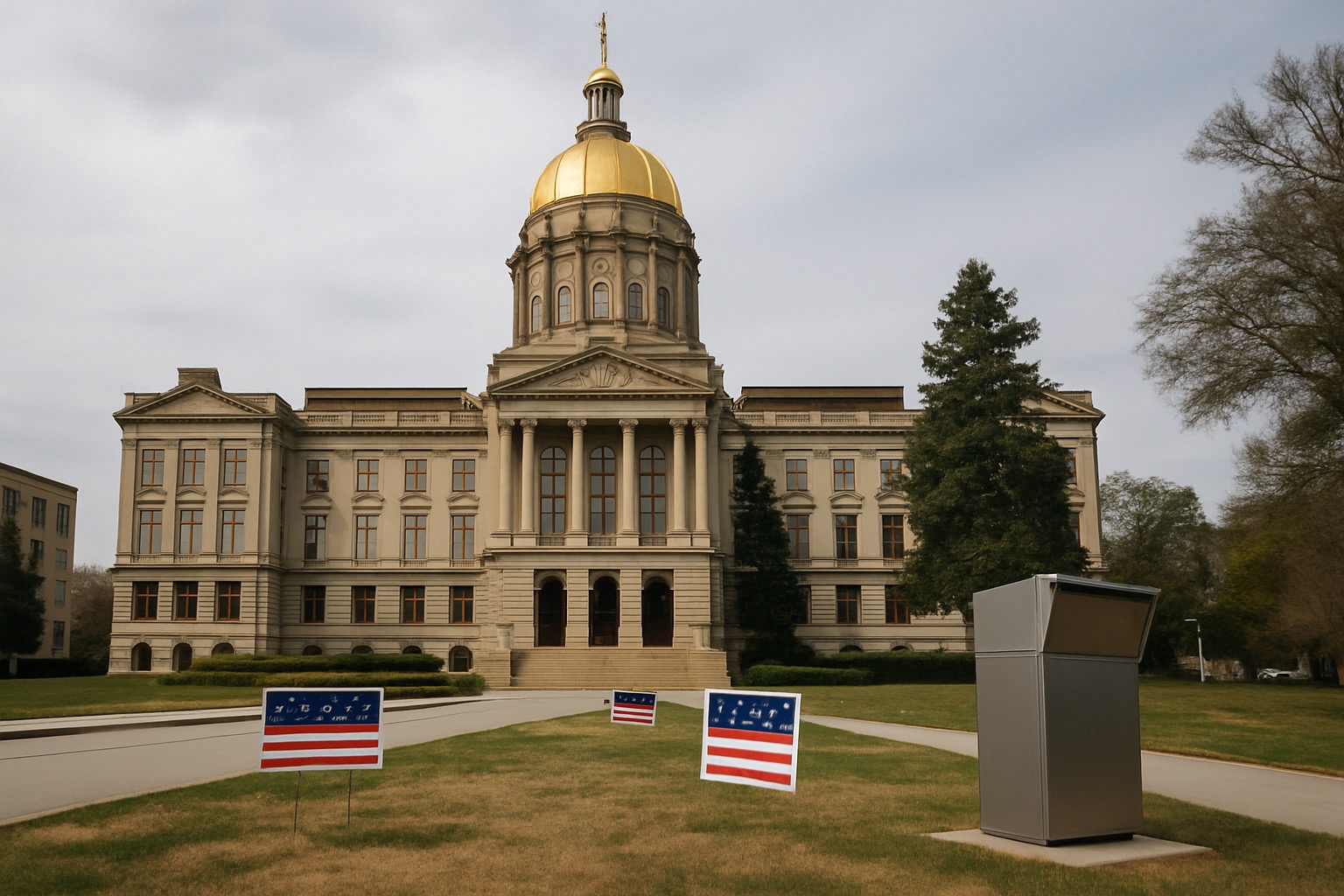
Brian Kemp is done. Georgia's two-term Republican governor — the man who withstood Trump's post-2020 pressure campaign, survived a brutal 2022 primary, and beat Stacey Abrams by 7.5 points in the general — can't run again. Georgia law bars consecutive third terms, and that constitutional wall has cracked open the most closely watched open-seat governor's race in the South.
The November 3 matchup: Rick Jackson, a self-made healthcare billionaire who spent more than $118 million to claim the Republican nomination, versus Keisha Lance Bottoms, Atlanta's former mayor and a senior adviser in the Biden White House. If Bottoms wins, she becomes the first Black woman ever elected governor of any state in American history.
Prediction markets are tracking the broader environment — Senate control sits at roughly 52% Republican / 49% Democratic at electionpredictions.us — and Georgia's governorship is deeply woven into that national picture. But the race itself is being defined by forces no national fund can fully buy: candidate biography, state-specific voter coalitions, and a polling picture that has surprised almost everyone.
Kemp's Shadow Over the Race
Brian Kemp's legacy looms large over both candidates. His two terms produced a run of major economic wins — Rivian's electric vehicle plant, Hyundai's $5.5 billion EV and battery complex, significant semiconductor and logistics expansions — that reshaped Georgia's employment landscape, particularly in rural and exurban counties that had been hollowed out for decades.
Kemp's other defining act was refusing to decertify Georgia's 2020 presidential election results despite sustained personal pressure from then-President Trump. That decision initially cost him politically inside the GOP, but ultimately validated his general-election viability: he won re-election in 2022 by 7.5 percentage points (53.4% to 45.9% over Abrams) while many Republican candidates nationally underperformed in what was supposed to be a red wave cycle.
The open-seat dynamic removes that incumbent advantage entirely. Neither Jackson nor Bottoms inherits Kemp's personal crossover appeal — which means the structural partisan lean of the state matters more in 2026 than it did in 2022.
Georgia's trajectory has been shifting in opposite directions simultaneously. Biden won Georgia in 2020 by just 11,779 votes — the narrowest margin of any state in that election. Trump won it back in 2024 by approximately 2.5 percentage points. Yet Georgia's two U.S. Senate seats are both held by Democrats, and the state's Public Service Commission seats have also trended toward Democrats in recent cycles. It is a state that resists clean partisan narrative.
Georgia has not elected a Democratic governor since Roy Barnes in 1998 — a 28-year drought that Bottoms would end if she wins in November.
Rick Jackson: The $118 Million Candidate
Rick Jackson was not a household name when he entered the Republican gubernatorial primary in February 2026. What he had instead of name recognition was money — a lot of it.
Jackson is the founder and chairman of Jackson Healthcare, one of the nation's largest healthcare staffing companies, headquartered in Alpharetta, Georgia. The company places medical professionals in hospitals, clinics, and government-run facilities across the country. Jackson describes himself as a self-made entrepreneur and a political outsider. His critics describe him differently: the Atlanta Journal-Constitution reported in March 2026 that Jackson Healthcare had earned more than $1 billion in contracts with Georgia state agencies — a number Bottoms' campaign has used aggressively.
Jackson entered the May 19 Republican primary against a field that included Lt. Governor Burt Jones (Trump-endorsed), Attorney General Chris Carr, and Secretary of State Brad Raffensperger. He spent heavily from day one. By the April 30 campaign finance deadline, Jackson had raised $83.5 million — nearly all of it from himself — compared to Jones's $4.4 million and Carr's $5.3 million.
The primary results sent the race to a June 16 runoff: Jones 38.4%, Jackson 32.5%, Raffensperger 15.0%, Carr 11.9%. In the runoff, Kemp endorsed Jackson. So did Carr, Ted Cruz, Rick Scott, and the broader establishment wing of the party that had been skeptical of Jones's close alignment with Trump. Jackson won the runoff and claimed the Republican nomination.
Since entering the general election, Jackson has continued spending at a pace no Georgia governor's race has seen before. He announced an $87 million general-election ad buy on July 29, and separately disclosed $13 million in outside contributions — including a $10 million check from the Republican Governors Association — in addition to his primary self-funding. Total raised or contributed to his campaign: more than $118 million. His campaign reported $4.3 million in cash on hand at the end of July, having spent nearly everything.
The message Jackson is running on: cost of living, economic development, and the argument that a successful businessman can deliver results the way Kemp did. His campaign talks about expanding broadband, lowering grocery costs, and continuing the manufacturing recruitment that characterized the Kemp years.
Keisha Lance Bottoms: The Historic Bid
Keisha Lance Bottoms has had a political biography built around a series of firsts. She served as Atlanta's 60th mayor from 2018 to 2022, becoming only the second Black woman to hold that office. She was considered a potential vice-presidential pick for Joe Biden in 2020. She subsequently served as a senior White House adviser for public engagement before returning to Georgia to launch her gubernatorial campaign in May 2025.
Bottoms won the Democratic primary outright on May 19 — avoiding a runoff — from a field of seven candidates that included former Republican Lt. Governor Geoff Duncan (who switched parties), state senator Jason Esteves, and former state labor commissioner Michael Thurmond. Pre-primary polling by the University of Georgia and Concord Public Opinion Partners had consistently shown Bottoms with roughly 35–42% support in a field where late deciders broke toward her.
The historic stakes of her candidacy have been noted in national coverage: no Black woman has ever been elected governor in the United States. Abrams ran twice in Georgia and narrowly lost both times — by 1.4 percentage points in 2018 and by 7.5 points in 2022. Bottoms represents a different strategic approach: she is running as a pragmatic, pro-business moderate, emphasizing her Atlanta record of attracting corporate investment, rebuilding the city's finances after COVID, and managing a large government organization. Her economic-development framing is deliberately designed to compete on Kemp's terrain rather than cede it.
Bottoms has raised $5.7 million since launching her campaign in May 2025 — and won her primary without a costly runoff. She had approximately $770,000 in cash on hand at the end of July 2026, a stark contrast to Jackson's nine-figure spending. Her campaign is banking on the Democratic Governors Association, national small-dollar fundraising, and voter registration infrastructure to close the resource gap.
The Money Gap — and Why It May Not Decide This Race
The fundraising disparity is historic. Jackson has spent more than $118 million on this race — more than any candidate in Georgia gubernatorial history. Bottoms has raised $5.7 million since May 2025. By the end of July, Jackson raised $6.1 million in a single two-month period (June–July), nearly twice what Bottoms had collected across her entire campaign.
But the polling tells a more complicated story.
Six publicly released general-election polls since June have largely shown Bottoms with a lead:
- Quantus Insights (July 29–August 1): Jackson 45%, Bottoms 46% — a 1.5-point Bottoms lead within the ±3.6% margin of error
- Fabrizio Ward/Impact Research (July 13–16): Jackson 46%, Bottoms 48% — Bottoms +2
- State Navigate (July 10–13): Jackson 44%, Bottoms 51% — Bottoms +7
- Wick (June 27–30): 43% each — tied
- Beacon Research/Shaw (June 23–27): Jackson 47%, Bottoms 52% — Bottoms +5
- Concord Public Opinion Partners (May 30–June 2): Jackson 38%, Bottoms 53% — Bottoms +15
The important caveat: nearly all of these polls come from Democratic-affiliated or neutral research firms. The one Republican-sponsored poll (Quantus Insights) shows the race closest. Both Fabrizio Ward (R) and Impact Research (D) partnered on the July 13–16 survey that found Bottoms +2, a bipartisan commission that carries somewhat more interpretive weight.
The Quantus Insights demographic crosstabs (July 29–August 1) show the coalitional structure clearly: Bottoms leads among Black voters by approximately 81 points, and among women by roughly 7 points. Jackson leads among men and among older voters. The race is being decided in Atlanta's northern suburbs — the same Cobb, Gwinnett, and Cherokee County terrain that has been swinging toward Democrats in statewide races while still delivering Republican legislative margins.
The Electoral Math: Why This Is Genuinely Competitive
Georgia's statewide electoral history since 2018 resists simple summary. Kemp beat Abrams by 1.4 points in 2018, then by 7.5 in 2022. Jon Ossoff won his Senate runoff in January 2021 by about 1.2 points. Raphael Warnock won his 2022 Senate race by about 2.8 points. Biden won Georgia's presidential race in 2020 by 0.23 percentage points. Trump won it back in 2024 by approximately 2.5 points.
The pattern across these elections suggests Georgia's electorate is not fixed — it responds to candidate quality, turnout mobilization, and the national environment. Kemp's 7.5-point margin in 2022 was substantially Kemp-specific; his personal favorability and bipartisan reputation drove a significant number of voters who simultaneously backed Warnock. Those voters are available to Bottoms if she runs a similar crossover campaign — and they're potentially accessible to Jackson if he can consolidate the Republican base without the polarizing baggage that has hurt recent candidates.
Forecasters have rated Georgia's governorship Lean Republican heading into the general, reflecting both the state's presidential-level drift toward the GOP and the historical pattern of Republicans winning the governorship. But the polling evidence available through mid-August 2026 has given Democrats reason to push back on that assessment.
Jackson's campaign points to Georgia fundamentals: the state has not elected a Democratic governor since 1998, Trump carried it in 2024, and the $118 million in advertising should move numbers in ways that early polling doesn't capture. Bottoms' campaign argues that the polling is speaking for itself, that name recognition advantages are already baked in given Jackson's ad saturation, and that Bottoms' turnout coalition — Black voters, suburban women, young voters — is one that Georgia Democrats have successfully activated in Senate and presidential races.
What would it take for Jackson to win? Consolidation of Republican voters who backed Jones in the primary (Trump's endorsee and the first-round plurality winner), strong performance in the Atlanta exurbs, and an ability to neutralize the Jackson Healthcare contract story before it becomes a defining narrative. What would it take for Bottoms to win? Historic Black voter turnout comparable to the 2020–2021 cycle, continued movement of college-educated suburban women toward Democrats, and enough crossover from independents and disaffected Republicans to offset Georgia's structural partisan advantage.
Key Factors to Watch
The contract story. Bottoms' campaign has made Rick Jackson's business dealings with Georgia state agencies a central line of attack. Jackson Healthcare's more than $1 billion in state contracts — in healthcare staffing for state facilities — gives Democrats a clean narrative to sell: that Jackson profited from the state he now wants to run. How Jackson handles that framing will shape whether the race stays competitive or tilts.
Republican primary healing. Jones, the Trump-endorsed candidate Jackson defeated, did not immediately endorse Jackson after the runoff. Trump has since backed Jackson for the general, but the degree to which Jones voters from north Georgia consolidate behind Jackson matters in a race this close.
Turnout infrastructure. Georgia has been the site of intensive voter registration and mobilization operations on both sides since 2018. The Bottoms campaign's ability to activate those networks without the electoral intensity of a presidential year is a significant variable.
The historic ceiling question. Abrams ran twice and lost both times. Is Georgia's political environment measurably better for Democrats in 2026 than it was in 2022? The Senate control market at 52% Republican / 49% Democratic suggests a national environment that is roughly a toss-up — which is more favorable to Democrats than the 2022 environment that produced Kemp's large margin.
Frequently Asked Questions
Who are the candidates for Georgia governor in 2026? Republican Rick Jackson, a healthcare entrepreneur who self-funded more than $100 million to win the GOP primary runoff on June 16, and Democrat Keisha Lance Bottoms, Atlanta's former mayor and a former Biden administration adviser who won the Democratic primary outright on May 19. Libertarian Chase Oliver is also on the November ballot.
Why is Georgia's governor race open in 2026? Incumbent Republican Brian Kemp is term-limited after serving two consecutive four-year terms. Georgia law bars a governor from seeking a third consecutive term, opening the race for the first time since 2018.
Would Keisha Lance Bottoms be a historic governor? Yes. No Black woman has ever been elected governor of any U.S. state. Bottoms, if elected, would be the first. She would also be the first Democratic governor of Georgia since Roy Barnes left office in 2003.
How much has Rick Jackson spent on this race? Jackson has raised or personally contributed more than $118 million to his campaign through late July 2026, having self-funded the bulk of his Republican primary run. He subsequently opened fundraising for the general election and received a $10 million contribution from the Republican Governors Association, bringing outside contributions to approximately $13 million.
Sources
- Georgia general election 2026 candidates, WABE / WSB-TV (July 2026)
- "Rick Jackson launches $87 million ad blitz," Augusta Chronicle (July 29, 2026)
- "Jackson leads Bottoms in fundraising," Capitol Beat News Service (August 11, 2026)
- "Rick Jackson raises $13 million in outside money," Atlanta Journal-Constitution (August 8, 2026)
- "Jackson accused of 'trying to buy' election," USA Today (July 28, 2026)
- Georgia governor primary live results, 270toWin / Fox 5 Atlanta (May 19, 2026)
- "Georgia again has a chance to elect first Black woman governor," 19th News (May 20, 2026)
- Georgia gubernatorial election 2026, Ballotpedia (updated July 28, 2026)
- Quantus Insights general election poll (July 29–August 1, 2026)