
Illinois Senate 2026 Race Guide: Juliana Stratton, Don Tracy, and the Open Seat Dick Durbin Built Over 29 Years
Illinois 2026 Senate: Stratton vs. Tracy in Dick Durbin's open seat. Why this safe Democratic hold matters for Senate control at 54¢ GOP.
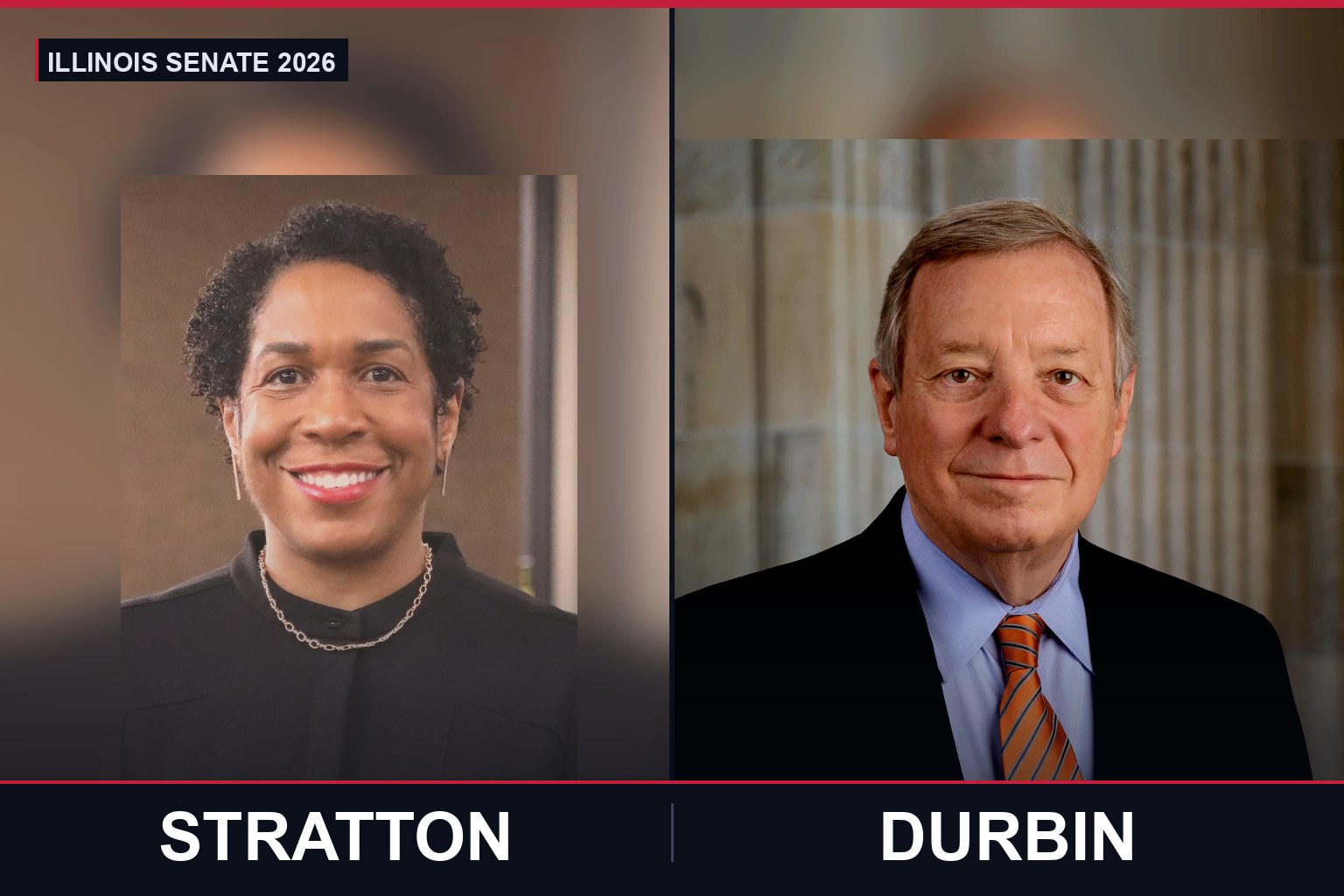
When Dick Durbin announced in April 2025 that he would not seek a sixth Senate term, he did more than end a 29-year run in the chamber — he opened a succession contest in one of the most reliably Democratic states in the country and handed Republicans their best opportunity to reclaim an Illinois Senate seat since 2010. Four months after a historic, expensive Democratic primary, the matchup is set: Lieutenant Governor Juliana Stratton against Springfield attorney Don Tracy, with the Senate's balance of power hanging on dozens of races just like this one.
Stratton enters November as a heavy favorite in a state that has not sent a Republican to the Senate since Mark Kirk's 2010 upset — and that has drifted further from Republican reach with each subsequent cycle. The market for Senate control, priced across Kalshi and Polymarket as of early August 2026, gives Republicans a 54 percent probability of retaining their majority and Democrats 46 percent. Illinois is not a state that figures prominently in the Republican math; it is, instead, one of the Democrats' most secure holds — a firewall that, if it holds, lets the party concentrate resources on genuine toss-ups elsewhere.
The Seat: 29 Years of Durbin, One Generation of Power
Dick Durbin first won Illinois's Class II Senate seat in 1996, defeating Republican state Rep. Al Salvi for the open seat left by retiring Democrat Paul Simon. He went on to serve as Senate Majority Whip — the chamber's second-ranking Democratic leadership position — for nearly two decades, giving Illinois outsized influence over budget negotiations, judicial confirmations, and floor scheduling. When Republicans recaptured the Senate majority in January 2025, he became Senate Minority Whip, a role he held until announcing his retirement.
When Durbin announced he would step down on April 23, 2025, he was 80 years old and in his fifth full term. "In my heart, I know it's time to pass the torch," he said in a video posted to social media. His departure set off the most competitive Illinois Senate primary in a generation. Ten Democrats and six Republicans filed to replace him, and the primary consumed an estimated $75 million or more in combined spending, with the Democratic contest alone drawing national attention and heavy outside investment.
Juliana Stratton: The Governor's Choice Who Ran the Table
Juliana Stratton, 60, enters the general election as the Democratic nominee and the state's first Black woman to serve as lieutenant governor — a position she has held since 2019 under Governor JB Pritzker. If she wins in November, she would become the sixth Black woman to serve in the United States Senate.
Stratton won the March 17 Democratic primary with approximately 40.4 percent of the vote in a fractured ten-candidate field. Her victory over U.S. Representative Raja Krishnamoorthi — who entered the race with more than $15 million in cash on hand and dominated early fundraising — was one of the more striking outcomes of the 2026 primary season. Krishnamoorthi spent approximately $28 million on advertising and operations through the primary; Stratton's own campaign account held roughly $1 million at the start of 2026.
The critical variable was Governor Pritzker. He endorsed Stratton in April 2025, the day after she announced, and subsequently directed more than $10 million through the Illinois Future PAC — a super PAC run by a former Pritzker political operative — into advertising on her behalf, according to Federal Election Commission filings reviewed by Capitol News Illinois. That outside spending helped close the gap against Krishnamoorthi in a race that analysts described as a genuine upset of a well-funded frontrunner.
Stratton won 47 of Illinois's 102 counties, with her strongest margins in Cook County — where Chicago's urban core provides Democrats their largest vote reservoirs — and in St. Clair County downstate, where she captured 54.3 percent of the vote, according to the New York Times primary results tracker. Krishnamoorthi won the suburban collar counties north and west of Chicago.
In the general election, Stratton has continued to out-raise her Republican opponent. In the second quarter of 2026 — the first full quarter of the general election campaign — she raised $1.1 million through her main campaign account and ended June with approximately $1.1 million cash on hand, according to Capitol News Illinois. She has also raised additional funds through a joint fundraising committee with the Democratic Party of Illinois.
Stratton has positioned herself as a progressive Democrat. Her primary campaign centered immigration enforcement — she called for abolishing U.S. Immigration and Customs Enforcement — and a profanity-laced campaign ad that drew national attention. She enters the general election with the structural advantages of name recognition as lieutenant governor, the governor's active support, and the state's Democratic baseline.
Don Tracy: The Springfield Attorney Running Against the Tide
Don Tracy, 75, is a Springfield attorney who served as chair of the Illinois Republican Party from 2021 to 2024 and as a member of the Illinois Gaming Board from 2015 to 2019 under then-Governor Bruce Rauner. He won the Republican primary on March 17 with approximately 40 percent of the vote in a six-candidate field, besting Chicago attorney Jeannie Evans (22.8 percent), Casey Chlebek (11.2 percent), and three others, according to Ballotpedia.
Tracy's primary campaign was almost entirely self-funded. He loaned his campaign $2 million in August 2025, which accounts for the bulk of his total fundraising. Individual donors contributed approximately $292,000 through the pre-primary period, according to FEC records — a figure that reflects the structural challenge Republicans face in Illinois: the party's national donor base has shown little appetite to invest heavily in what most forecasters consider a non-competitive general election.
In the second quarter of 2026, Tracy raised approximately $133,000 and spent more than he brought in — about $164,000 in operating expenses, according to FEC records reported by the Chicago Tribune. He ended June with approximately $1.5 million in cash on hand, most of it his own loan capital.
Tracy has cast the race as a contest against single-party rule in Springfield and Chicago. He has pointed to the fact that when Durbin retires, every statewide elected official in Illinois will reside in Chicago or Cook County. "I was born in Urbana in Eastern Illinois, raised in Mt. Sterling in Western Illinois, and I raised my own family in Springfield in Central Illinois," he said during the primary, arguing that 101 of the state's 102 counties deserve direct representation. He has emphasized tax cuts, energy development, and border enforcement.
The Structural Math: Why Illinois Isn't Competitive
Illinois's blue lean is durable and well-documented at the federal level. Kamala Harris carried the state by 10.9 percentage points in 2024 — 54.4 percent to 43.5 percent — even as Donald Trump outperformed his 2020 margins in many Midwest states. Four years earlier, Joe Biden won Illinois by 17.1 points.
Republicans have not won an Illinois Senate race since Mark Kirk's 2010 upset of Democratic nominee Alexi Giannoulias, a race that unfolded during a nationally difficult midterm environment for Democrats. Kirk held Barack Obama's former Class III Senate seat until Tammy Duckworth defeated him by 15 percentage points in 2016. That was the last Illinois Senate contest before this open seat cycle.
Cook Political Report rates the 2026 general election as Solid Democratic. The structural advantage of Chicago and suburban Cook County — which together account for a majority of the state's electorate — has proven difficult to overcome even in favorable Republican environments. Tracy's geographic argument resonates in the 101 outstate counties, but the vote arithmetic hasn't supported a statewide Republican Senate win since Kirk.
The Primary Fracture: What It Means for November
One feature of this race worth watching is whether Stratton can consolidate a Democratic coalition that splintered across three competitive primary candidates. Krishnamoorthi won the suburban collar counties — DuPage, Lake, Kane — that have become increasingly important to Democratic statewide margins in recent cycles. Stratton's coalition leaned on the urban core and downstate cities. Robin Kelly, who finished third, drew support from the South Side and south suburbs.
In past Illinois Senate races, the nominee's ability to thread those geographic divides has determined the margin of victory. Durbin's 2014 re-election — his narrowest general election — came in a nationally difficult year for Democrats, and he still won by nearly 10 points. Stratton's path to a similar result runs through the same playbook: maximize margins in Chicago, hold Cook County suburbs, and limit losses in the collar counties and downstate.
On the Republican side, Tracy lacks the resources to mount a significant advertising campaign in the Chicago media market — one of the most expensive in the country — and has not attracted meaningful national Republican investment. The Chicago Tribune's editorial board noted in late July 2026 that Illinois Republicans' "anemic fundraising underscores" the party's structural challenges in the state.
The Balance of Power Context
The broader balance-of-power question — who controls both chambers after November — captures how individual Senate races fit into the national picture. That market, priced across three platforms as of early August 2026, puts Democrats winning both chambers at 46 percent probability, Democrats taking the House while Republicans hold the Senate at 40 percent, and Republicans sweeping both at 13 percent.
Track the market: https://electionpredictions.us/events/balance-of-power-2026-midterms
Illinois is not a seat that competitive scenario analysis puts in play. Its role in the midterms is as a baseline Democratic hold — one of the seats that anchors the party's path back to a Senate majority. A Stratton victory by double digits would confirm the structural picture and free the party to focus resources on closer fights in Iowa, Georgia, North Carolina, and Maine.
Key Issues Shaping the Race
Immigration and ICE. Stratton's call to abolish ICE was the defining issue of her primary campaign and remains central to her brand heading into the general. Tracy has aligned himself with Trump on border enforcement, framing the issue around securing the country's northern and southern borders.
Economic anxiety and state competitiveness. Illinois has seen consistent net out-migration, and Tracy's single-party-rule critique speaks to voters who blame decades of Democratic governance for high taxes, pension liabilities, and business departures. It's a credible argument on its own terms — but it has consistently failed to translate into Republican Senate wins in a state where Chicago's electoral weight is decisive.
Durbin's legacy. The seat carries with it decades of accumulated seniority and institutional influence. A freshman senator, regardless of party, will enter the 2027 session at the bottom of the committee seniority ladder. Durbin's departure represents a real loss of legislative clout for the state, and both candidates have acknowledged it in different ways: Stratton by emphasizing her readiness to build influence from day one, Tracy by arguing that the state needs a senator willing to challenge the status quo from outside the party establishment.
The Iran factor. The ongoing U.S. military involvement in Iran has shaped some national security messaging. Tracy has expressed support for the war effort; Stratton has focused on domestic issues, including reproductive rights and criminal justice reform — the policy portfolio she developed as lieutenant governor.
Bottom Line
Illinois Senate 2026 is not a competitive race in the conventional sense. Juliana Stratton enters the general election with the structural advantages of a deep-blue state, the incumbent governor's full political and financial backing, and a Republican opponent who is largely self-funding against one of the country's most expensive advertising environments. Don Tracy has a credible biography and a geographic argument that resonates outside the metro area, but the fundraising gap, the state's partisan baseline, and the absence of national Republican investment all point the same direction.
If Tracy somehow makes this close, it would signal a national environment far more adverse to Democrats than current markets are pricing. If Stratton wins by double digits — as the structural indicators suggest she should — Illinois will confirm its status as one of the most secure Democratic Senate seats in the country, regardless of national headwinds.
The general election is November 3, 2026.
Sources
- USA Today — "Dick Durbin, the No. 2 Democrat in Senate, announces he won't seek reelection in Illinois" (April 24, 2025): https://www.usatoday.com/story/news/politics/2025/04/23/dick-durbin-illinois-retirement-senate/83230274007/
- PBS NewsHour — "Illinois Lt. Gov. Juliana Stratton wins Democratic primary for U.S. Senate" (March 18, 2026): https://www.pbs.org/newshour/nation/illinois-lt-gov-juliana-stratton-wins-democratic-primary-for-u-s-senate
- NBC News — "Illinois Senate Primary Election 2026 Live Results" (updated July 28, 2026): https://www.nbcnews.com/politics/2026-primary-elections/illinois-senate-results
- Capitol News Illinois — "Pritzker spends big in second fundraising quarter as Bailey struggles to keep up" (July 30, 2026): https://capitolnewsillinois.com/news/pritzker-spends-big-in-second-fundraising-quarter-as-bailey-struggles-to-keep-up/
- Chicago Tribune — "Republican Darren Bailey treads water in governor's race as GOP struggles to raise campaign cash" (July 16, 2026): https://www.chicagotribune.com/2026/07/16/illinois-governor-senate-gop-fundraising-struggles/
- Capitol News Illinois — "Pritzker spent $10 million to boost Stratton in primary, records show" (April 20, 2026): https://capitolnewsillinois.com/news/pritzker-spent-10-million-to-boost-stratton-in-primary-records-show/
- New York Times — "Juliana Stratton Wins Bruising Illinois Democratic Senate Primary" (March 17, 2026): https://www.nytimes.com/live/2026/03/17/us/illinois-election-primary-midterms
- Ballotpedia — "United States Senate election in Illinois, 2026": https://ballotpedia.org/United_States_Senate_election_in_Illinois,_2026
- FEC.gov — Stratton, Juliana candidate overview: https://www.fec.gov/data/candidate/S6IL00458/
- The Guardian — "Illinois heads to elect next senator and five congressional district nominees" (March 17, 2026): https://www.theguardian.com/us-news/2026/mar/17/illinois-election-day-senate-congressional-races