Kansas Governor 2026 Race Guide: Ty Masterson vs. Cindy Holscher and the Fight to Define Kansas After Eight Years of Democratic Control
Term-limited Gov. Laura Kelly's open seat is the GOP's best gubernatorial pickup of 2026. Masterson vs. Holscher on November 3.
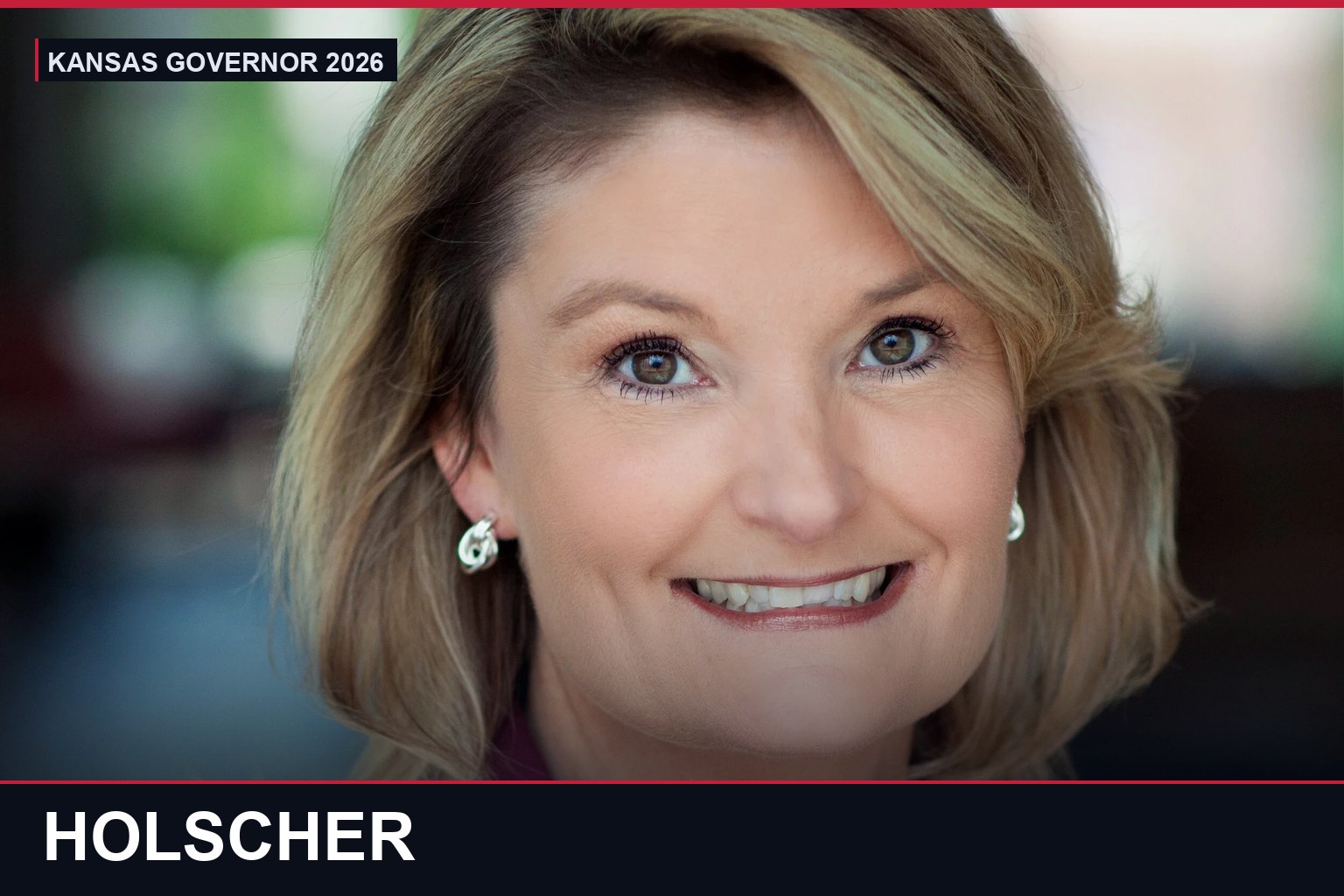
Eight years of Democratic governance in one of the country's most reliably Republican states ends on November 3 — unless Cindy Holscher can pull off a second consecutive upset.
That is the core of the Kansas governor's race. Term-limited Gov. Laura Kelly, who won in 2018 and 2022 while Kansas was voting heavily Republican up and down the rest of the ballot, cannot run again. The open seat has drawn two candidates from opposing corners of their parties: Republican state Senate President Ty Masterson, backed by President Donald Trump, and Democratic state Sen. Cindy Holscher, a progressive from Overland Park who beat Kelly's own preferred successor in the primary.
Every major race-rating outlet — the Cook Political Report, Sabato's Crystal Ball, Fox News, Inside Elections, and RealClearPolitics — rates this race Lean R or Tilt R. NBC News called it "the GOP's best gubernatorial pickup opportunity this year." Kansas hasn't voted for a Democratic presidential candidate since Lyndon Johnson in 1964, and Donald Trump carried the state by 16.1 points in 2024.
But Kansas has a documented history of electing governors who look nothing like its federal delegation, and the structural dynamic that kept Kelly in office for eight years hasn't disappeared. The question is whether Holscher — more progressive than Kelly, running in a political environment that has shifted further right at the presidential level — can replicate it.
The Candidates
Ty Masterson, 61, is the president of the Kansas State Senate, representing Andover in Sedgwick County. He has served in the state legislature since 2005 and has been Senate president since 2021. Trump endorsed him in the Republican primary, calling in to a tele-rally less than a week before the August 4 vote. Masterson won with approximately 43 percent in a crowded seven-candidate field, leaving businessman Phil Sarnecki (22%), Insurance Commissioner Vicki Schmidt (14%), and Secretary of State Scott Schwab (11%) far behind. His running mate is state Sen. Jeff Klemp of Lansing.
Cindy Holscher, 56, is a state senator from Overland Park representing the 8th district, a seat she has held since 2021. She built her campaign around a populist, anti-establishment message focused on progressive priorities including healthcare access, school funding, and what she describes as a check on Republican supermajority overreach in the legislature. Her running mate is Wichita state Rep. KC Ohaebosim, a physician.
Her primary win was the bigger story of primary night. Kelly had endorsed fellow Johnson County Democrat Ethan Corson, a more moderate state senator with a significant fundraising advantage and institutional backing. Holscher won anyway, taking 48.6 percent (107,061 votes) to Corson's 38.8 percent (85,570), with Overland Park Mayor Curt Skoog pulling 12.6 percent. Kelly endorsed Holscher within days of the result, urging party unity and framing November as a fight to preserve the policies of her administration.
"I know Governor Kelly understands the urgency of mobilizing voters from across our state to make sure Donald Trump's choice Ty Masterson loses this election," Holscher said in a statement after Kelly's endorsement. "We must unite Kansans of all parties to defeat him — and we will."
Eight Years of Kelly, and What Masterson Did During Them
Laura Kelly won in 2018 by running explicitly against the legacy of the Brownback era — the tenure of Republican Gov. Sam Brownback (2011–2018), who enacted an aggressive income tax-cutting experiment that led to a fiscal crisis, court-ordered school funding shortfalls, and credit downgrades before Brownback left office for a federal appointment. Kelly restored school funding, fought for Medicaid expansion against a resistant legislature, and managed the state through the COVID-19 pandemic in a way that kept her competitive with Kansas voters even as Trump won the state by double digits.
Masterson was in the state legislature throughout the Brownback era and voted for key pieces of that tax plan. He also repeatedly blocked Medicaid expansion efforts from advancing — a record that Holscher has foregrounded as evidence he would, in her words, "drag us back into the Brownback years." Rural hospitals across Kansas closed their doors during the years Medicaid expansion was blocked; Democratic campaigns have tied those closures directly to Republican legislative votes.
Masterson rejects the comparison entirely. He argues the state's finances are now healthy, that Holscher's progressive record makes her a radical even by Kansas Democratic standards, and that Kelly herself described Holscher as an extremist during the primary — a line he has deployed repeatedly since primary night.
"Cindy Holscher would be the most radical progressive governor in the history of Kansas," Masterson told supporters after his primary win. "I serve with Cindy Holscher in the state Senate, and I've seen firsthand just how far to the left she is."
Republican Governors Association chair Greg Gianforte amplified the attack in a statement after the primary: "Cindy Holscher is an extreme liberal who has stood in the way of property tax relief, parental rights, and Kansas values. This race comes down to a simple message: it's about common sense versus crazy."
Holscher has sought to turn the attacks around and keep the focus on the Brownback legacy rather than her own record. "Our state cannot afford another extremist like Ty Masterson," she said on primary night, before calling for Democratic unity heading into November.
The Data Center Question
One specific policy dispute has become a vulnerability for Holscher heading into the general election: data centers.
Holscher voted yes on a data center expansion bill in the Kansas legislature before announcing her gubernatorial campaign. After entering the race, she reversed course, calling for a statewide moratorium on new data centers until Kansas has what she described as "common-sense guardrails" to protect taxpayers and natural resources. Republicans have pointed to the vote-then-reversal as political opportunism. Her supporters argue she updated her position in response to constituent concerns about energy consumption, water usage, and the fiscal terms of large-scale data center subsidies.
Emporia State University political science professor Michael Smith told KWCH that the data center issue could work in Holscher's favor with certain audiences, noting that "people are really fired up about this" across party lines in rural and suburban Kansas. Smith also flagged that the Trump administration's Iran policy has complicated the national political environment for Republican candidates who have closely aligned with the White House.
"Trump's support is in trouble. His MAGA base is extremely loyal, but they are not loving this war in Iran," Smith said.
The Structural Landscape
Kansas presents a genuine analytical tension. On one hand, the state's presidential-level partisan tilt is severe: Trump won by 16.1 points in 2024, Republicans hold supermajorities in both chambers of the state legislature, and nearly every statewide elected office outside the governor's mansion is currently held by a Republican. Masterson's party controls the structural machinery, the donor base, and the ideological alignment of the median Kansas voter.
On the other hand, Kansas has consistently elected Democratic governors even while voting Republican in federal races. Kelly won in 2018 against then-Secretary of State Kris Kobach and won re-election in 2022 against Attorney General Derek Schmidt, taking 49.5 percent of the vote, while Trump was carrying Kansas by substantial margins. The state has a documented pattern of ticket-splitting at the gubernatorial level that has no equivalent in its Senate or presidential results.
There is also an historical pattern worth noting, though not a law: Kansas has not elected two governors of the same party in a row since the 1960s. Kelly is a Democrat, which by that pattern would favor a Republican next. But the pattern has also been interrupted before, and it is not a reliable standalone predictor. What it does capture is that Kansas voters have historically been willing to see the governorship as a distinct office from their partisan federal preferences — a willingness that is the foundation of any Holscher path to victory.
The difference Holscher faces compared to Kelly is ideological positioning. Kelly ran and governed as a centrist, cross-party dealmaker who carefully avoided the national Democratic brand while making pragmatic arguments about fiscal responsibility and school funding. Holscher is more explicitly progressive, and Masterson has made that the central frame of his campaign from primary night forward. Whether Kansas voters who supported Kelly twice see Holscher as a continuation of that governing tradition or as a departure from it is the defining question of the race.
What Would a Holscher Upset Require?
For Holscher to win in a state Trump carried by 16 points, she would need to replicate and expand the Kelly coalition: run up large margins in Johnson County and the Kansas City suburban ring that have shifted toward Democrats in recent cycles, hold competitive margins in college towns like Lawrence and Manhattan, and peel off independent and soft-Republican voters who have historically been willing to split their tickets for governor even while voting Republican for Senate and president.
The Medicaid expansion argument could be a tool for that coalition — particularly with rural hospital administrators, healthcare workers, and communities that have watched facilities close during years of Republican legislative resistance to expansion. The data center moratorium call could find a bipartisan audience in areas concerned about energy costs, water rights, and the fiscal terms of large-scale tax incentive packages.
Masterson's path is more straightforward: nationalize the race, keep the focus on Holscher's progressive record and primary positioning, and turn out a Republican base that has voted consistently for the party at the federal level for decades. In a midterm environment where Republicans are defending executive and legislative turf nationwide, a Kansas pickup would be a meaningful addition to a potential GOP governorship majority.
The general election campaign runs through November 3, 2026. Neither candidate had released a public general election poll as of the date of this article.
National Market Context
No active Kansas governor election contract was available through the major U.S. prediction markets as of August 10, 2026. The race fits within the broader 2026 midterm landscape tracked across platforms. Prediction markets are currently pricing Republican control of the Senate at approximately 55 cents on the dollar, with Democrats at 46 cents — reflecting the overall competitive midterm environment into which the Kansas governor's race falls.
Sources
- Kansas Reflector: "Masterson scores win in GOP primary for Kansas governor; Holscher prevails in Democratic race" (Aug. 4, 2026) — kansasreflector.com
- Kansas Reflector: "Kansas' Democratic, GOP nominees for governor seek unity — except with each other" (Aug. 6, 2026) — kansasreflector.com
- NBC News: "Republican Ty Masterson and Democrat Cindy Holscher to face off in Kansas governor's race" (Aug. 4, 2026) — nbcnews.com
- ABC News: "Kansas live primary results" (Aug. 5, 2026) — abcnews.com
- Kansas City Star: "Cindy Holscher victorious in Democratic primary to succeed Kansas Gov. Laura Kelly" (Aug. 4, 2026) — kansascity.com
- KWCH: "Kansas governor's race takes shape after both parties pick their candidates" (Aug. 6, 2026) — kwch.com
- Capital-Journal: "Ty Masterson beats crowded GOP field in Kansas governor's race" (Aug. 4, 2026) — cjonline.com
- Kansas Public Radio: "In Kansas governor's race, Republican Ty Masterson will face Democrat Cindy Holscher" (Aug. 4, 2026) — kansaspublicradio.org
- KSN: "Kelly puts support behind Holscher in Kansas governor's race" (Aug. 5, 2026) — ksn.com
- New York Times: "Kansas Governor Primary 2026: Live Election Results" (Aug. 4, 2026) — nytimes.com
- Newsweek: "GOP's Chances of Losing Major Races in Kansas as Hamilton, Holscher Win" (Aug. 5, 2026) — newsweek.com
- Cook Political Report: Kansas Governor 2026 (Lean R rating) — cookpolitical.com