
Maine Governor 2026 Race Guide: Hannah Pingree, Bobby Charles, and the 74-Year Pattern at Stake
Maine governor 2026: Pingree leads Charles by 9–14 points as Maine tests whether it will elect a new same-party governor for the first time since 1952.
Maine Governor 2026 Race Guide: Hannah Pingree, Bobby Charles, and the 74-Year Pattern at Stake
Maine has a political quirk that has held without interruption since the Eisenhower administration: no party has successfully handed the governorship to a new candidate from the same party in back-to-back elections. Republican Frederick Payne won in 1948. Republican Burton Cross won in 1952. Then the streak began. Every time since, the Blaine House has switched parties when a new face sought the office.
Janet Mills broke half of that equation — she won re-election in 2022 as an incumbent, which incumbents occasionally manage. But Mills is now term-limited, and her successor on the Democratic ticket, former House Speaker Hannah Pingree, is asking Maine voters to do something the state hasn't done since Harry Truman's first full term: elect a new governor from the same party that held the seat before.
The current polling puts Pingree as the clear favorite. Cook Political Report rates this race Likely D. Three consecutive polls released since the June 9 primary show her leading by nine to fourteen points. She has raised more money than both opponents combined. And the state's partisan lean tilts Democratic at the presidential level.
Still, Bobby Charles — the Republican nominee and former State Department official — is not running a placeholder campaign. He has been closing ground modestly since the June primary. And independent Rick Bennett, a former Republican state senator who left his party to run as a third-party candidate, is drawing enough support to keep the three-way math interesting in a state that has a long history of rewarding independent-minded voters.
This is the race to watch in Maine this November. Here is what you need to know.
The Open Seat
Janet Mills, elected in 2018 by seven points and re-elected in 2022 by thirteen over former Governor Paul LePage, cannot seek a third consecutive term under Maine law. She announced in late 2025 that she would seek the U.S. Senate seat held by Republican Susan Collins — a bid that ultimately stalled when she suspended her Senate primary campaign as progressive challenger Graham Platner surged to a commanding lead.
That exit left Maine's governorship fully open for the first time since 2018, drawing the largest field in recent memory. Five Democrats and seven Republicans competed in the June 9 primary, joined by several independents who had already qualified directly for the November ballot. Both the Democratic and Republican primaries were so competitive that neither produced a first-round winner — both went to ranked-choice tabulation under Maine's state election law.
The Democratic Nominee: Hannah Pingree
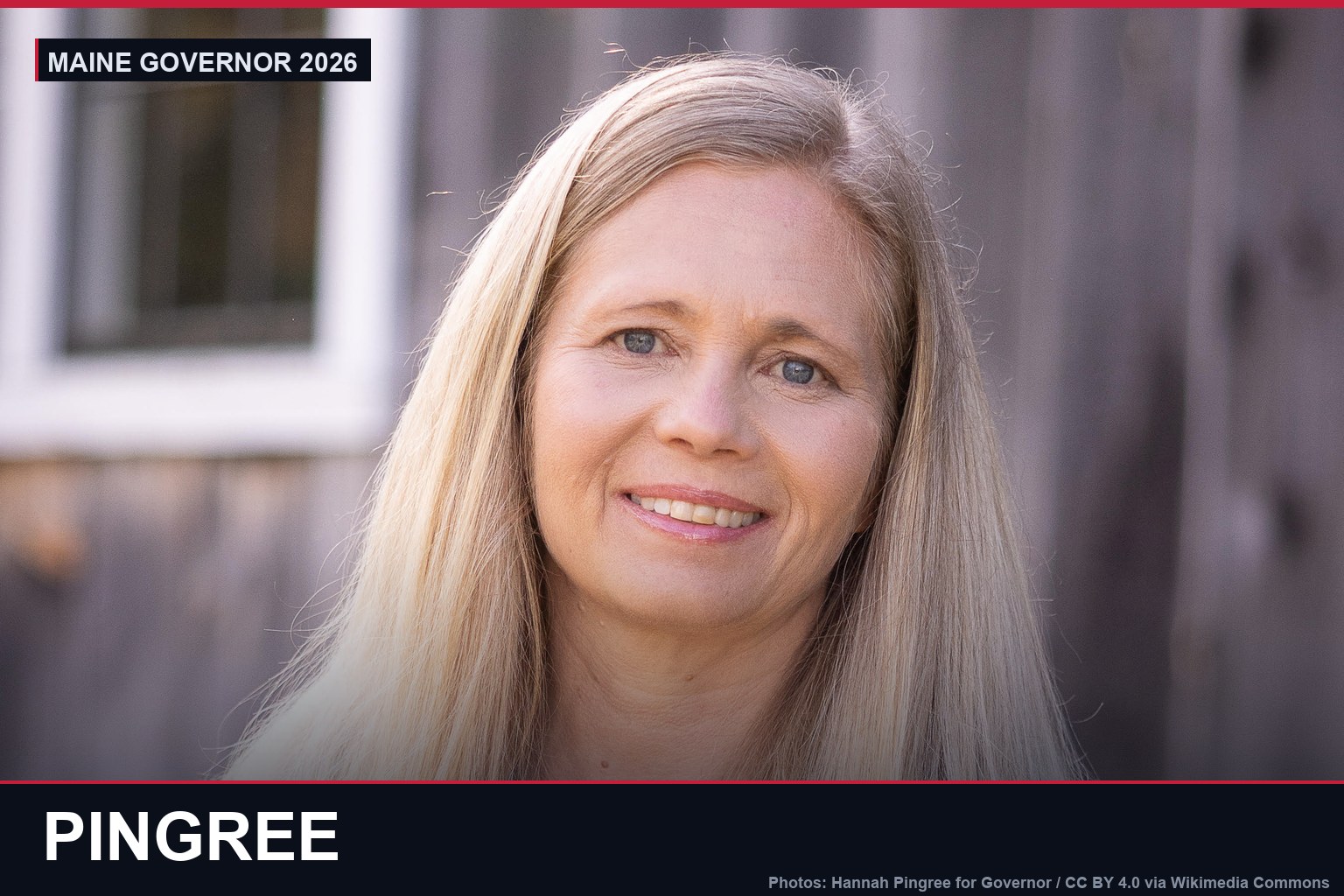
Hannah Pingree, 49, carries the Maine Democratic establishment in her résumé and the state's coastline in her biography. She grew up on North Haven, a small island off the Penobscot Bay coast, where her father is a boat-builder. Her mother is Rep. Chellie Pingree, who has represented Maine's 1st Congressional District since 2009.
Pingree served in the Maine House of Representatives from 2002 to 2010, rising to become the 99th Speaker — the second woman to hold that position in state history. She graduated from Brown University with a degree in political science. After leaving the legislature due to term limits, she spent years running community institutions on North Haven and serving on local boards before joining Gov. Janet Mills' administration in January 2019 as director of the newly created Office of Policy Innovation and the Future. In that role, she co-chaired the Maine Climate Council and oversaw cross-agency work on housing, clean energy, and long-range economic policy. She resigned in May 2025 to run for governor.
Pingree entered the primary as a credible but not dominant contender in a field that initially included Secretary of State Shenna Bellows, former Senate President Troy Jackson, public health official Nirav Shah — who led early polling — and energy executive Angus King III, son of independent U.S. Sen. Angus King. Shah led after the first round of the June 9 primary, but Pingree had secured second-choice co-endorsements from both Bellows and Jackson. When lower-ranked candidates were eliminated and their votes redistributed through ranked-choice tabulation, Pingree won the Democratic nomination.
Gov. Mills endorsed Pingree. The Maine Education Association and the Maine State Employees Association followed. Her campaign message centers on housing affordability, healthcare access, and positioning herself as the candidate who can continue Mills-era governance while being willing to break from it on labor and tribal sovereignty — two issues where the outgoing governor drew progressive criticism.
The Republican Nominee: Bobby Charles
Bobby Charles, 63, won his primary not with the most money but with the most organized conservative voters in a seven-candidate Republican field. He served as U.S. Assistant Secretary of State from 2003 to 2005 under President George W. Bush, worked previously as a naval intelligence officer, and later founded a Washington-based consulting and law firm.
Charles ran a prolific social media campaign, frequently posting AI-generated cartoons and sharp-edged commentary targeting Democratic candidates. He ran as an unabashedly conservative nominee — pledging to eliminate Maine's state income tax entirely and cut the state's roughly $7 billion annual budget by $4 billion, positions that reflect national Republican priorities more than the moderate Maine Republicanism associated with figures like Sen. Susan Collins or former governor John McKernan. His overarching pitch: eight years of Democratic governorship have produced a housing crisis and rising property taxes, and Maine needs a structural reset, not continuity.
Charles loaned his campaign approximately $220,000 at various points. Through the July 14 reporting period, he had raised $1.3 million total and held $180,000 in cash on hand, according to campaign finance reports filed with the Maine Commission on Governmental Ethics and Election Practices.
The Independent Wild Card: Rick Bennett
Rick Bennett, a state senator from Oxford in western Maine, left the Republican Party earlier this year and qualified for the November ballot as an independent. He is polling at 6% to 9% in general election surveys, positioning himself as a pragmatic alternative to what he describes as the polarizing extremes in both major parties.
Bennett raised just under $800,000 and held approximately $94,000 in cash on hand through the latest reporting period — a fraction of Pingree's resources. His presence on the ballot does not currently appear to shift the dynamics systematically toward Charles; the major polls show Bennett drawing from across the spectrum. But Maine has a long history of independent-friendly voters, and his presence keeps the three-way math open through November.
What the Polls Show
Three surveys conducted since the June primary all point to the same basic shape of the race: Pingree leads in a three-way contest with Charles closing modestly and Bennett stable at single digits.
A Beacon Research/Shaw & Co. poll conducted August 6–10 among 1,000 registered voters (±3.0%) found Pingree at 49%, Charles at 38%, and Bennett at 9% — a nine-point margin.
A University of New Hampshire Survey Center Pine Tree Poll conducted July 15–20 among 1,178 likely voters (±2.9%) found Pingree at 49%, Charles at 35%, and Bennett at 6% — a fourteen-point lead.
A New York Times/Portland Press Herald/Siena University poll conducted June 19–26 among 608 likely voters (±4.8%) found Pingree at 50%, Charles at 36%, and Bennett at 8% — again a fourteen-point spread in the three-way.
A Fox News poll conducted in mid-August, reported by the Portland Press Herald, found Pingree's lead at nine points (49%–38%) — narrower than in the same Fox survey in June, which had shown an eleven-point advantage. Charles is gaining ground, but the trajectory still leaves Pingree with a substantial cushion, and the fundraising gap makes a significant late surge difficult without major outside spending.
The Fundraising Picture
Campaign finance reports through July 14 filed with the Maine Commission on Governmental Ethics and Election Practices tell a stark story: Pingree has raised more than $3 million since entering the race in June 2025 — more than Charles and Bennett combined.
Charles has raised approximately $1.3 million. Bennett has raised approximately $780,000.
In cash on hand heading into the fall stretch, Pingree held $854,000 to Charles's $180,000 and Bennett's $94,000. Pingree outraised Charles by nearly $700,000 in the most recent reporting period alone ($900,000 to $217,000).
The Maine Republican Party has countered that Charles draws more heavily from small-dollar Maine donors — with 78% of his contributions under $100, compared to Pingree's higher average contribution of $306 — and has argued that her financial edge reflects out-of-state national donor networks. A pro-Charles political action committee, Reclaim Maine, had spent approximately $60,000 through the July filing. At current resource levels, Charles would need either a dramatic surge in outside spending or a ground-campaign-first approach to remain competitive in the fall advertising window.
The 74-Year Pattern
The last time Maine elected a new governor from the same party that held the seat was 1952, when Republican Burton Cross succeeded Republican Frederick Payne. Since then, party control has changed each time a new candidate sought the office — Democrats followed Republicans, Republicans followed Democrats, with only incumbent re-elections breaking the rotation.
Mills won re-election as an incumbent in 2022, which is structurally different from what Pingree is now attempting: a new Democrat succeeding a term-limited Democrat. Maine hasn't done that in 74 years.
Cook Political Report rates the race Likely D as of July 10, 2026. The state's D+4 Cook Partisan Voting Index, the fundraising gap, Pingree's polling leads, Mills's endorsement, and the primary turnout differential — 217,493 Democratic votes cast versus 129,084 Republican votes in the June 9 primary, per Maine Secretary of State data — all point in the same direction. Kamala Harris won Maine with 54% in 2024.
But Charles's tax-elimination pitch and that historical headwind represent the structural arguments Republicans are banking on. They frame the open seat as a natural correction waiting to happen — Maine's 74-year pendulum swinging back.
Key Issues Shaping the Race
Housing and affordability. Maine's housing costs have risen sharply, particularly along the coast and in Greater Portland. Pingree has centered her campaign on supply-side housing investment and workforce housing policy. Charles frames the problem as a product of Democratic overregulation and high taxes — his income-tax elimination pledge is partly sold as property-tax relief for homeowners.
The Trump factor. Mills spent her governorship in open conflict with the Trump administration, including a high-profile dispute over transgender athlete policies in schools — a flashpoint that drew national attention. Pingree is running as a defender of the Mills-era resistance posture. Charles has aligned with the national Republican policy agenda. The contrast is clear and intentional on both sides.
The income tax pledge. Charles's proposal to eliminate Maine's state income tax is the most aggressive policy commitment in the race. Critics argue it would require devastating cuts to schools, Medicaid, and public services — his $4 billion budget-cut pledge points in that direction. Supporters call it structural reform. In a high-cost state where many residents already feel squeezed, the pitch is landing with some voters even if the mechanics remain contested.
Climate and energy. Pingree co-chaired the Maine Climate Council and has made clean energy investment a signature issue. Charles has not prioritized climate as a theme, positioning it as secondary to economic concerns.
Live Congressional Majority Markets
Maine's governor race sits inside a broader 2026 environment where Senate and House control both hang in genuine uncertainty. Senate control is currently priced as a coin flip, while House Democrats are significant favorites:
What to Watch
Bennett's trajectory. If his numbers fade below 5% by October, where those votes go matters. His voters are likely to split unpredictably between Pingree and Charles. Any movement could tighten or stabilize the race's margin.
Charles's resource problem. With $180,000 in cash on hand entering the fall advertising window against Pingree's $850,000, Charles needs either substantial outside spending or an exceptional ground-game operation to close the gap. Reclaim Maine's current $60,000 in spending is not close to what a competitive general election advertising campaign requires in a state this competitive.
The Trump approval ceiling. Maine gave Kamala Harris 54% in 2024. Trump's approval in Maine represents a structural ceiling for Charles. Any further deterioration in the president's numbers in the state compounds the Republican nominee's challenge, particularly in the southern Maine suburbs that decide most statewide races.
Housing momentum. If Maine's housing market softens heading into November, Pingree's issue advantage weakens. If it remains acute, her framing of eight years of Democratic effort on the problem alongside a credible plan forward is harder for Charles to displace with a tax-elimination pledge that takes years to implement.
Bottom Line
Hannah Pingree enters the fall as a substantial favorite to win Maine's governorship — backed by polling leads of nine to fourteen points across August surveys, a more than two-to-one fundraising advantage, the outgoing governor's endorsement, and the structural tilt of a D+4 state in a midterm environment that broadly favors Democrats. Cook Political rates this race Likely D.
Bobby Charles is running a credible and ideologically focused conservative campaign. He has narrowed the gap slightly since the primary. But the combination of resource disparity, state-level partisan lean, and Democratic primary enthusiasm makes this difficult terrain.
If Pingree wins, she breaks a 74-year pattern and extends Democratic control of the Blaine House for a third consecutive term. If Charles wins, he will have pulled off one of the more unexpected governor's race upsets of the 2026 cycle — and handed Republicans a significant messaging win in a state Democrats have treated as safely blue for statewide offices since 2018.
Verification: Sources Used in This Article
- Portland Press Herald — Pingree dominates fundraising in Maine governor's race (July 22, 2026)
- Portland Press Herald — Maine voters say Susan Collins votes with Trump too often in Fox News poll (August 13, 2026)
- WMTW — Pingree is out-fundraising both opponents combined (July 22, 2026)
- NBC News — Maine's race for governor heads to ranked-choice tallies in both primaries (June 10, 2026)
- Washington Post — Hannah Pingree, Bobby Charles advance in Maine governor's race (June 19, 2026)
- Politico — Democrat Hannah Pingree and MAGA ally Bobby Charles will face off for Maine governor (June 19, 2026)
- Cook Political Report — Maine Governor 2026 (Likely D, rated July 10, 2026)
- The Maine Wire — Pingree Opens $3 Million Fundraising Lead in Maine Governor's Race (July 23, 2026)
- Newsweek — Democrat and Republican Voter Turnout Compared in Six Key Primary States (August 12, 2026)
- Maine Public Radio — Gubernatorial and congressional campaigns rake in cash as 2026 elections ramp up (July 2025)
- New York Times — Who Is Ahead in the Maine Governor's Race? Latest 2026 Election Polls (polling tracker, updated August 2026)