

Massachusetts Senate 2026 Race Guide: Ed Markey, Seth Moulton, and the Primary That Won't Budge
Markey 74¢, Moulton 26¢ — one month from Massachusetts’ Sept. 1 primary. Race guide: polling, FEC filings, the 2020 parallel, and what the market is pricing.
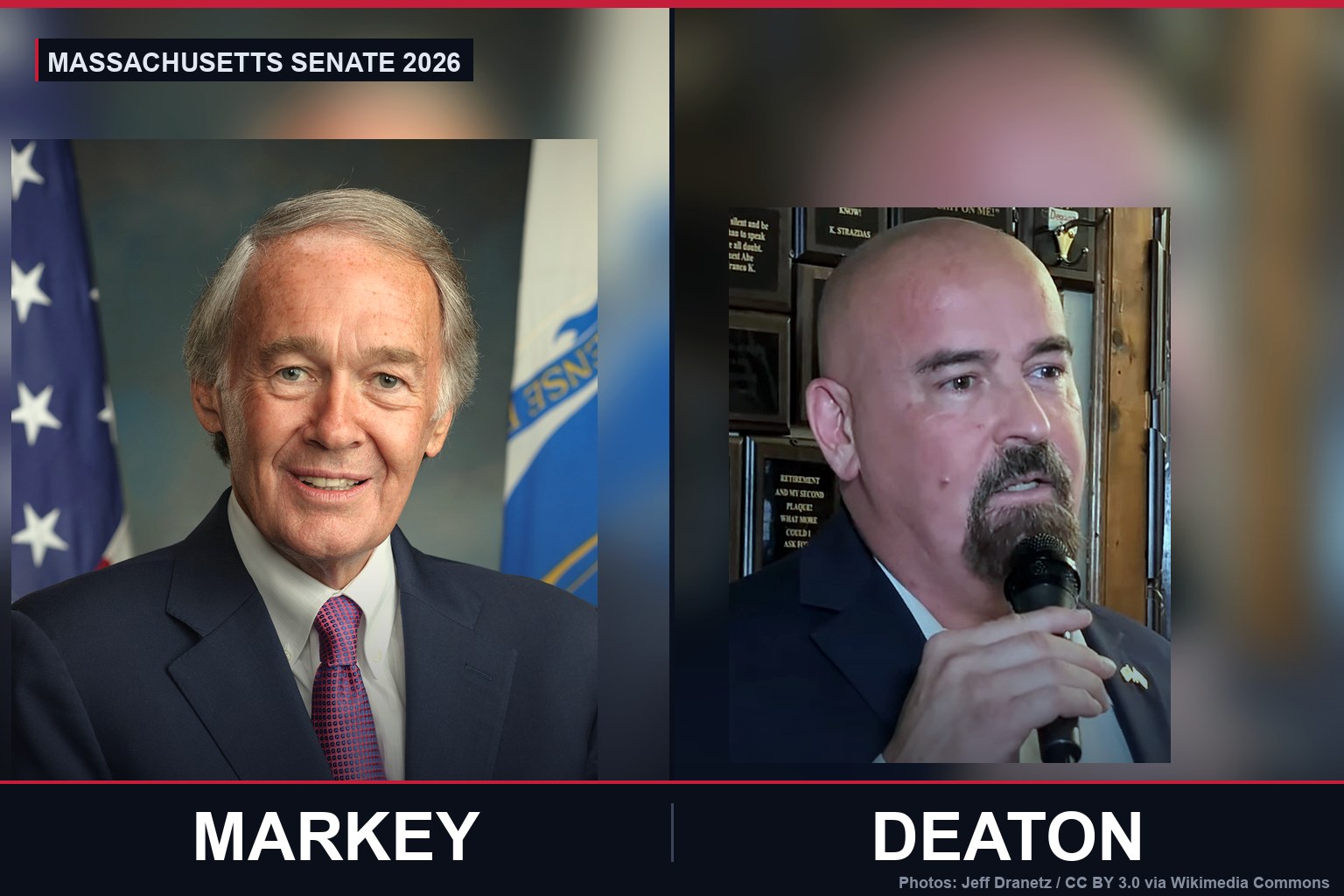
The Primary That Won't Budge
Prediction markets price Sen. Ed Markey as a heavy favorite in Massachusetts' Democratic Senate primary — at roughly 74 cents on the dollar, with Rep. Seth Moulton at 26 cents. Yet the most recent public polling tells a narrower story: a six-point margin with nearly a quarter of likely voters still undecided, one month from Election Day. That gap between market confidence and poll movement makes the Markey-Moulton contest one of the most analytically interesting Democratic primaries on the 2026 calendar.
The primary is September 1, 2026. The general election is November 3. And the key fact about Massachusetts Senate 2026 is that the general election is not the competitive race — this is a reliably Democratic state that has not sent a Republican to the U.S. Senate since Scott Brown won a 2010 special election, and Brown lost re-election in 2012. Whoever wins the Democratic nomination will be an overwhelming favorite in November. The real contest is internal: a Democratic Party sorting out what it values — decades of progressive credentialing versus generational renewal — in the shadow of a second Trump term.
Ed Markey: The Incumbent Who Beat a Kennedy
Edward J. Markey, 80, has been a fixture in Massachusetts federal politics since Gerald Ford was president. First elected to the House of Representatives in 1976, he served 37 years in the lower chamber before winning the Senate seat in 2013 when John Kerry joined the Obama administration as Secretary of State. Markey is the longest-serving member of the current Massachusetts congressional delegation.
His Senate record sits firmly in the progressive column. He is best known nationally as the co-author, alongside Rep. Alexandria Ocasio-Cortez of New York, of the Green New Deal — the sweeping climate and economic framework that became a defining document of the congressional left. That partnership with Ocasio-Cortez proved decisive in the primary fight he now uses as a template: in 2020, Markey defeated Rep. Joe Kennedy III — grandson of Robert F. Kennedy and a scion of Massachusetts' most storied political family — by 56%-44%, handing the Kennedy dynasty its first-ever electoral loss in Massachusetts. Markey ran to Kennedy's left, won the endorsement of Ocasio-Cortez and the Sunrise Movement, and outflanked a younger, better-known, better-funded challenger.
Entering 2026, Markey has won the state party convention and holds endorsements from most of the Massachusetts congressional delegation and the bulk of the state's progressive infrastructure. He turned 80 on July 11, 2026. If he wins re-election, he would begin a new six-year Senate term at 80 and serve through 2033 — when he would be 87. That arithmetic is the animating force of Seth Moulton's campaign.
Seth Moulton: The Marine Making the Generational Argument
Seth Moulton, 47, is a Marine Corps veteran who served in Iraq, a Harvard physics graduate (class of 2001), and the congressman representing Massachusetts' 6th Congressional District — the North Shore, anchored in Salem. He is a member of the New Democrat Coalition, the caucus of moderate, pro-growth House Democrats, and has spent a decade building a reputation on national security, veterans' affairs, and bipartisan defense issues.
He announced his Senate candidacy on October 15, 2025, citing Markey's age directly: "We're in a crisis, and with everything we learned last election, I just don't believe Sen. Markey has what it takes." The message has been disciplined — Moulton rarely attacks Markey on policy grounds, because the two are broadly aligned on most issues. His case is structural, not ideological: the Democratic Party needs generational renewal, and a senator beginning a new term at 80 represents a practical liability in a moment demanding high-energy opposition.
The contrast with Joe Kennedy's 2020 challenge is instructive and deliberate. Kennedy ran as a fellow progressive making an ambition-based argument — he struggled to explain why Markey's record was insufficient. Moulton is making a different pitch: not that Markey is wrong on the issues, but that the calendar matters. That argument lands differently with different voter groups, as the polling data makes clear.
Running for Senate requires Moulton to vacate his House seat, making the 6th Congressional District an open race in 2026 — a competitive Democratic primary unfolding simultaneously in his absence.
The Polling Picture: Steadily Tightening, Still Markey's Race
The polling arc through 2026 tells a story of slow, consistent tightening — but not a collapse. Markey has led in every survey conducted since Moulton's announcement.
Early post-announcement polls showed commanding leads. A UMass Amherst/WCVB survey in November 2025 put Markey at 51%, Moulton at 28%. A Suffolk University/Boston Globe poll the same month showed Markey 45%, Moulton 22%, with 30% undecided. Those numbers reflected Moulton's low name recognition at the time — a majority of likely Democratic primary voters had not formed an opinion of him.
The compression accelerated through spring 2026. A University of New Hampshire survey in April 2026 had Markey leading 46%-33% — a 13-point spread. The Suffolk/Globe poll in mid-April found 47%-30%, with Markey still up 17 points. Then, in May, the Emerson College poll recorded the most dramatic shift: Markey 37%, Moulton 32% — a five-point gap, 29% still undecided. It was the closest the race had been, and it scrambled assumptions about whether this was a competitive contest.
The most recent survey, a University of New Hampshire poll from July 1, 2026, found Markey leading 41%-35% among likely Democratic primary voters — a six-point margin, with undecided voters at 23%. The RealClearPolitics polling average as of early August 2026 puts Markey at roughly 39%, Moulton at 33.5%, a gap of approximately five to six points across pollsters.
The consistent thread: Markey leads registered Democrats by double digits. Moulton leads unenrolled voters — independents who choose to pull a Democratic primary ballot — by a six-point margin, according to Emerson's May survey. In a low-turnout September primary, the composition of the electorate matters enormously. Markey's machine has decades of practice turning out his base.
The Money Race: Moulton's Structural Edge Heading Into the Stretch
Federal Election Commission filings through March 31, 2026 tell a counterintuitive financial story. Markey has outraised Moulton on total dollars — $6.5 million to $4.3 million — but has also outspent him heavily, burning through $5.6 million versus Moulton's $2.8 million in expenditures. That leaves Moulton with more cash on hand entering the summer: $3.3 million for Moulton versus $2.5 million for Markey.
In a primary race decided September 1, the August advertising sprint is decisive. Holding more cash at the start of August gives Moulton a structural advantage in the paid-media final push — an opportunity to sustain air cover while Markey's operation focuses on ground-game turnout. It is worth noting that Markey found himself in a similar — if more acute — financial position against Kennedy in late 2019 before ultimately outperforming expectations.
The Key Divides: Who's With Whom
The Emerson College polling crosstabs from May 2026 sketch a clear map of the electorate. Markey leads registered Democrats by 13 points — the firewall that has sustained his lead in every survey. Moulton leads unenrolled voters 38%-32%. Among ideological self-identification, Markey carries progressives (52%) and self-identified socialists (67%); Moulton carries moderates (70%). Markey leads women 37%-29%; men split nearly evenly.
The University of New Hampshire's July 2026 survey reinforced the pattern: Moulton took majority support among self-identified moderates, while Markey locked up liberals and progressives. Forty-eight percent of likely primary voters said they had a favorable opinion of Markey; 32% said the same of Moulton. Moulton's lower name recognition — even after nine months of campaigning — continues to be a structural drag on his ceiling.
The wildcard is turnout among unenrolled voters, who can participate in Massachusetts primaries by requesting a party ballot. They represent a meaningful share of the September electorate but historically vote at lower rates than registered partisans in primaries. Moulton's campaign is banking on a higher-than-usual unenrolled turnout driven by dissatisfaction with the status quo. Markey's operation is banking on the opposite: that the primary rewards loyalty, not protest.
The 2020 Parallel — and Its Limits
Both campaigns invoke the 2020 Kennedy primary, for opposite reasons. Markey's team notes that he was the underdog early — trounced in initial polls, struggling to collect ballot signatures during the pandemic — and still won by 12 points. He did it by building a coalition of progressive organizations around his climate record, turning his age and seniority from a liability into proof of legislative effectiveness. Kennedy never successfully articulated why Markey's record was inadequate; Markey made the race about the Green New Deal.
Moulton's team argues that his challenge is structurally different. Kennedy's argument was generational but vague — "it's time for new leadership" without a specific critique of Markey's fitness. Moulton's argument centers on a concrete mathematical concern: age and physical capacity for a six-year term starting at 80. Kennedy was also running as a fellow progressive competing for the same base. Moulton is explicitly running as the moderate lane, arguing that the Democratic Party's unenrolled and independent-friendly voters want a different profile. The electorate he is targeting is not identical to the one Kennedy competed for.
The July 30, 2026 Boston Globe analysis, published one month from the primary, described the race as "stuck" — the same story lines repeating since the fall: Markey ahead, Moulton gaining but not enough to surge. That stasis favors the incumbent. But one month in a low-information, low-turnout primary — where a late-breaking endorsement, a memorable debate moment, or a single viral moment can move numbers significantly — leaves the outcome genuinely uncertain.
The General Election: A Safe Democratic Hold
Whoever wins the Democratic primary on September 1 will enter the November 3 general election as a prohibitive favorite. The Republican nominee is John Deaton, an attorney. In polling, both Markey and Moulton defeat Deaton by more than 20 points among likely general-election voters. The University of New Hampshire's April 2026 survey put Markey over Deaton 55%-32% and Moulton over Deaton 56%-25%.
Massachusetts last sent a Republican to the Senate when Scott Brown won a January 2010 special election to fill the seat vacated by Ted Kennedy's death. Brown lost re-election in 2012 to Elizabeth Warren by nearly eight points. No Republican has come close since. For Senate control purposes, the seat is a Democratic hold regardless of the primary outcome — what changes is who holds it and what brand of Democratic politics it represents.
From a Senate control market perspective, Massachusetts does not move the needle on the Republican or Democratic tally. The race that will determine Senate control in 2027 runs through Georgia, Texas, Maine, Iowa, Michigan, North Carolina, and New Hampshire — not the Bay State.
The Bottom Line
Massachusetts Senate 2026 is, at its core, a primary story. The Democratic nominee will win in November; the question is what vision of the Democratic Party wins in September. Ed Markey, 80, brings five decades on Capitol Hill, the Green New Deal, and a progressive infrastructure that turned back a Kennedy. Seth Moulton, 47, brings a Marine combat record, cash-on-hand advantage, and a tightening poll trend built on moderate and unenrolled voters.
Prediction markets reflect the structural advantages of incumbency: Markey at 74 cents, Moulton at 26. Public polling reflects a real race: Markey leading by five to six points with a substantial undecided bloc one month out. Both can be true simultaneously. Incumbents win primaries in Massachusetts. But sometimes they don't — and the Kennedy primary proved that an incumbent who looked safe entering the summer could campaign his way to victory from a vulnerable position. The difference is that in 2020, it was Markey doing the campaigning from behind. In 2026, it is Moulton who needs to close.
Verification
Sources:
- Boston Globe (July 30, 2026): Race described as "stuck" one month from primary
- Axios Boston (July 1, 2026): UNH poll: Markey 41%, Moulton 35%
- MassLive (July 1, 2026): Moulton closes to within 6 points — UNH survey
- Axios Boston (May 7, 2026): Emerson poll: Markey 37%, Moulton 32%
- Boston Globe (April 15, 2026): Suffolk/Globe poll: Markey 47%, Moulton 30%
- Emerson College Polling (May 2026): Full crosstab breakdown
- University of New Hampshire Survey Center (April 2026): Markey 46%, Moulton 33% in UNH survey
- Federal Election Commission — campaign finance filings, Q1 2026: FEC.gov
- NBC Boston / Suffolk University (November 2025): Early primary poll: Markey 45%, Moulton 22%
- New York Times (September 1, 2020): Markey defeats Kennedy — 2020 primary results
- Ballotpedia — Massachusetts Senate 2026: Candidate and election data