
Michigan Senate 2026 Race Guide: Abdul El-Sayed vs. Mike Rogers and the Seat That Could Decide the Majority
Post-primary race guide: El-Sayed vs. Rogers in Michigan's November 3 Senate toss-up — the contest both parties say will decide the majority.
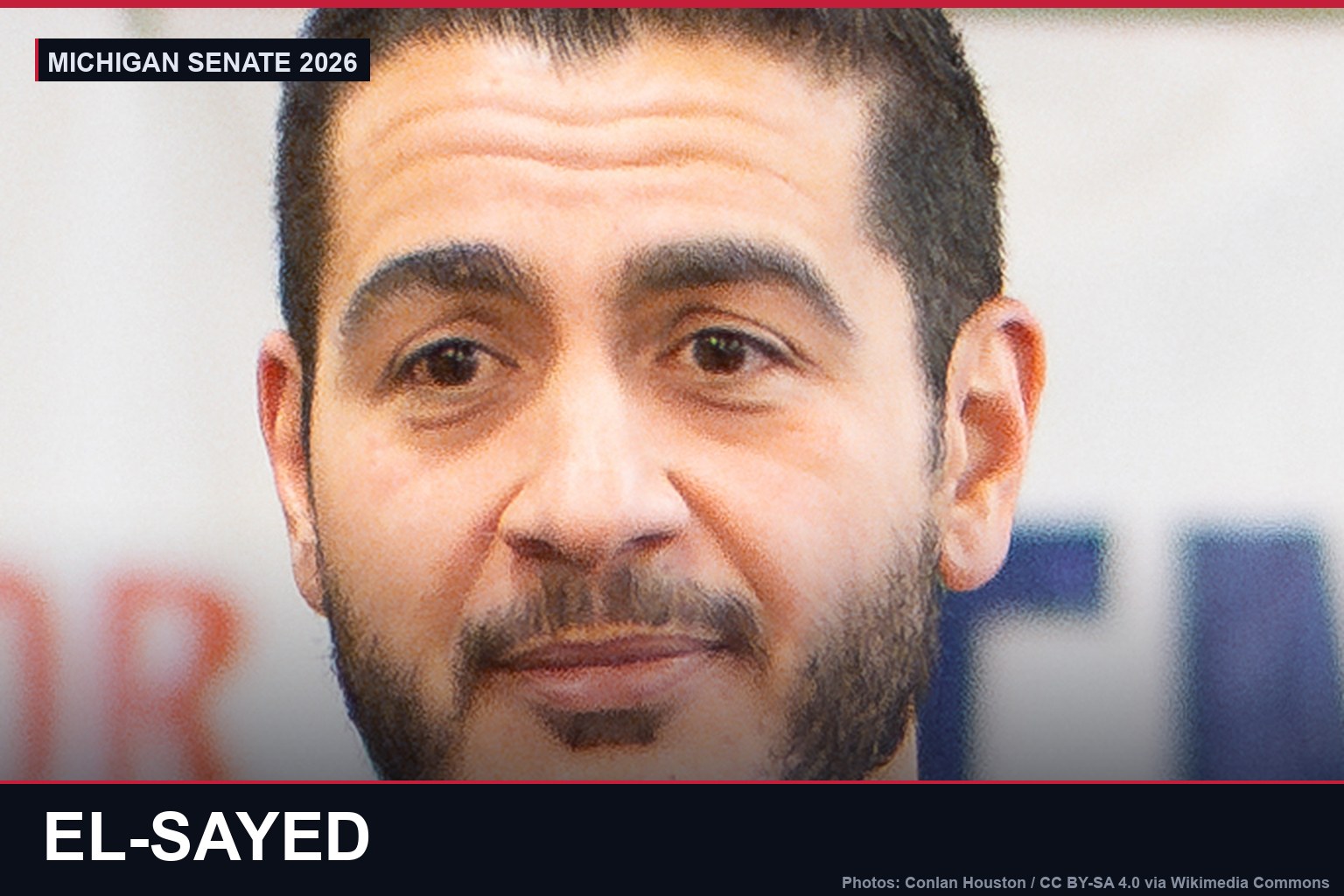
The most expensive Democratic Senate primary in American history ended Wednesday morning with a one-point margin and an immediate pivot. Abdul El-Sayed — a progressive physician, former Wayne County public health director, and Rhodes Scholar — won Michigan's Democratic nomination by 48.48% to 47.51%, a gap of roughly 15,000 votes out of more than 1.5 million cast, according to the Associated Press. His general election opponent, Republican Mike Rogers, had been waiting. Rogers ran unopposed in his party's primary and issued a statement within hours calling the Democratic nominee "the most radical, extreme" candidate he had ever seen nominated by a major party.
What follows is a November 3 general election that every major election analyst rates a Toss-Up — and that prediction markets price as one of the closest Senate contests on the board.
The seat being contested belongs to retiring Democratic Sen. Gary Peters, who won re-election in 2020 and announced he would not seek a third term. Peters's retirement created Michigan's first open Senate seat in more than a decade — and set off a Democratic primary that consumed $80 million or more in spending and divided the party along ideological fault lines it is now racing to paper over before November.
The Democratic Nominee: Abdul El-Sayed
El-Sayed, 42, is a Michigan-born son of Egyptian immigrants who trained as a physician at the University of Michigan before earning a doctorate at Oxford as a Rhodes Scholar. He served as director of the Wayne County Health, Human, and Veterans Services Department from 2015 to 2017, then mounted an unsuccessful run for governor in 2018. He had never won a contested election before Tuesday's primary.
His platform is unambiguously left-of-center: Medicare for All, a halt to U.S. military aid to Israel, and campaign finance reform anchored by a ban on corporate political donations. He earned endorsements from Sen. Bernie Sanders (I-VT) and Rep. Alexandria Ocasio-Cortez (D-NY) and drew significant support from Michigan's Arab American and Muslim American communities, who are concentrated in southeast Michigan communities including Dearborn and Hamtramck. If El-Sayed wins in November, he would become the first Muslim senator in American history.
The primary was bruising. His opponent, Rep. Haley Stevens (D-MI), received substantial backing from pro-Israel groups and argued from start to finish that El-Sayed risked losing the seat to Rogers in November — a concern she cited explicitly in an August 2 post. The race ultimately came far closer than polls had predicted: polling aggregates heading into election night showed El-Sayed ahead by double digits in the primary, but he won by less than one point, per the AP. Stevens conceded Wednesday morning and endorsed El-Sayed within hours. "He is a doctor, a community health official, a Rhodes Scholar, and a dedicated Michigander," Stevens said in a statement. "I am proud to offer my support as he takes on Mike Rogers in the general election."
El-Sayed's challenge now is to translate a coalition built on progressive enthusiasm, college-town dominance (he won Washtenaw County — home to Ann Arbor and the University of Michigan — with 61% of the primary vote, per the New York Times), and Arab American turnout into a coalition capable of winning a state that voted for Trump in 2024 by 1.4 points.
The Republican Nominee: Mike Rogers
Mike Rogers, 63, brings an unusual biography to his second consecutive Michigan Senate campaign: Army officer, FBI special agent, congressman, and former chairman of the House Intelligence Committee.
Rogers was born in Livonia, Michigan, graduated from Adrian College in 1985, and served as a U.S. Army lieutenant through 1989. He then joined the FBI as a special agent in Chicago, investigating organized crime and public corruption until 1994. He entered the Michigan State Senate in 1995, won a seat in the U.S. House in 2000 (by 111 votes, the closest House race in the country that year), and went on to serve seven terms representing Michigan's 8th Congressional District. He chaired the House Permanent Select Committee on Intelligence from 2011 to 2015, where he focused heavily on cybersecurity and Chinese economic espionage.
Rogers left Congress in 2015 and returned to run for Senate in 2024, winning the Republican primary and then narrowly losing the general election to now-Sen. Elissa Slotkin (D-MI) by fewer than 20,000 votes — while Donald Trump was carrying Michigan for the presidency by more than 80,000, per NBC News. That near-miss set up his 2026 campaign for Peters's seat, which he announced on April 14, 2025.
On the financial side, Rogers reported $5.6 million cash on hand entering the general election, following his strongest fundraising quarter to date — nearly $3.2 million across authorized committees in the second quarter of 2026, per his campaign. In April 2026, the Senate Leadership Fund, the primary super PAC dedicated to electing Republican senators, committed $45 million to his race — its largest investment in a non-Republican-held seat, per the Detroit Free Press. Trump has endorsed Rogers.
Rogers is running on national security, manufacturing, border security, and lowering household costs. He is not running toward the center on El-Sayed's platform: his statement after the primary called El-Sayed's positions "complete insanity" and framed the race as a choice over whether Michigan hands power to "fringe extremists," per CNN.
What the Polls Show
The general election polling picture is uniformly tight, with no single survey showing a lead outside the margin of error.
The most recent public poll, from EPIC-MRA (July 24–31, 600 likely voters, ±4.0%), showed Rogers ahead 46%–43%. A Mitchell Research & Communications survey conducted July 28–29 (672 likely voters, ±3.8%) showed an exact tie at 45%–45%. A SoCal Strategies poll (a Republican-leaning firm, July 28–30, 640 likely voters) showed Rogers ahead 42%–41%. The Glengariff Group (July 22–24, 600 likely voters) showed the widest gap among recent polls: Rogers 49%, El-Sayed 39%, per the Hill.
The overall polling average through July 31 showed Rogers ahead by roughly 0.3 points — a statistical dead heat.
Both Cook Political Report and Sabato's Crystal Ball rate the race a Toss-Up. Inside Elections has also listed it as a Tossup, per Newsweek.
Prediction markets — sourcing consensus pricing across Kalshi, Polymarket, and PredictIt — give El-Sayed a 59¢ edge to Rogers' 41¢ as of August 6. The market is pricing a Dem-lean where the polling average shows a near-perfect tie. That gap is the central pricing puzzle in the race.
The Electability Argument — and the Independents Gap
The primary debate about El-Sayed's general-election prospects wasn't abstract. The same EPIC-MRA poll that showed Rogers leading El-Sayed 46%–43% also showed Rogers trailing Stevens 44%–42% in a hypothetical matchup. More striking: a Glengariff Group survey showed Rogers holding a nearly 28-point lead over El-Sayed among independent voters — while running essentially even with Stevens among the same group, per the Hill.
Those numbers represent the core challenge for El-Sayed's campaign. Michigan's Senate electorate is not simply Ann Arbor and Dearborn. It includes suburban Oakland County and Macomb County voters, rural northwestern Michigan, and the auto-industry communities of the Saginaw Valley and the Thumb — constituencies where El-Sayed's primary coalition did not run particularly strong.
El-Sayed's side argues that primary enthusiasm measures differently than general-election performance — that new voters he mobilized in the primary represent an expansion of the electorate that conventional likely-voter models undercount. Sanders made that case explicitly after the result, telling CNN he was "confident" El-Sayed could win by expanding the "voter turnout universe."
Peters, who has won two Michigan Senate races himself, offered a more pointed assessment: El-Sayed needs to "make inroads immediately with the party" to consolidate the factions that backed Stevens — particularly Black voters and older voters who skewed toward the moderate congresswoman, per CNN.
Michigan's Political Geography
The state's volatility makes projection difficult. Trump won Michigan in 2016 by fewer than 11,000 votes, lost it in 2020 by more than 150,000, then won it again in 2024 by approximately 80,000. Those swings reflect a state that responds to candidate quality, turnout intensity, and economic conditions more than a fixed partisan lean.
The last Republican to hold a Michigan Senate seat was Spencer Abraham, who served a single term from 1995 to 2001, per the AP. Rogers would be the first Republican senator from Michigan in a quarter-century if he wins — a milestone his campaign has emphasized throughout.
Michigan's Arab American and Muslim American communities — among the largest in the country — were a central organizing force for El-Sayed's primary coalition. His criticism of U.S. military policy toward Israel drove that turnout. How those voters perform in November, and whether El-Sayed can also consolidate the Black voter support and senior vote that Stevens attracted, will be critical to his path.
For Rogers, the path runs through the independent voters where he holds a consistent polling advantage, and through the structural benefit of running in an environment where the party out of power in the White House typically gains ground in midterms.
What Comes Next
Both candidates now enter a 90-day sprint. El-Sayed has already challenged Rogers to five debates — Rogers has not responded publicly. The Senate Leadership Fund's $45 million commitment and Rogers's own $5.6 million cash on hand mean the Republican advertising infrastructure is ready. El-Sayed, who declined large PAC money in the primary, will need to demonstrate he can keep pace financially while unifying a party he divided nearly in half.
The outcome in Michigan could determine which party controls the United States Senate after November 3. Senate control — pricing Republican control at 54¢ and Democratic control at 46¢ — tracks closely with Michigan's individual race pricing, reflecting how tightly the two are linked in market pricing.
For now, the race is what the forecasters say it is: a genuine toss-up in a purple state, between a progressive newcomer testing whether left-wing politics can win outside blue strongholds, and a former intelligence committee chairman trying to become Michigan's first Republican senator since the Clinton era.
Sources: Associated Press (apnews.com, Aug 5–6, 2026); NBC News (nbcnews.com, Aug 4–5, 2026); CNN (cnn.com, Aug 4–5, 2026); The Guardian (theguardian.com, Aug 5–6, 2026); The Hill (thehill.com, Jul 28–Aug 4, 2026); NPR (npr.org, Aug 5, 2026); Newsweek (newsweek.com, Aug 4–5, 2026); Detroit Free Press (freep.com, Apr 6, 2026); New York Times (nytimes.com, Aug 5–6, 2026); Fox News (foxnews.com, Aug 5, 2026); Mike Rogers for Senate campaign (rogersforsenate.com, Jul 15, 2026); USA Today (usatoday.com, Aug 5, 2026); EPIC-MRA poll (Jul 24–31, 2026, via the Hill and Newsweek); Mitchell Research & Communications poll (Jul 28–29, 2026, via the Hill).