Minnesota Governor 2026 Race Guide: Amy Klobuchar, the Divided Republican Field, and the First Open Governor's Race Since 2018
Minnesota's first open governor's race since 2018: GOP primary (Demuth 73¢, Lindell 26¢) vs. DFL nominee Amy Klobuchar in November.
Minnesota's governorship has been in Democratic hands since 2011 — 16 consecutive years. On November 3, 2026, voters will decide whether that streak reaches 20. For the first time since 2018, the race is open: Governor Tim Walz announced on January 5, 2026 that he would not seek a third term, citing the state's ballooning welfare fraud scandal. His exit upended a race that had barely begun and reshaped the midterm landscape in one of the country's most closely watched swing states.
The candidate who stepped into the vacuum was the most prominent Democrat in the state. Senator Amy Klobuchar launched her gubernatorial campaign on January 29, 2026, backed by the DFL endorsement and a decade-plus of statewide electoral dominance. On the Republican side, the primary decided today — August 11 — features a chaotic three-way contest between a legislative insider, a Trump-endorsed entrepreneur, and a healthcare executive who won the party's convention endorsement under disputed circumstances. Whoever emerges faces Klobuchar in November in what every major forecaster rates as a Democratic advantage.
The Fraud Scandal That Changed Everything
The proximate cause of this open race is a welfare fraud scandal that drew national attention. Minnesota's federally funded child care programs became the target of a wide-ranging scheme, with hundreds of millions of dollars — with some estimates exceeding $1 billion — in potentially fraudulent payments identified in state programs. A viral video in late 2025 propelled the story from local news to national attention, drawing sharp attacks from President Donald Trump and the Republican Governors Association.
Walz, who had announced his intention to seek a third term in September 2025, absorbed the political fallout. Though not accused of wrongdoing, he faced relentless Republican pressure. On January 5, 2026, he withdrew. "I've decided to step out of the race and let others worry about the election while I focus on the work," he said in his statement, taking no questions at the news conference that followed. Later that month, he told an interviewer he would "never run for an elected office again." For Republicans, the vacancy represented a rare opening in a state that has not elected a Republican to any statewide office since 2006.
Amy Klobuchar: The DFL's Dominant Favorite
Klobuchar's entry transformed the Democratic field immediately. She secured the DFL endorsement and raised $9.3 million for her campaign through July 20, holding approximately $4.5 million in cash on hand, according to the Associated Press. Her six DFL primary opponents reported a combined total of less than $3,200 in the bank.
Klobuchar brings unusual statewide credibility. She won her 2024 Senate reelection by approximately 16 percentage points, even as Vice President Kamala Harris carried Minnesota by only about 4 points. That gap reveals an independent political identity that has made Klobuchar one of the most durable vote-getters in the state's modern history.
Republicans have sought to frame Klobuchar as a "third Walz term," arguing that Democrats' management of state government and the fraud scandal disqualify them. Democrats counter that Klobuchar spent two decades in the U.S. Senate — not in the governor's office — and has a proven record of winning voters across party lines.
The Republican Three-Way: Convention Chaos and Its Aftermath
The Republican primary decided today did not follow the conventional path. The Republican Party of Minnesota's state convention in late May chose healthcare executive Kendall Qualls as the GOP-endorsed candidate after a drawn-out process requiring 10 rounds of voting. But party chairman Alex Plechash announced that voting anomalies had been detected and that candidates who had pledged to abide by the endorsement would be released from that commitment. The practical result: the door to a primary was open.
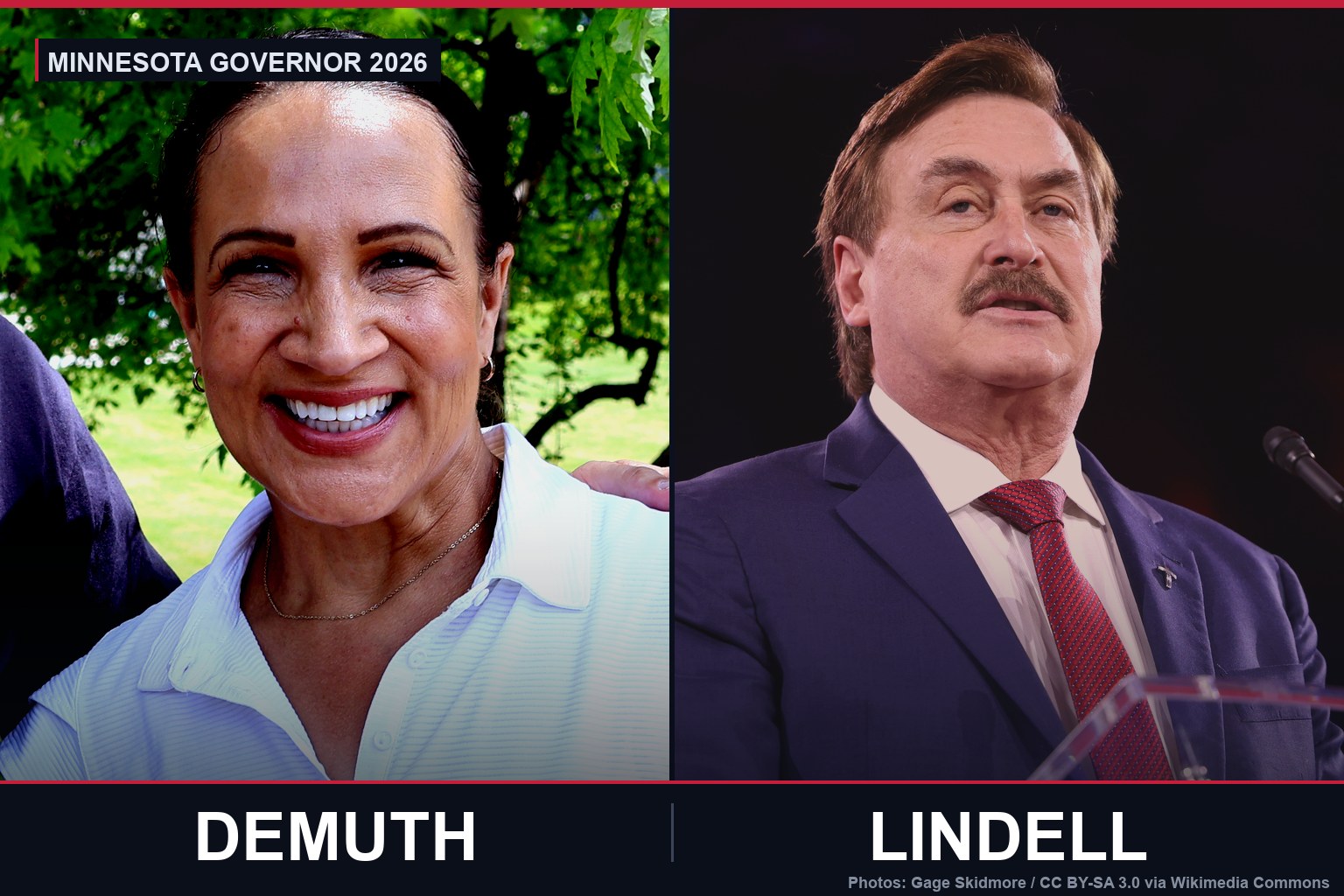
Minnesota House Speaker Lisa Demuth, who had come in second at the convention, announced she would take her campaign to primary voters. Mike Lindell, the MyPillow CEO and prominent figure in national conservative media, had already filed. When President Trump endorsed Lindell in July 2026, it added an additional layer of unpredictability to a race that had already defied easy categorization.
The Three Candidates
Lisa Demuth is the current Speaker of the Minnesota House and the most prominent Republican officeholder in the state. She has served in the legislature since 2019 and has centered her campaign on government efficiency, ending fraud in state programs, and cutting taxes. Demuth argues that her experience navigating a 67-67 tied House is the primary credential that makes her competitive against Klobuchar in November. "I'm the only candidate who can deliver the Republican trifecta Minnesota needs to change course," she wrote in a Star Tribune opinion piece in August. She holds the backing of the National Rifle Association and has benefited from approximately $2.7 million in independent expenditures from a super PAC called Restore Sanity. As of July 20, she held more campaign cash on hand than either of her primary rivals, according to the Associated Press.
Mike Lindell entered the race as an outsider with a nationally prominent profile and, ultimately, President Trump's endorsement. The MyPillow CEO has cast himself as a political disruptor and drawn strong support from the most Trump-aligned primary voters. Though Lindell outraised Demuth overall during the campaign, Demuth held the larger war chest as of July 20, according to the AP.
Kendall Qualls holds the formal Republican Party endorsement and has campaigned as a political outsider — a retired healthcare executive who has never held elected office. Qualls would be the first Black candidate to win a major party gubernatorial nomination in Minnesota history if he prevails. His available polling has consistently lagged behind both Demuth and Lindell.
What the Market Says
Prediction markets are pricing a clear frontrunner ahead of today's vote. Our consensus pricing across major exchanges places Lisa Demuth at 73¢ and Mike Lindell at 26¢.
That market pricing diverges notably from at least one recent public poll, which showed Lindell leading among Republican primary voters — 34% to Demuth's 28% and Qualls's 17%, per the Twin Cities Pioneer Press. Prediction markets price probability with real money, which can surface information that polling misses, including the turnout intensity of committed voters on a summer primary day. But markets can also underweight late-breaking survey data. Today's results will be the first hard test of which signal was closer to reality.
The General Election Landscape
Regardless of who wins today, the general election path against Klobuchar runs steeply uphill. Every major rating service has assessed this race as Safe or Solid Democratic. Cook Political Report and Sabato's Crystal Ball both rate it as a Democratic advantage.
The polling record is consistent across multiple firms. A Mason-Dixon survey of 800 likely voters, conducted June 8–10 and sponsored by the Star Tribune, KARE-TV, and the University of Minnesota Hubbard School of Journalism, showed Klobuchar leading Demuth 48% to 40%, and leading Lindell 53% to 36%. The Mason-Dixon margin of error was ±3.5 percentage points. An Emerson College poll of 1,000 likely voters conducted in February found Klobuchar ahead of Demuth 51% to 38% and ahead of Lindell 53% to 31%, with a margin of error of ±3.0 percentage points.
The structural backdrop reinforces the polling. Minnesota has not elected a Republican to any statewide office since 2006, when Governor Tim Pawlenty won his second term. Harris carried the state by approximately 4 points in 2024; Obama won it by approximately 7 points in 2020. Among independent voters specifically, the Emerson poll found Klobuchar leading Demuth by 27 points and Lindell by 40 points — a gap that reflects the structural difficulty Republicans face in statewide Minnesota contests.
The Path to a Republican Upset
The Mason-Dixon poll found that both Demuth and Qualls face double-digit undecided percentages in their matchups with Klobuchar — 12% and 14%, respectively. A Republican nominee who could convert a large share of those undecided voters while driving above-average base turnout would have a mathematical path to a competitive general election, even if it remains an uphill climb.
Demuth's campaign has made the electability argument its central pitch: she is the only candidate in the primary who has won contested elections and delivered conservative policy results in a Democratic-leaning environment. Qualls and his supporters counter that the formal party endorsement and his biography as a political outsider give him the best shot at expanding the coalition. Lindell's argument rests almost entirely on Trump's endorsement and the hope that MAGA turnout in a midterm primary electorate translates to something competitive statewide — a theory that conflicts with every available general election poll and the state's recent voting history.
The Historical Stakes
This race carries weight beyond November. A Demuth victory in the primary would make her the first woman to win the Republican gubernatorial nomination in Minnesota's history. A Qualls victory would make him the first Black candidate nominated by a major party for governor in the state. Either outcome would represent a milestone for Minnesota Republicans regardless of what follows in November.
Key Issues Heading Into the Fall
Both parties expect the fraud scandal to remain central. Republicans plan to hold Klobuchar's party accountable for Walz's oversight failures; Democrats plan to draw a clear line between a two-term U.S. Senator and a governor's administration she did not run. Taxes and affordability — which Demuth has made her signature pitch — will be active campaign territory. Immigration and state-federal cooperation, a flashpoint during the Walz administration's interactions with federal enforcement agencies, are expected to animate the Republican base and remain part of the fall debate.
What to Watch Tonight
The primary results that come in tonight will be the first hard data point in a race that has been defined by competing polls, a disputed convention, and a market signal that diverges from public polling. A decisive Demuth win validates the prediction market pricing and sets up a well-funded challenger with legislative credentials. A Lindell win — the scenario polls recently suggested was possible — would test whether Trump's endorsement can overcome the electability argument in a state where Republicans have not won statewide in 20 years and would likely prompt forecasters to widen their general election rating further toward Democrats. A Qualls victory would be the day's biggest surprise.
All three scenarios lead to the same November opponent: Amy Klobuchar, who spent the summer building her campaign treasury as Republicans fought each other through a chaotic primary process. Minnesota's governor's mansion has been in Democratic hands for 16 years. Whether that changes on November 3 will depend heavily on who emerges from tonight's results — and whether any Republican candidate can close a polling deficit that no survey, so far, has suggested is within easy reach.