Minnesota Senate 2026 Race Guide: Flanagan, Craig, and the Fight for Tina Smith's Seat
Minnesota's open Senate seat draws two history-making Democrats and a contested GOP primary ahead of the August 11 vote that sets the November matchup.
The open seat created by Sen. Tina Smith's retirement is drawing two contested primaries, $20 million in outside spending, and serious national attention as the August 11 primary approaches. With both parties fielding would-be history-making candidates, Minnesota's Senate contest has become one of the defining races of the 2026 cycle — and one of the clearest windows into the broader fight for Senate control.
The Seat and Why It Matters
When Sen. Tina Smith announced in early 2025 that she would not seek another full term, she triggered Minnesota's first truly competitive open-seat Senate contest since 2006. Smith had served since being appointed in January 2018 to replace former Sen. Al Franken, then won a partial term that year and a full six-year term in 2020. Her decision to step aside drew crowded primaries on both sides of the ballot and set off a fundraising and outside-spending war that has made this primary one of the most expensive in the state's history.
The winner on November 3 will hold the seat through January 2031. More immediately, the outcome will factor into which party controls the Senate starting in January 2027. Prediction markets currently put the odds of Republicans retaining their Senate majority at approximately 55 percent — a number that shifts meaningfully with competitive results like this one.
Democratic Primary: Two Historic Candidates, One Bitterly Contested Race
The Democratic-Farmer-Labor primary has drawn national attention for a straightforward reason: both leading candidates would make history.
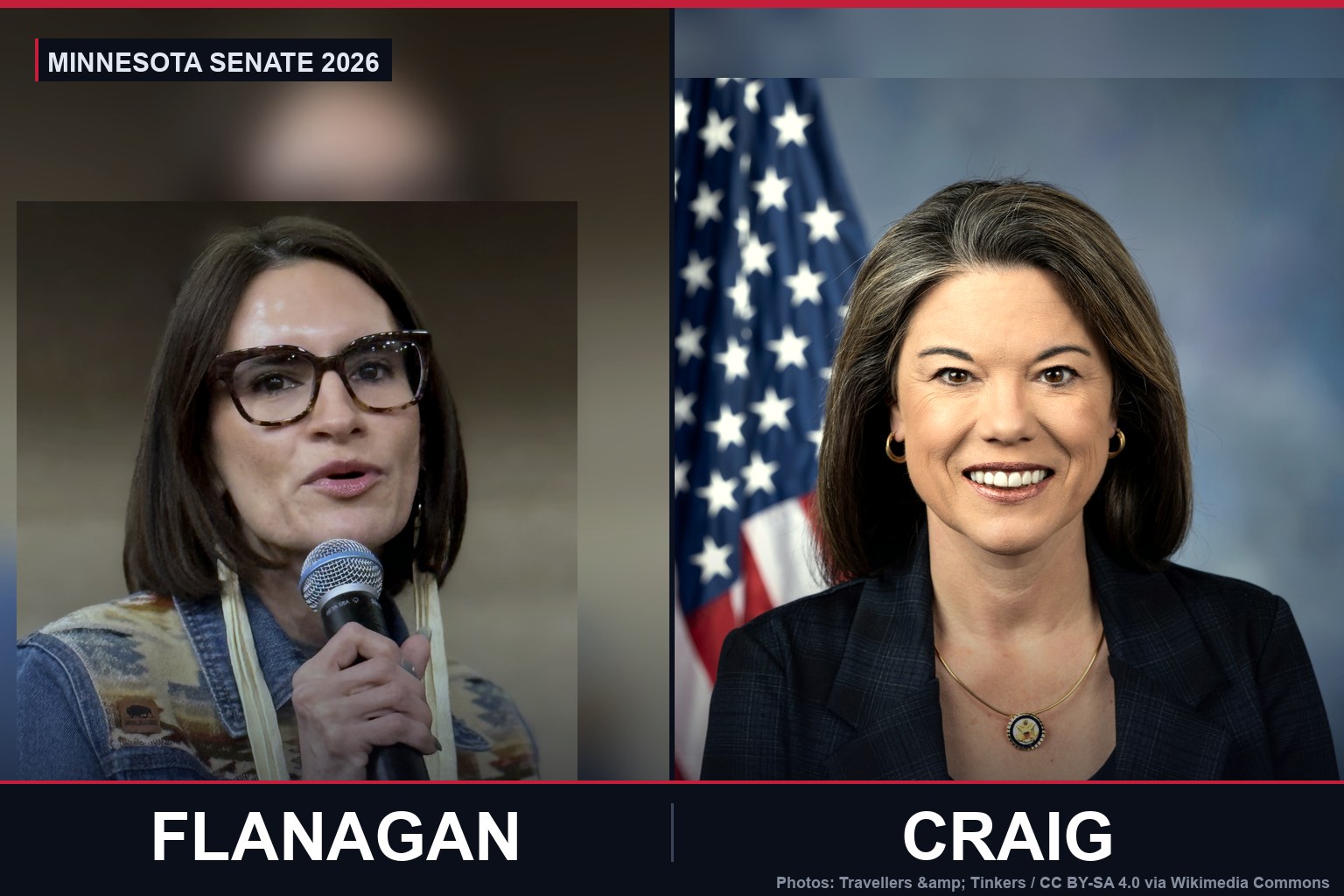
Lt. Gov. Peggy Flanagan is a citizen of the White Earth Nation and currently the highest-ranking Native American official in Minnesota state government. If she wins the Senate seat in November, she would become the first Native American woman ever elected to the U.S. Senate — a milestone that has energized Native communities and progressive organizations across the country. Flanagan served as lieutenant governor alongside Gov. Tim Walz, who ran on the 2024 Democratic presidential ticket as vice-presidential nominee. When the Harris-Walz ticket fell short, the Senate race opened as an alternative avenue for Flanagan's political ambitions.
Flanagan secured the DFL party endorsement at the June 2026 convention in Rochester, where she won on the strength of a unified progressive coalition that included retiring Sen. Smith herself, along with national endorsers including Sens. Bernie Sanders and Elizabeth Warren, and a majority of DFL state legislators. Her campaign has accepted no corporate PAC money and positioned her as the grassroots choice of the party's activist base.
Rep. Angie Craig represents Minnesota's 2nd Congressional District in the southern Twin Cities suburbs and has won five competitive general elections in a swing seat, regularly outpacing the Democratic presidential margin in her district by double digits. Craig skipped the DFL endorsement process entirely and went directly to primary voters. If elected, she would be the first openly LGBTQ+ person to represent Minnesota in the U.S. Senate. Her central argument is electability: as a five-term congresswoman who has won repeatedly in a competitive suburban district, Craig contends she is better positioned to hold the seat in November than a more progressive nominee.
The primary has become extraordinarily expensive. Through June 30, 2026, Craig's campaign had raised approximately $11.9 million compared to Flanagan's $6 million, according to Federal Election Commission records. Beyond the candidate committees, the Super PAC "North Star Dawn" — backed by cryptocurrency interests and a technology billionaire with data center investments — spent more than $18 million on advertising supporting Craig and opposing Flanagan, according to the Minnesota Reformer. The Democratic Lieutenant Governors Association spent roughly $2 million backing Flanagan in response.
Polling has been genuinely contested. The only independent nonpartisan survey released in the closing weeks of the campaign was by KSTP/SurveyUSA, which found the candidates statistically tied in mid-July at 40 percent each, according to KSTP News. A July 28 Public Policy Polling survey — commissioned by Flanagan-aligned groups — showed Flanagan ahead 46 to 32 percent, a 14-point advantage, citing Craig's vulnerability on her voting record including her support for the Laken Riley Act. The Minnesota Reformer, reviewing the full polling landscape as of July 31, described the overall picture as a toss-up in the independent data, with each side's internal surveys unsurprisingly favoring their own candidate.
The ideological contrast is sharpened by Craig's voting record. Flanagan's campaign has hammered Craig as the only Minnesota Democrat to vote for the Laken Riley Act and as a representative who has publicly cited alignment with Republican House Whip Tom Emmer as a point of pride. Craig frames the same record as pragmatic centrism — and argues that winning in November requires a candidate who can carry independents and suburban moderates who might balk at a more progressive nominee.
Republican Primary: Endorsement vs. Electability
The Republican contest reflects a parallel tension between activist-base purity and general-election calculation.
Adam Schwarze, born in St. Paul and raised in Bloomington after being adopted at six months old, is a former Marine and Navy SEAL who served nine deployments across 70 countries. He entered politics after being arrested in Hawaii for an alleged COVID quarantine violation in 2020 — charges that were ultimately dismissed and expunged — an episode he credits with spurring him toward electoral action. At the Minnesota GOP state convention in Duluth on May 30, Schwarze won the party's endorsement after six rounds of balloting, capturing nearly 63 percent of delegate votes, according to the Minnesota Star Tribune. He pitched himself to delegates as an uncompromising conservative tightly aligned with President Trump, and was joined on the convention floor by the father of Defense Secretary Pete Hegseth.
Michele Tafoya, a four-time Emmy Award-winning former NBC Sunday Night Football sideline reporter who became a conservative political commentator, entered the race with the endorsement of National Republican Senatorial Committee Chairman Sen. Tim Scott — who backed her immediately upon her January 2026 announcement. Tafoya declined to honor the party endorsement after losing to Schwarze in Duluth and announced she would continue to the August 11 primary regardless. Her pitch rests on the argument Cook Political and most forecasters implicitly support: in a state Republicans have not won statewide since 2002, electability matters. She brings significantly higher name recognition with the broader Republican electorate and has also been endorsed by Pro Football Hall of Fame coach Tony Dungy, her former NBC colleague, according to Fox News.
KSTP's SurveyUSA polling found Schwarze running in third place among Republican primary voters — behind Tafoya and at points behind Royce White as well — despite holding the party endorsement, according to KSTP News. Royce White, the former NBA player who ran against Sen. Amy Klobuchar in 2024, is also on the Republican ballot but has not polled competitively in the closing weeks.
Minnesota has not elected a Republican U.S. Senator since November 2002, when Norm Coleman won by 2.2 points in an election held 11 days after the death of incumbent Sen. Paul Wellstone in a plane crash. Democrats replaced Wellstone on the ballot with former Vice President Walter Mondale, but Coleman prevailed. The two-decade Republican drought reflects a state that has steadily sorted toward Democrats in federal elections — Harris won by 5.1 points in 2024 — even as the Iron Range has continued drifting rightward. (St. Louis County shifted from a Clinton +17 margin in 2016 to a Trump +3 margin in 2024 based on presidential returns.)
General Election Outlook
Both Cook Political Report and Sabato's Crystal Ball at the University of Virginia Center for Politics rate the Minnesota Senate race as Lean Democratic. Cook moved the race from Likely Democratic when Smith announced her retirement, citing the open-seat dynamics and the potential for a more progressive Democratic nominee to face general-election headwinds in a 5-point Biden/Harris state.
A Mason-Dixon poll conducted for a consortium of Minnesota news organizations in June 2026 found a generic Democrat leading a generic Republican by 8 points — 49 to 41 percent — according to the Minnesota Reformer. In named matchups, both Craig and Flanagan led Tafoya by approximately seven points, including in Craig's own campaign polling.
Republicans' best-case scenario runs through a combination of: Tafoya winning the GOP primary (giving the party its most general-election-viable nominee), Flanagan winning the DFL primary (Republican operatives have stated publicly they prefer to face Flanagan, citing her progressive positioning and association with the Walz administration's welfare fraud scandal), and a national environment less favorable to Democrats than current polling suggests.
Craig's electability argument is aimed precisely at preempting that scenario. Her central ask of DFL primary voters is to look past ideology and toward November: that a Flanagan nomination hands Republicans their preferred general-election matchup and risks a seat Democrats cannot afford to lose. Flanagan's counter is that Minnesota Democrats don't need to trim their sails — that running a progressive, historic candidate in a D+8 environment is not a liability but an asset, and that compromising on values in a primary guarantees nothing in November.
What Happens on August 11
Minnesota's primary is a closed partisan process: voters pick a party column — DFL or Republican — and vote only within it, according to the Minnesota Reformer. The candidate with the most votes in each column advances to the November 3 general election.
For Senate majority watchers, the primary results will clarify the actual November matchup. Tafoya vs. Craig or Tafoya vs. Flanagan are meaningfully different general-election races. A Schwarze win, while possible given historical patterns around party endorsements, would likely make the seat safer for Democrats. The August 11 results set the board for the final three months.
Key Dates
- August 11, 2026: Democratic and Republican primaries
- November 3, 2026: General election
Sources: Ballotpedia (ballotpedia.org); Minnesota Star Tribune (startribune.com); Minnesota Reformer (minnesotareformer.com); KARE11 News (kare11.com); KSTP News (kstp.com); Sabato's Crystal Ball, University of Virginia Center for Politics (centerforpolitics.org); Cook Political Report (cookpolitical.com); Native News Online (nativenewsonline.net); MinnPost (minnpost.com); St. Cloud Times / States Newsroom (sctimes.com); Federal Election Commission (fec.gov).