

Minnesota Senate 2026 Race Guide: Peggy Flanagan, Michele Tafoya, and the Open Seat Republicans Are Betting On
Minnesota's open Senate seat pits Lt. Gov. Peggy Flanagan against Michele Tafoya. Flanagan leads every poll, but a government fraud scandal could close the gap.
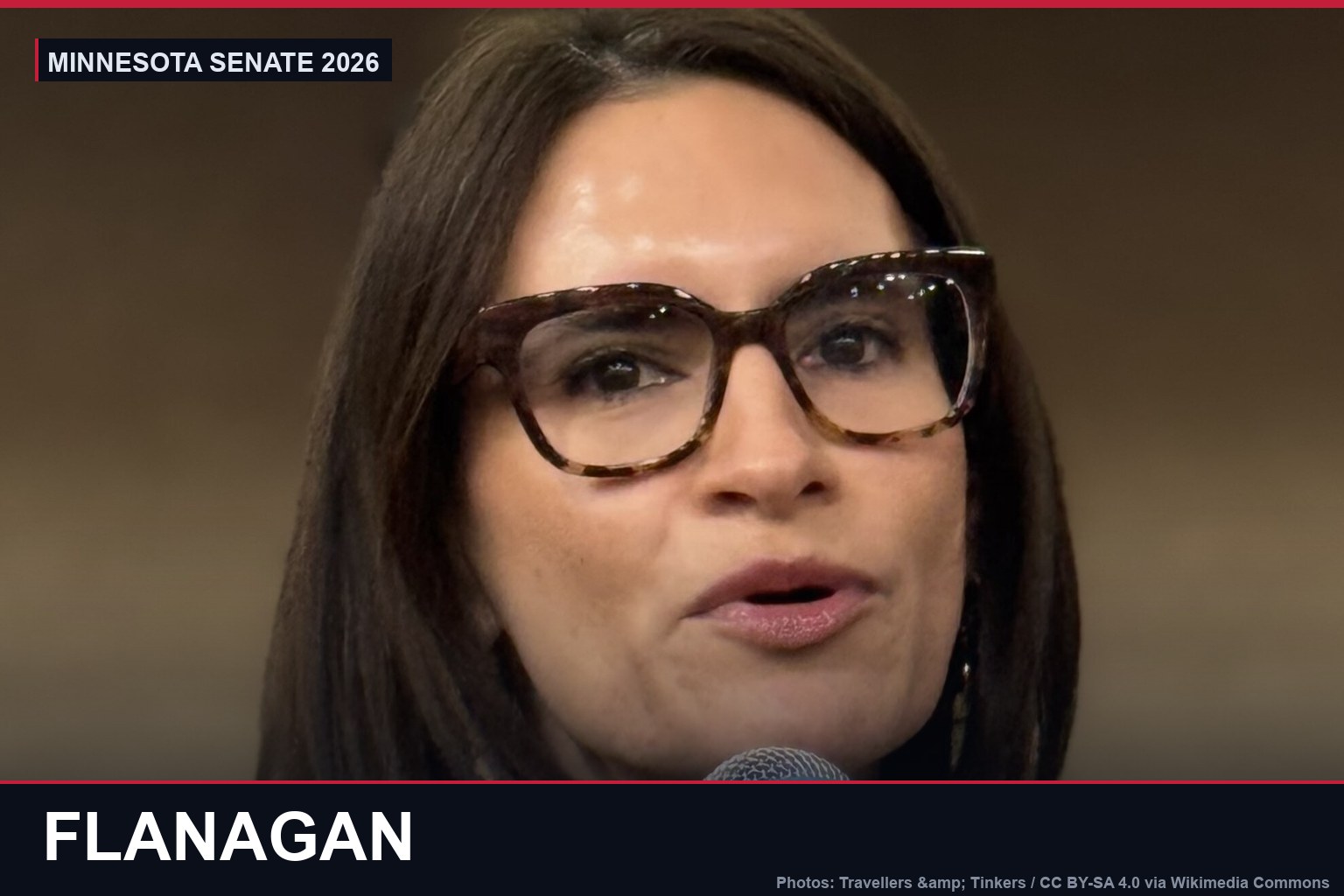
When Tina Smith announced she would not seek re-election, she set off the most consequential Senate primary Minnesota had seen in years — and handed national Republicans a rare opening in a state they have not won statewide at the Senate level since 2002.
The result of August 11's primary contests: Lt. Gov. Peggy Flanagan (D) against Michele Tafoya (R), a former NFL sideline reporter turned political commentator. Flanagan could become the first Native American woman ever elected to the United States Senate. Tafoya could end a 24-year Democratic winning streak for Minnesota's junior Senate seat.
Everything about this race is unusual. The Democrat with the historic profile enters the general with a cash disadvantage and a government fraud scandal following her. The Republican is a television celebrity who beat the state party's endorsed candidate by 28 points, supports abortion access up to 12 weeks, and carries no formal Trump endorsement into a state where he lost by 4.2 points in 2024.
The general election runs to November 3. Flanagan leads in every public poll. Tafoya is competitive in all of them.
The Open Seat and Why It Matters Nationally
Minnesota's Class 2 Senate seat has been in Democratic hands since 2009, when Al Franken completed his recount victory over Republican Norm Coleman after one of the closest Senate races in modern history. Smith was appointed to the seat in 2018 after Franken's resignation and won re-election in 2020. Her retirement creates the first truly open general-election contest for the seat since Coleman's 2002 win.
Nationally, the stakes are clear. Republicans hold the Senate majority heading into November. Democrats need to defend their existing seats while flipping GOP-held ones in Alaska, Iowa, Ohio, and Texas. A Flanagan loss in Minnesota would force Democrats to replace a defensive hold with an offensive flip they do not currently have the numbers to absorb. As Cook Political Report's analysis put it, losing Minnesota means Democrats need to win in two or more states Trump carried by double digits — a significantly harder path.
Peggy Flanagan: Grassroots, History, and a Fraud Shadow
Flanagan, 46, is a member of the White Earth Band of Ojibwe and Minnesota's first Indigenous lieutenant governor, having served alongside former Gov. Tim Walz. Her victory on primary night was a study in what grassroots organization can accomplish against a cash-heavy opponent.
Going into August 11, Flanagan had approximately $1.1 million in her campaign account. Rep. Angie Craig, her primary opponent, had $3.6 million — and outside groups had poured more than $11.9 million in television and digital advertising behind Craig through the North Star Dawn super PAC, per the Minnesota Reformer's reporting on the primary. Flanagan's main outside support came from the Democratic Lieutenant Governors Association, which spent about $2 million.
Flanagan won anyway, 59.0% to Craig's 39.4%, per MPR News's final certified results. Her margins in Ramsey County (St. Paul), the Iron Range, and greater northern Minnesota — including the counties surrounding tribal lands — provided the cushion that raw spending could not overcome. "For months now, I've been telling you this campaign was about the many versus the money," Flanagan told supporters on election night. "Guess what: The many just won."
Craig conceded within hours and endorsed Flanagan, framing the general matchup by calling Tafoya "MAGA-Michele" — a preview of the DFL's intended general-election contrast.
The challenge Flanagan inherits is not the primary wound. It is the fraud shadow.
During the Walz-Flanagan administration, approximately $250 million in federal COVID-era nutrition program funds were stolen through fraudulent vendors in what became one of the largest social services fraud cases in Minnesota history. The scandal drew federal investigations and dominated the final phase of Walz's tenure before his exit from the governor's race.
An internal poll conducted by Impact Research for Craig's campaign, surveying 808 likely Minnesota general-election voters from May 26–28, found that Flanagan led Tafoya 51–44% on a clean ballot. After respondents heard a message tying Flanagan directly to the scandal — saying she ignored whistleblowers and failed to hold fraudsters accountable — the race shifted to a 47–47 tie, per the Minnesota Reformer's reporting on the polling memo. Among independent voters specifically, Flanagan's 7-point lead flipped to Tafoya +3 under the fraud message — a 10-point swing in the group most likely to decide the race.
Tafoya has made government accountability the organizing principle of her campaign. Flanagan's campaign has pushed back, calling the framing misleading. But notably, Walz — whose approval rating collapsed amid the scandal's intensification — has not endorsed Flanagan's Senate bid.
Michele Tafoya: The Celebrity Nominee With a Moderate Pitch
Tafoya, 57, spent three decades as one of American sports broadcasting's most recognizable faces, most prominently as NBC's sideline reporter for Sunday Night Football. She is a four-time Emmy Award winner who retired from broadcasting in 2022 and entered politics via a conservative-leaning podcast and commentary circuit.
She entered the Republican primary without the state party's endorsement — that went to Adam Schwarze, a former Navy SEAL who secured the nod at the GOP state convention in Duluth in May. What Tafoya had instead was celebrity name recognition, the backing of the National Republican Senatorial Committee's chair, and money. According to Federal Election Commission filings through June 30, 2026, Tafoya raised $4.67 million for the primary cycle with $2.08 million in cash on hand at that reporting date. Her most recent fundraising quarter alone topped $2.6 million, per Sahan Journal's primary night reporting.
She defeated Schwarze by 28 points on August 11 — 52.1% to 24% — with former basketball player Royce White taking 11%, according to primary night results reported by MPR News and the Sahan Journal. It was the largest margin of victory in a competitive Minnesota Republican Senate primary in the modern era.
The Star Tribune reported after the primary that national Republican donors are now more willing to invest in the race with Tafoya as the nominee, given the match-up dynamics with Flanagan. Republican party strategists view Minnesota as one of several states where they can potentially expand the Senate majority — unusual language for a state that has trended Democratic for a generation.
Tafoya's pitch to Minnesota voters is built around three pillars: government accountability on fraud, immigration enforcement, and a moderate-sounding abortion position that strips Democrats of their usual attack line. She has described herself publicly as "pro-choice" and said she supports access to abortion up to 12 weeks' gestation — a stance well to the left of most Republican Senate nominees nationally and one designed to prevent Flanagan from making reproductive rights the dominant general-election frame.
She has no Trump endorsement. In a state where Trump lost by 4.2 points in 2024, that is, at minimum, not a liability.
Tony Dungy, the Pro Football Hall of Fame coach and former broadcasting colleague, has endorsed Tafoya. Outside that, her coalition is built more around national conservative donors than party infrastructure — a resource advantage she intends to press through November.
The Polling Picture
Four post-primary or late-primary general-election surveys frame the competitive range:
- KSTP/SurveyUSA (Aug. 13–17, 661 LV, ±4.3%): Flanagan 46%, Tafoya 41%
- Deep Root Analytics for Republicans (Aug. 17–18, 597 RV, ±4.0%): Flanagan 50%, Tafoya 45%
- Impact Research for Craig campaign (May 26–28, 808 LV, ±3.5%): Flanagan 51%, Tafoya 44%
- Emerson College (Feb. 6–8, 1,000 LV, ±3.0%): Flanagan 47%, Tafoya 41%
The range across named-candidate polling: Flanagan leads by 5 to 7 points in a clean ballot environment. A Mason-Dixon survey commissioned by KARE-TV, the Star Tribune, and the University of Minnesota found Democrats leading Republicans on the generic Senate ballot 49–41% in June — and named-candidate surveys tracked closely to that generic number, per Newsweek's reporting.
Hamline University political scientist David Schultz told Newsweek the structural picture favors Flanagan: "Reaction to Metro Surge, anti-Trump sentiment, and the fact that approximately 55 to 56 percent of Minnesota voters are in the Twin Cities metropolitan area all point toward a Democratic advantage." He added that Tafoya "could nevertheless be a competitive candidate."
The fraud-messaging finding from the Craig campaign's internal survey is the number that hangs over every other poll in the race. Flanagan's 6-to-7-point lead evaporates in survey conditions that closely simulate what a Republican general-election campaign against her would actually run. That is not a polling artifact — it is the campaign's operating reality.
What the Forecasters Say
Every major election forecaster rates Minnesota as at least Lean Democratic:
- Cook Political Report: Likely D
- Sabato's Crystal Ball: Likely D
- Inside Elections: Likely D
- Silver Bulletin: Likely D (as of Aug. 11)
- FiftyPlusOne: Likely D (as of Aug. 18)
- RealClearPolitics: Lean D (as of Aug. 14)
- The Economist: Lean D (as of Aug. 14)
The shift from Likely to Lean at RCP and The Economist reflects the fraud vulnerability, Tafoya's financial profile, and the race's demonstrated sensitivity to negative messaging. No outlet has moved the race to Toss-Up — but the motion is toward Tafoya, not away from her.
Senate Control: The Bigger Picture
Minnesota is not where Republicans expect to win the Senate majority — they are playing offense in several other states. But it is among the few Democratic-held seats where the structural conditions give the opposition a plausible path.
The Senate control market currently reflects just how evenly matched the broader landscape is.
A Tafoya win in Minnesota, combined with Republican holds elsewhere, would give the GOP a more comfortable majority. A Flanagan win, combined with Democratic flips in competitive Republican-held states, keeps the path to a Democratic majority open. Minnesota is the foundation, not the ceiling, of Democratic Senate math this cycle.
Key Factors Through November
Immigration: Federal immigration enforcement became a flash point in Minneapolis in January 2026, when two American citizens were fatally shot by federal officers during protests. The incidents fueled sustained anti-enforcement sentiment in the Twin Cities metro — the vote-rich region that determines statewide outcomes. Flanagan will press Tafoya on her alignment with Trump's enforcement approach; Tafoya will counter with border-security framing.
Abortion: Tafoya's self-described pro-choice-to-12-weeks positioning is designed to neutralize Flanagan's most reliable attack. Whether Minnesota's general-election voters — who lean pro-choice and are accustomed to statewide candidates who reflect that — accept Tafoya's framing or view it as insufficient will shape the race's final weeks.
DFL party unity: Craig conceded immediately and endorsed Flanagan. The Craig fundraising network — which had raised $12.7 million for the primary cycle through July 22, per Roll Call's pre-primary reporting on FEC data — needs to convert to Flanagan general-election support. That pivot is underway. The question is velocity and whether Flanagan can translate her small-donor primary coalition into a general-election war chest competitive with Tafoya's resource base.
The Walz silence: The former governor has not endorsed Flanagan. His absence from her coalition is a liability that Tafoya will maintain as a campaign theme — and a variable Democrats cannot fully control.
The Bottom Line
Flanagan leads. She leads in every public poll, in every forecaster's model, and in the structural math of a state Kamala Harris carried by 4.2 points just two years ago. She is the clear favorite.
But the race's operating reality is that a well-constructed negative campaign on government accountability can close a 6-to-7-point gap to zero in survey conditions that closely mirror what November will actually look like. Tafoya has the name recognition to make those messages land, the fundraising to run them at scale, and a personal profile — moderate on abortion, no Trump anchor — that limits Flanagan's standard playbook.
The fraud variable, Walz's silence, and Tafoya's crossover potential make this a race where the margin matters more than the direction. Minnesota tilts Democratic. Whether it tilts enough runs to November 3.
Sources
- MPR News — "Flanagan wins DFL duel in Senate race, Tafoya claims GOP nod for open seat" (Aug. 12, 2026) — mprnews.org
- Star Tribune — "Republicans like their chances with Tafoya facing Flanagan for Senate" (Aug. 15, 2026) — startribune.com
- Roll Call — "What to know about the Minnesota Senate election" (Aug. 7, 2026) — rollcall.com
- Minnesota Reformer — "In tight Senate race, Peggy Flanagan can't escape the f-word" (July 28–Aug. 12, 2026) — minnesotareformer.com
- Newsweek — "Flanagan's Chances of Losing to Michele Tafoya in Minnesota Senate Race" (Aug. 12, 2026) — newsweek.com
- Federal Election Commission — Campaign finance filings, Minnesota Senate candidates, 2025–2026 cycle — fec.gov
- NBC News — "Minnesota Senate Primary Election 2026 Live Results" — nbcnews.com
- Cook Political Report — "Trajectory of Minnesota Senate Race In Flux" (Aug. 7, 2026) — cookpolitical.com
- Sahan Journal — "Live election results: Peggy Flanagan, Michele Tafoya win Senate primaries" (Aug. 12, 2026) — sahanjournal.com
- Smart Politics / University of Minnesota — "A Short Dive into Minnesota's US Senate Primary" (Aug. 18, 2026) — smartpolitics.lib.umn.edu