

Montana Senate 2026 Race Guide: Kurt Alme, Alani Bankhead, Seth Bodnar, and the Three-Way Spoiler Math That Could Decide a Senate Seat
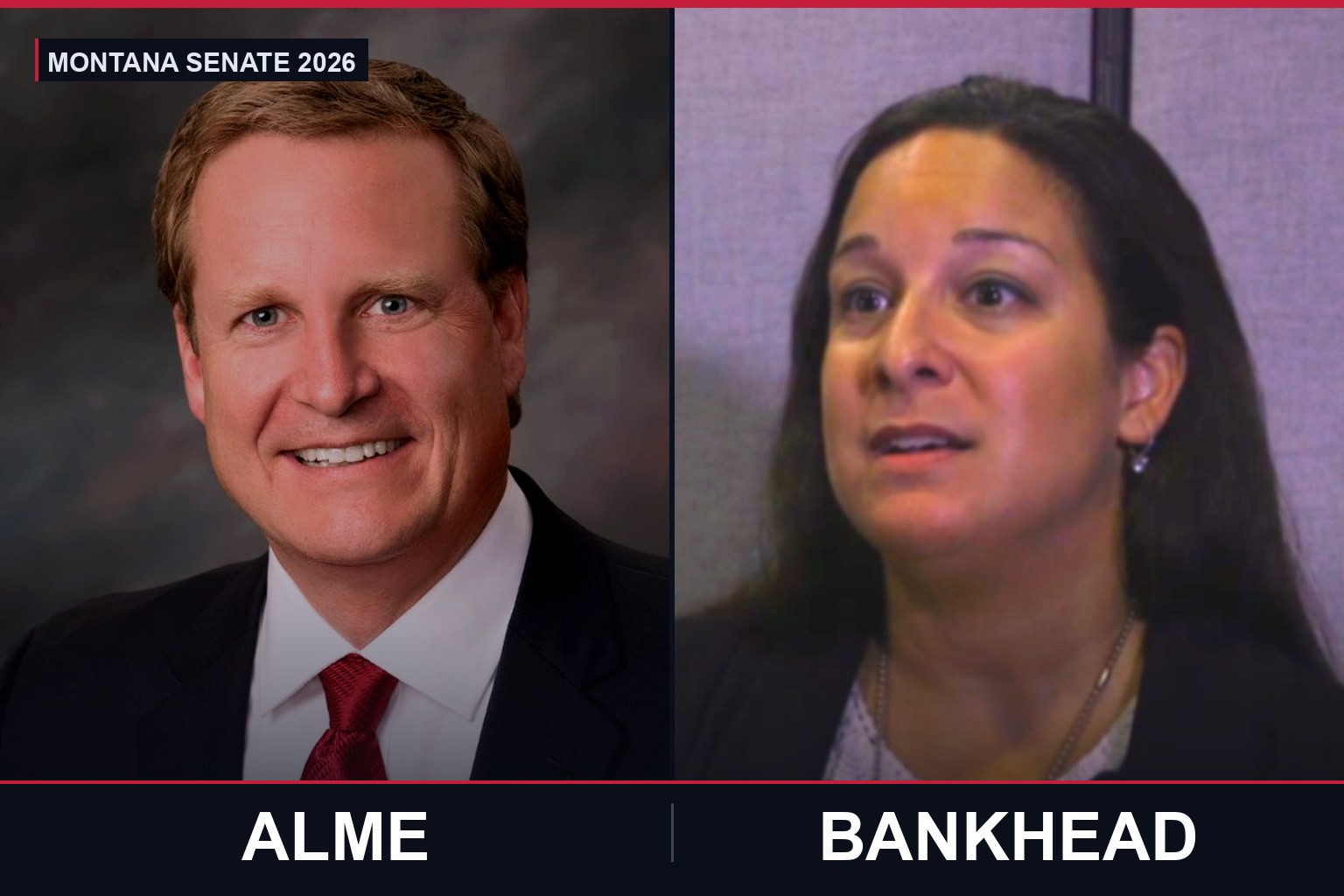
Montana Senate 2026: Alme (R) vs. Bankhead (D) vs. Bodnar (I) compete for Steve Daines's open seat in a three-way race that could determine Senate control.
The market for Senate control sits at a coin flip — 51% Democratic, 50% Republican — and Montana is one of the seats where voters will explain why.
Not because any forecaster rates it competitive. Cook Political Report calls it Solid R. Inside Elections says Solid R. Sabato's Crystal Ball says Safe R. On paper, Montana's open Senate seat looks like one of the safest Republican holds in the country.
But this race isn't on paper. It's a three-way collision between a Trump-endorsed prosecutor who was installed in a last-minute switcheroo, a Democratic primary winner the party is begging to quit, and a former Green Beret running as an independent who might actually be able to win — if the math ever breaks his way.
The Seat: Steve Daines and the Filing-Deadline Switcheroo
Montana's Class II Senate seat has been held by Republican Steve Daines since 2015. Daines had already filed for re-election when, on March 4, 2026, the final day of candidate filing, something extraordinary happened.
At 4:52 p.m. — eight minutes before the deadline — former U.S. Attorney Kurt Alme filed paperwork to run. Three minutes later, at 4:55 p.m., Daines withdrew. At 5:02 p.m., Daines announced his retirement and endorsed Alme. Within the hour, President Trump and Governor Greg Gianforte had also endorsed Alme.
The switcheroo was designed to prevent Democrats from recruiting a top-tier candidate to run against an untested Republican nominee. It drew criticism from both parties. The Montana Republican Party notably declined to endorse Alme in the primary, saying it "supports a competitive primary process to let voters pick their preferred candidates."
Alme won the June 2 primary with 76.1% of the vote against two minor opponents, but the maneuver left an asterisk on his nomination that his opponents have not let voters forget.
This is Montana's first open Senate election since 1976.
The Republican: Kurt Alme
Kurt Alme, 59, was born in Great Falls, Montana, and grew up across the state — Dillon, Victor, Helena, and Miles City — as his parents followed teaching careers. He earned a bachelor's degree in business from the University of Colorado (summa cum laude, Truman Scholar) and a law degree from Harvard Law School (cum laude).
Alme's career has been a mix of law and government. After clerking for a federal judge in Helena, he practiced law at the Crowley Fleck firm in Billings, then served as an Assistant U.S. Attorney prosecuting white-collar crime. He later became Montana's Director of Revenue under Governor Judy Martz, where he oversaw the state's largest income tax rate cut, and Budget Director under Governor Gianforte.
President Trump nominated Alme as U.S. Attorney for the District of Montana twice — once in 2017 and again in 2025. During his tenure, criminal prosecutions reached a 20-year high. He resigned on March 4, 2026, to run for the Senate.
Alme has never run for elected office. His campaign emphasizes law-and-order credentials, tax cuts, and Montana roots. He holds endorsements from Trump, Daines, Gianforte, Senator Tim Sheehy, the NRA, Americans for Prosperity, Club for Growth, and the Susan B. Anthony Pro-Life America fund.
As of June 30, Alme had raised $1.98 million and had $1.45 million cash on hand, according to FEC filings.
The Democrat: Alani Bankhead
Alani Bankhead, a retired Air Force officer with 21 years of service in counterintelligence, special operations, and security assignments, won the Democratic primary on June 2 with 43.6% of the vote in a five-candidate field, defeating former state representative Reilly Neill (33%) and tribal historic preservation officer Michael Black Wolf (13.1%).
Bankhead's primary win came despite — or perhaps because of — an unusual interference campaign. Progressive Vet PAC, nominally supporting Bankhead, was later revealed to have spent its money with the apparent goal of boosting her over Neill to set up a general-election scenario more favorable to independent candidate Seth Bodnar. Meanwhile, the Republican-aligned More Jobs, Less Government PAC — the same group that spent to elect Tim Sheehy in 2024 — ran ads that it officially described as supporting Bankhead, in what opponents called a transparent effort to keep the Democratic nominee in the race and split the anti-Alme vote.
Bankhead's fundraising has been a fraction of her opponents'. Through June 30, she had raised $58,829 total with just $21,484 cash on hand. The Democratic Senatorial Campaign Committee publicly dismissed her candidacy, with a top executive stating that "the DSCC partners with viable campaigns who have a path to victory, which Ms. Bankhead does not."
Despite pressure from 17 Democratic state legislators, former Democratic matriarch Carol Williams, VoteVets, and virtually every major progressive organization in the state, Bankhead let the August 11 withdrawal deadline pass without stepping aside.
"If money mattered, Tester would have won because he raised more money than Sheehy," Bankhead told reporters, referring to Jon Tester's well-funded but ultimately unsuccessful 2024 Senate campaign.
Montana Secretary of State Christi Jacobsen, a Republican, confirmed that even if Bankhead had withdrawn, she would have had to be replaced by another Democrat — the party could not simply concede the ballot line.
The Republican-aligned Senate Leadership Fund thanked Bankhead for her decision: "Alani Bankhead displayed profound courage in the face of relentless harassment by Chuck Schumer's thugs and allies."
The Independent: Seth Bodnar
Seth Bodnar, 47, may be the most formidable independent Senate candidate in recent Montana history.
A West Point graduate (Class of 2001) and Rhodes Scholar at Oxford, Bodnar served a decade of active duty in the U.S. Army, including deployments to Iraq with the 101st Airborne Division and overseas service as a Green Beret commanding a Special Forces detachment in the 1st Special Forces Group. After the military, he built a career in business before becoming the 19th president of the University of Montana, a post he held from 2018 until his resignation in January 2026.
Bodnar entered the race on March 4, 2026 — the same day Daines withdrew and Alme filed — with the backing of former Senator Jon Tester. In a leaked text message, Tester had referred to the Democratic Party brand as "poison" in Montana and advocated for an independent candidacy as the best path to defeating Alme.
The independent has assembled a cross-partisan coalition that would be the envy of most major-party nominees. His endorsements include former Democratic Senators Jon Tester and Max Baucus, former independent Senator Joe Manchin, former Republican Governor Marc Racicot, VoteVets, the League of Conservation Voters, Montana AFL-CIO, End Citizens United, Forward Montana, and Montanans for Public Lands.
Bodnar collected nearly 30,000 petition signatures across 52 of Montana's 56 counties to qualify for the ballot — more than double the 13,327 required.
His fundraising reflects the enthusiasm. Through June 30, Bodnar had raised $3.24 million — more than Alme and Bankhead combined — with $977,779 cash on hand. A network of super PACs, including Progressive Vet PAC, Montana Freedom PAC, and Montanans for Public Lands, has spent an additional $6 million boosting his candidacy, according to Inside Elections.
On issues, Bodnar runs on a platform of protecting public lands (roughly one-third of Montana's territory is public land), defending Medicaid expansion, supporting abortion rights, and reforming a political system he says has "stopped working for all Montanans."
The Math: Why This Race Is Three Races in One
The central paradox of the Montana Senate race is visible in every poll: the anti-Alme majority exists, but it may never coalesce.
Consider the July polling from GQR, a Democratic firm:
- Four-way race (actual ballot): Alme 41%, Bodnar 27%, Bankhead 22%, Austin (L) 6%. Alme wins by 14 points.
- Alme vs. Bodnar head-to-head: Bodnar 50%, Alme 44%. Bodnar wins by 6.
- Alme vs. Bankhead head-to-head: Alme 52%, Bankhead 44%. Alme wins by 8.
Election analyst G. Elliott Morris, writing in his Substack "Strength in Numbers," put the probabilities starkly: on the current ballot, Alme has roughly a 97% chance of winning. Remove Bankhead and keep only Bodnar, and Alme's win probability drops to 20%.
The Bullfinch Group, a Republican firm, found a similar dynamic in July: Alme led the three-way field at 36%, with Bankhead at 22% and Bodnar at 24% — but 18% remained undecided. Both partisan and independent pollsters agree that Bodnar outperforms Bankhead one-on-one against Alme in every tested configuration.
With the August 11 withdrawal deadline now past and Bankhead confirmed on the ballot, the three-way math is locked in through November 3.
The Context: Montana's Political Shift
Montana was once friendly to ticket-splitting Democrats. Jon Tester won three Senate terms (2006, 2012, 2018), and Democrats Steve Bullock and Brian Schweitzer each served two terms as governor, giving the party a 16-year hold on the governor's mansion from 2005 to 2021.
That era appears over. Republican Greg Gianforte won the governorship in 2020. Tester lost to Tim Sheehy by over 7 points in 2024 despite raising more money — a margin that was still far better than Kamala Harris's 20-point loss in the state. For the first time since 1911, both of Montana's Senate seats are held by Republicans.
Trump carried Montana by over 20 points in 2024. The state legislature is dominated by Republicans, 32-18 in the state Senate and similarly lopsided in the House. The PVI sits at R+11.
And yet: Tester still carried six counties that Trump won simultaneously. Montana voters have a demonstrated capacity for split-ticket behavior — it just hasn't been enough recently to overcome the state's rightward drift.
What to Watch
Can Bodnar consolidate? With Bankhead on the ballot, Bodnar needs to persuade voters who would otherwise pick a Democrat that he — not the party's actual nominee — is the serious alternative. His endorsements and fundraising say he can. The polling says he needs Bankhead's voters to cross the partisan bridge.
How much does Trump's popularity matter? Alme's candidacy is built on the Trump brand. NPR noted that Alme's "lack of name recognition and President Trump's plunging poll numbers" are factors Bodnar is counting on. If Trump's approval continues to sink in Montana, the generic Republican advantage narrows.
The dark-money chess match. Both sides are playing proxy wars. Democratic-aligned dark money is funding Bodnar's independent bid through a web of super PACs and 501(c)(4)s. Republican-aligned groups are, counterintuitively, running ads supporting Bankhead — the weaker Democrat — to ensure the anti-Alme vote stays split.
November 3 turnout patterns. Montana has no early voting by mail for all (absentee voting requires an excuse or applying). Turnout dynamics in a midterm year could benefit Bodnar if independent and moderate voters show up — or they could benefit Alme if the electorate skews toward reliable partisan voters.
The Bottom Line
Every major forecaster has Montana rated as safe for Republicans, and on the current ballot, that's the right call. Kurt Alme is running in a state where Trump won by 20 points, with the full weight of the Republican establishment behind him, against two opponents who are splitting the opposition vote.
But this race is a reminder that forecaster ratings describe the most likely outcome, not the only possible one. Montana has an anti-Alme majority. It has a candidate — Bodnar — with the biography, the money, and the endorsements to consolidate it. What it doesn't have, as of August 11, is a consolidated ballot.
The withdrawal deadline has passed. Alani Bankhead will be on the November 3 ballot. The math is set. Whether that math changes the final answer depends on whether enough Montana voters can solve a coordination problem that the candidates themselves could not.
Sources: FEC campaign finance filings (fec.gov); NBC News Montana Senate primary results; New York Times Montana Senate polling tracker; NPR, "Montana's Democratic candidate is facing pressure to drop out by the deadline" (Aug. 9, 2026); Daily Montanan, "Independent Bodnar again leads all candidates in latest fundraising reports" (July 16, 2026); Flathead Beacon, "Behind the Push to Clear the Field in Montana's Senate Race" (Aug. 5, 2026); Military.com, "Veteran Candidates in Montana's US Senate Race Clash as Major Deadline Nears" (Aug. 7, 2026); VoteVets endorsement announcement (July 24, 2026); Ballotpedia, Montana Senate 2026; Club for Growth endorsement (Aug. 6, 2026); CBS/TNND, "Montana Democrat's US Senate candidacy may boost GOP opponent's odds" (Aug. 12, 2026); G. Elliott Morris, Strength in Numbers, "To defeat Republicans, Democrats may have to sit some races out" (July 28, 2026); Montana Free Press Election Guide 2026; Inside Elections, "Untangling the Democratic Dark Money Web Funding Independent Candidates" (Aug. 7, 2026). Market odds sourced from electionpredictions.us (consensus of Kalshi, Polymarket, and PredictIt).