Nebraska Senate 2026 Race Guide: Pete Ricketts, Dan Osborn, and the Independent Who Could Break 90 Years of History
Pete Ricketts vs. Dan Osborn in Nebraska's 2026 Senate race: every public poll shows a near-tie in a state Trump won by 20 points.
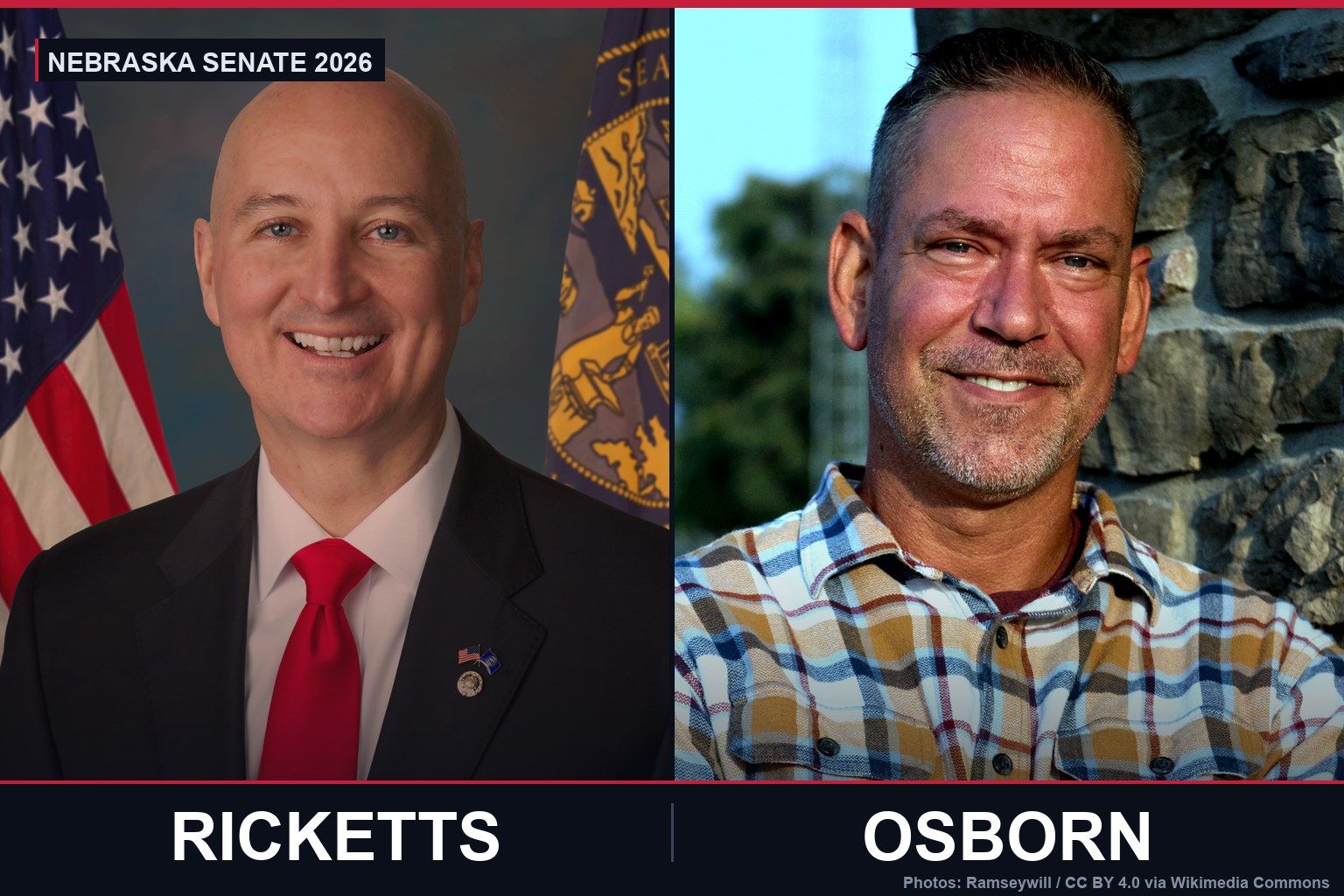
Nebraska is not supposed to be a battleground. The state has not sent a Democrat to the U.S. Senate since Bob Kerrey's departure in 2001. No independent has won a Senate seat there since 1936. Donald Trump carried Nebraska by more than 20 percentage points in both 2020 and 2024, and Republicans have held both Senate seats continuously since 2012.
Yet with fewer than 80 days until November 3, every public poll of Nebraska's 2026 Senate race shows Republican incumbent Pete Ricketts either tied with independent challenger Dan Osborn or trailing him. The forecasters maintain a "Likely Republican" rating—pointing to structural advantages that have never failed Nebraska Republicans in this era. But the unusual nature of this contest makes structural models a less reliable guide than usual.
This is not a Republican-versus-Democrat race. It is a contest between a wealthy Republican incumbent with a net-negative favorability rating and a Navy veteran and former industrial mechanic running as an independent who has, for a second consecutive cycle, cleared the field of Democratic competition. Those two facts together produce a matchup that Nebraska has not seen in living political memory.
The Incumbent: Pete Ricketts
Pete Ricketts, 59, is the son of TD Ameritrade founder Joe Ricketts and a co-owner of the Chicago Cubs. He served two terms as Nebraska governor from 2015 to 2023—during which he built a reputation as a fiscal and social conservative—before being appointed to the U.S. Senate by his successor, Governor Jim Pillen, in January 2023, following the resignation of Republican Sen. Ben Sasse.
Ricketts won a 2024 special election concurrent with the general election, defeating Democrat Preston Love Jr. by 25 points. That margin—stronger than Trump's showing in Nebraska that year—suggested Ricketts had established himself as an incumbent rather than merely a placeholder.
But 2026 presents a different test. Running without a high-profile Democratic opponent, the race has collapsed into a straight choice between Ricketts and Osborn, and the favorability numbers tell a troubling story for the incumbent. A May 2026 survey from Tavern Research found Ricketts at 43% favorable and 50% unfavorable overall—a net of -7—and deeply underwater with the independent voters who decide statewide races in Nebraska, at -37 among that group.
The Ricketts campaign has centered its case on his gubernatorial and Senate record, with particular emphasis on border security and tax cuts. On the attack, it has repeatedly described Osborn as a "fake independent" whose donors include Democratic-aligned PACs and union committees, and characterized payments to Osborn family members who work on the campaign as a "family grift." Ricketts invested $5.2 million of his own money into his campaign during the second quarter of 2026 alone—which Osborn's campaign turned into a political prop, staging a press conference with a giant novelty check made out to "My sweet baby boy Pete Ricketts," a reference to Ricketts's father, Joe.
The Challenger: Dan Osborn
Dan Osborn, 52, grew up in Hoisington, Kansas, served in the U.S. Navy aboard the USS Constellation, and spent two decades as an industrial mechanic and union steward at a Kellogg's plant in Omaha before an extended labor strike in 2021 ended his employment there. He became a public face of the work stoppage—which lasted more than a year—before pivoting to politics.
In 2024, Osborn ran against then-incumbent Republican Sen. Deb Fischer as a registered nonpartisan. Most analysts viewed the race as safely Republican; Fischer had won her 2018 reelection by 27 points. Osborn held her to 53%-47%—a 6-point margin in a state Trump won by more than 20—and nearly flipped Nebraska's 1st Congressional District, which includes Lincoln. He raised $14 million, demonstrating a national fundraising operation that defied the conventional logic of a safe red-state race.
For 2026, Osborn pivoted to the Ricketts seat, framing the contest explicitly in class terms: "the billionaire versus the mechanic." His campaign has sworn off corporate PAC contributions, relying instead on union PACs and small-dollar individual donors—more than 17,000 of whom gave in the third quarter of 2025 alone at an average contribution of roughly $43, per campaign disclosures reported by the Nebraska Examiner. He has also pledged, if elected, not to caucus with either party.
How the Field Cleared
Nebraska Democrats have again organized around Osborn rather than running their own candidate. Cindy Burbank won the May 2026 Democratic primary, but announced she would withdraw from the general election before the filing deadline, explicitly saying Osborn "deserves a fair shot against Ricketts." The move converts what would have been a three-way race—with a Democrat potentially splitting the anti-Ricketts vote—into a de facto two-way contest.
Osborn himself had to navigate a separate hurdle. As an independent, he could not appear on the primary ballot and instead needed to gather enough petition signatures to qualify for the general election. Nebraska law requires signatures from at least one percent of votes cast in the previous gubernatorial election, with a floor of 4,000 valid signatures.
Osborn's campaign announced in late July 2026 that the Nebraska Secretary of State's office had verified 6,096 valid signatures against the 4,000 required, confirming his place on the November ballot, per a report from IVN.us. Republicans had signaled interest in challenging his petitions; the verification resolved that question.
The only remaining ballot candidate is Mike Marvin of the Legal Marijuana NOW party, who raised $27,745 through June 30, 2026, according to Federal Election Commission records—not a meaningful factor in the arithmetic.
The Polls—and the Asterisk
Five public surveys conducted between the spring of 2025 and May 2026 have all shown the race at or near statistical tie:
- Tavern Research (D-aligned), May 8–11, 2026, 1,165 likely voters: Osborn 47%, Ricketts 42%, 12% undecided
- Impact Research (D-aligned), February 2–5, 2026, 600 likely voters: Ricketts 48%, Osborn 47%
- Lake Research Partners (D), December 11–17, 2025, 900 likely voters: Ricketts 48%, Osborn 47%
- Lake Research Partners (D), July 23–29, 2025, 900 likely voters: Osborn 47%, Ricketts 46%
- Change Research (D), March 28–April 1, 2025, 524 likely voters: Ricketts 46%, Osborn 45%
The asterisk: every poll in this race has been sponsored by Osborn's campaign, by Democratic-aligned firms, or by groups supportive of his candidacy. No independent, nonpartisan, or Republican-affiliated pollster has released public numbers. That is a meaningful data gap. Polls commissioned by or on behalf of a candidate's side tend to skew favorable; they are useful evidence but not definitive. The aggregate polling average from Race to the WH through May 11 showed Osborn leading by approximately one point, well within any survey's margin of error.
What the favorable polling does credibly suggest is why the race is close when it is close: the structure of Osborn's coalition. The Tavern Research survey found that among self-identified independent voters, Osborn leads Ricketts 62% to 20%—a 42-point margin. The same poll found Osborn drawing 17% of Trump 2024 voters and 14% of self-identified Republicans. A generic Democrat tested in the same poll against Ricketts ran 14 points weaker with independents than Osborn did. That differential—not partisanship, but the specific cross-partisan coalition an independent can assemble—is the structural core of Osborn's theory of the race.
Ricketts's favorability numbers reinforce the polling picture. Osborn registered net +11 (46% favorable, 36% unfavorable) in the same survey; Ricketts came in at net -7 (43% favorable, 50% unfavorable). A sitting U.S. senator who is underwater with a majority of his own constituents enters the final stretch of a campaign from a disadvantaged position, whatever the registration numbers say.
The Money
Federal Election Commission filings through June 30, 2026, show Ricketts with a significant cash advantage: $11.23 million raised for the cycle versus $5.75 million for Osborn, according to FEC records reported by the Nebraska Examiner. Ricketts held $6.91 million in cash on hand versus Osborn's $2.42 million.
But the story inside those totals complicates the picture. Ricketts raised $6.3 million in the second quarter of 2026—more than triple Osborn's $1.9 million for the same period. However, $5.2 million of that Ricketts Q2 total came from himself. Excluding the self-contribution, Ricketts raised approximately $1.1 million from outside donors in Q2; Osborn raised $1.9 million. Osborn also outraised Ricketts in Q1 2026 by approximately $200,000, per the Nebraska Examiner's reporting on federal filings.
The Ricketts campaign has emphasized Osborn's reliance on out-of-state donors and union PAC contributions—Ricketts campaign officials stated that more than 83% of Osborn's itemized Q2 donations came from outside Nebraska, primarily California—and characterized that fact as evidence that Osborn is a "coastal Democrat" operation dressed up in independent branding. The Osborn campaign counters that Ricketts's largest donors include corporate PACs from Altria, the American Bankers Association, and Union Pacific, representing the establishment interests Osborn is explicitly running against.
A longer-term financial comparison: In his 2024 race against Fischer, Osborn raised $14 million total and came within 6 points of an upset in a presidential-year environment. Whether national Democratic money—which the DSCC declined to deploy in 2024 but may reconsider in a race this tight—flows toward Osborn in the final stretch could materially shift the cash equation.
The Coalition Math
Nebraska's registered voter rolls are heavily lopsided: approximately 620,000 registered Republicans, roughly 280,000 nonpartisans, and a smaller Democratic base, per state voter registration data reviewed by Newsweek. Democrats are not going to win Nebraska by turning out Democrats. Osborn's arithmetic runs entirely through the nonpartisan bloc—where he dominates in polling—and a meaningful slice of registered Republicans.
The structural case for Ricketts holding on is that Nebraska partisanship reasserts itself in the voting booth in ways that registered-voter composition and polling snapshots may not fully capture. Nebraska is not a state where independent candidates have established a track record of outperforming their polling. The organizational infrastructure of the Nebraska Republican Party—voter contact, mail, and late-cycle advertising—has reliably delivered strong margins regardless of the top-of-ticket environment.
The structural case for an Osborn upset is that he has already demonstrated once, in 2024, that those assumptions break down when a non-partisan candidate frames the race as class conflict rather than partisan competition. He ran competitively in rural Nebraska and flipped competitive precincts around Lincoln. Ricketts, a child of generational wealth running his first accountability race as a sitting senator rather than a first-time candidate, presents different contrasts than Fischer did. A net-negative favorability rating among your own electorate—and a -37 among the critical independent bloc—is not a position from which incumbents typically fend off well-funded insurgencies without difficulty.
There is also the question of late money. Republicans outspent Osborn significantly in 2024 without preventing a near-upset; national party infrastructure and outside spending in the final 60 days will matter. Whether those resources are deployed in a race officially rated Likely Republican is itself an open question.
Forecasters and Market Context
Major race forecasters are aligned at Likely Republican: Cook Political Report, Sabato's Crystal Ball at the University of Virginia Center for Politics, Inside Elections, and Decision Desk HQ all place Nebraska in that category as of mid-August. Sabato's Crystal Ball moved the race from Safe Republican to Likely Republican when Osborn entered the race in summer 2025—a recognition that this is a live contest while stopping short of calling it a true toss-up.
The Nebraska Senate race is tracked on electionpredictions.us:
For real-time market pricing on the overall battle for Senate control—which both a Ricketts win and an Osborn win would directly influence—the current market reflects a genuine coin flip at 50% Democratic and 50% Republican, one of the tightest Senate-control readings of the cycle:
The 90-Year Barrier
The last independent to win a U.S. Senate election in Nebraska was George Norris in 1936—a Progressive-era agrarian who ran without a party label for what would prove his final term. Nebraska politics have transformed several times since. The structural argument that independent Senate candidates in deep-red states overperform their polling and underperform on Election Day is well-supported by recent history.
Osborn is running against that history while having already rewritten part of it. His 2024 campaign against Fischer, in an environment that should have produced a 20-point Republican victory, produced a 6-point one. That margin shift—14 points closer than the state's presidential performance—is the empirical foundation on which both his 2026 candidacy and the interest it has attracted are built.
Whether he can close the remaining gap depends on factors the current evidence does not resolve: whether the D-aligned polling record in this race accurately captures the independent coalition or systematically overstates it; whether Burbank's withdrawal holds and Democratic voters consolidate behind a non-Democrat at the high rates polling assumes; whether late Republican investment resets a race that has been consistently close; and whether Osborn's working-class message sustains traction in rural communities that have moved sharply toward the Republican Party.
What is certain is that by any prior framework for Nebraska politics, this race should not be this close. That it is tells you something about how this particular independent, facing this particular incumbent, in this particular national environment, has defied the conventional expectations before.
Sources
- Federal Election Commission filings (FEC.gov) — fundraising data through June 30, 2026
- Nebraska Examiner — Q1 and Q2 2026 fundraising reports (April 28, 2026; July 28, 2026)
- Tavern Research — Nebraska Senate poll, May 8–11, 2026 (tavernresearch.com)
- Newsweek — "Pete Ricketts' Nebraska Race Tightens as Field Clears for Osborn," May 13, 2026
- USA Today — "Nebraska Senate race hinges on accusations of trying to 'trick' voters," May 12, 2026
- IVN.us — "Nebraska's Senate Race Is Officially Osborn vs. Ricketts," July 28, 2026
- Sabato's Crystal Ball, UVA Center for Politics — "Notes on the State of Politics: Nebraska Senate," July 10, 2025
- CNN — "The 9 Senate seats most likely to flip in 2026," August 10, 2026
- Race to the WH — Nebraska Senate polling aggregate, through May 11, 2026