

New Hampshire Senate 2026 Race Guide: Chris Pappas vs. John E. Sununu
A comprehensive 2026 Senate race guide: Democrat Chris Pappas vs. Republican John E. Sununu in a New Hampshire toss-up that could swing Senate control.
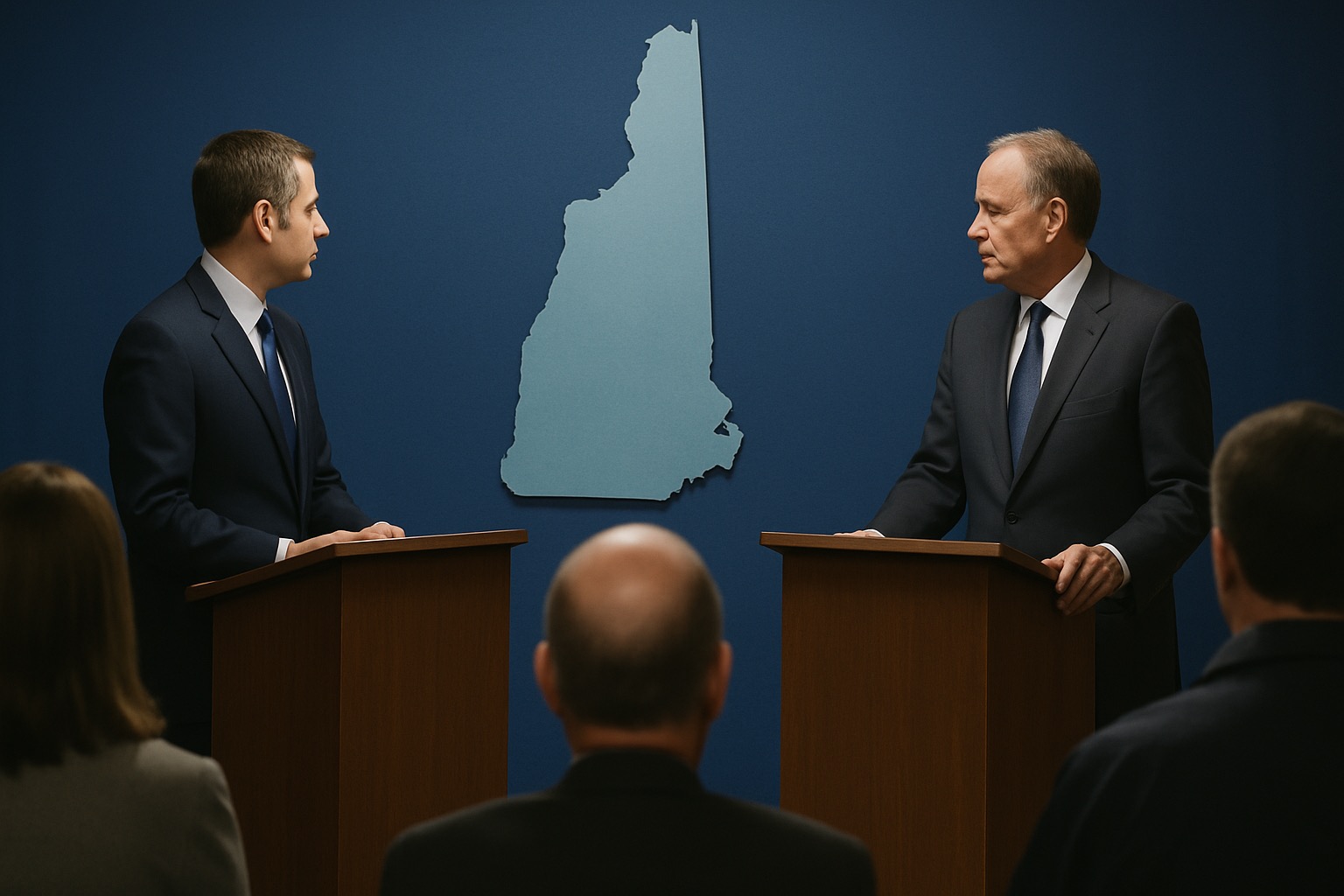
The Stakes: A Senate Seat That Could Decide the Chamber
New Hampshire’s Senate race doesn’t have a single candidate polling above 50 percent. It doesn’t have an incumbent. It has a September primary, a November general, and roughly $8 million already banked between the two frontrunners — in a state of about 1.4 million people where a Senate race is often decided by tens of thousands of votes.
That combination — open seat, close polls, massive spending — makes the Granite State one of the most watched federal contests of the 2026 cycle. Election markets price control of the Senate at 55 percent Republican heading into the fall, with Democrats needing a net gain of four seats to flip the chamber. New Hampshire is one of their clearest realistic pickup opportunities on the map.
Shaheen Retires: The Domino That Started Everything
The race begins, as so many 2026 races do, with a retirement. In March 2025, Sen. Jeanne Shaheen announced she would not seek a fourth term, ending an 18-year run in the Senate and a half-century career in New Hampshire politics. Shaheen, 78, described the decision as “difficult” and cited the political environment under President Trump as a motivating factor for staying active — even while stepping away from re-election.
“It’s important for New Hampshire and the country to have a new generation of leadership,” Shaheen told The New York Times at the time.
Her departure transformed a race that might have been a reliable Democratic hold into one of the most genuinely competitive Senate contests on the map. Shaheen was first elected in 2008, defeating then-Republican Sen. John E. Sununu. She won re-election twice after that, most recently in 2022. Without her name on the ballot, both parties see a genuine opening for the first time in nearly two decades.
The seat is one of ten open Senate races in 2026 where no incumbent is running. As of spring 2026, the Cook Political Report and Larry Sabato’s Crystal Ball rated the general election “Lean Democratic,” while Inside Elections placed it at “Tilt Democratic” — a shade closer to competitive territory — according to Ballotpedia’s race tracker.
The Democratic Field: Pappas in Front, Manzur Closing
Democratic Rep. Chris Pappas, 44, was the first major candidate into the race, announcing his Senate bid in April 2025 with a campaign video positioning him as a fighter willing to take on the Trump administration directly. A four-term congressman representing New Hampshire’s 1st Congressional District since 2019, Pappas has won competitive House races in a swing district multiple times and enters the Senate primary with strong name recognition and a commanding financial advantage.
Pappas raised approximately $3.5 million in the second quarter of 2026 alone, according to Federal Election Commission filings reported by the Boston Globe and New Hampshire Public Radio. His campaign entered August with roughly $5.1 million cash on hand — a figure that dwarfs every other candidate in the race and positions him well for a costly general election fight in the expensive Boston media market.
Still, the Democratic primary is not without friction. Karishma Manzur, a scientist from Exeter, has emerged as a progressive challenger drawing support from younger voters and those who identify on the left of the party. A University of New Hampshire Survey Center poll released June 30, 2026 found Pappas leading Manzur 53 percent to 29 percent in the Democratic primary — a 24-point margin, but notably tighter than the 43-point edge Pappas held in an April UNH poll. Manzur raised approximately $67,000 in Q2 and reported about $49,000 cash on hand, making a major organizational push in the primary a steep climb.
Both candidates will appear on the September 8 primary ballot. Pappas remains the overwhelming favorite to emerge as the Democratic nominee.
The Republican Field: Sununu vs. Brown — and a Familiar Name
The Republican primary carries its own built-in narrative. John E. Sununu, who served as New Hampshire’s U.S. Senator from 2003 to 2009, is attempting to reclaim the very seat he lost to Jeanne Shaheen 18 years ago. Older brother of former Gov. Chris Sununu (who repeatedly declined to run), he entered the race in October 2025 and became the immediate frontrunner.
Before his Senate tenure, John E. Sununu served three terms in the U.S. House of Representatives. His campaign raised approximately $1.5 million in Q2 2026 and ended the period with roughly $2.7 million cash on hand, according to FEC filings reviewed by the Boston Globe. His messaging has focused on economic themes — jobs, affordability, independence from Washington partisanship — and has largely kept his eye on the general election rather than engaging heavily with Brown.
Standing in Sununu’s way — at least nominally — is Scott Brown, the former Massachusetts senator who moved to New Hampshire after losing his Bay State seat in 2012 and then unsuccessfully challenged Shaheen in the 2014 New Hampshire Senate race. Brown has positioned himself as a Trump-aligned candidate and entered the race in June 2025, citing the urgency of sending a conservative to Washington. He raised approximately $279,000 in Q2 2026 and reported $736,000 cash on hand — enough to stay visible in a small state, but far behind Sununu’s financial pace.
Primary polling is lopsided. The June 30 UNH Survey Center poll found Sununu leading Brown 59 percent to 20 percent among likely Republican primary voters, with 20 percent unsure. An Emerson College poll from March 2026 had Sununu ahead 48 percent to 19 percent, with 33 percent undecided. Sununu’s support is broad across ideological lines within the Republican coalition, including among voters who identify as libertarian and conservative — a critical bloc in New Hampshire’s GOP primary electorate.
One complication: Inside Elections noted that Sununu’s post-Senate lobbying work is information largely unfamiliar to primary voters at this stage — and that general election opponents will likely spotlight it in the fall. The primary has not yet fully priced that in.
The State: Independents Decide Everything
New Hampshire has more registered independent voters than registered Democrats or Republicans. These voters — who tend to lean libertarian on economic issues and moderate on social policy — have consistently served as the decisive bloc in close federal races. They’re the reason the state sends members of both parties to Washington, sometimes in the same election cycle.
The statewide landscape in 2026 offers mixed signals. Former Vice President Kamala Harris carried New Hampshire in 2024 by 2.8 percentage points (50.7 percent to 47.9 percent), a substantially narrower margin than President Biden’s 7.4-point advantage in 2020, suggesting the state is trending toward Republicans at the presidential level. Republicans also hold the governor’s office — Gov. Kelly Ayotte won in 2024 by 9 points — and control both chambers of the state legislature.
At the federal level, though, 2026 headwinds are pointing against Republicans. Trump’s approval rating in New Hampshire has registered among his lowest nationally in recent surveys. Democrats led the generic congressional ballot in the state by 10 to 11 points as of mid-2026, according to UNH polling. In a state with a large independent bloc accustomed to ticket-splitting, those numbers create room for a Democratic Senate candidate to outrun the national environment.
New Hampshire’s Senate races have historically been among the closest in the country. The 2016 Senate race was decided by less than one percentage point. The state’s “Live Free or Die” political culture rewards candidates who project independence from party leadership — a frame that could work for both a Sununu-type Republican and a moderate Democrat like Pappas.
Head-to-Head: What the Polls Show
General election polling, on its face, looks like modest good news for Pappas. Multiple surveys through June 2026 show him with a lead — but none of them pushes him above 50 percent, and none is outside the margin of error.
- The June 30 UNH Survey Center poll (margin of error ±2.1 points): Pappas 47%, Sununu 44% — a statistical tie
- A Saint Anselm College Survey Center poll reported by WMUR: Pappas 47%, Sununu 41%
- Emerson College (March 2026): Pappas 45%, Sununu 44% — a virtual tie
The crosstabs illuminate the structural battle ahead. Women break for Pappas by roughly nine points. Men break for Sununu by six. Voters under 40 support Pappas by a wide margin; voters in their 50s and 60s favor Sununu by double digits. The decisive group — independent voters — remains the central battleground where this race will actually be won or lost.
A January 2026 UNH Survey Center poll had Sununu as the frontrunner for the Republican nomination, with both Pappas and Sununu drawing roughly the same general-election support from independent voters. The fact that Sununu has tightened the race in every subsequent poll, even as the national environment has moved toward Democrats, is the central data point Republicans point to when arguing New Hampshire is genuinely in play.
The Money Race: Pappas’s Financial Edge
This race will be expensive. Q2 2026 FEC filings, reported by the Boston Globe and NHPR, show the financial landscape as of mid-July 2026:
- Chris Pappas (D): ~$5.1 million cash on hand | ~$3.5 million raised in Q2
- John E. Sununu (R): ~$2.7 million cash on hand | ~$1.5 million raised in Q2
- Scott Brown (R): ~$736,000 cash on hand | ~$279,000 raised in Q2
- Karishma Manzur (D): ~$49,000 cash on hand | ~$67,000 raised in Q2
Pappas holds nearly a 2-to-1 cash advantage over Sununu. In a state where Granite Staters are reached primarily through the Boston television market — one of the most expensive media markets in New England — that financial edge could prove decisive in the closing stretch of the campaign.
National party organizations will add substantially to both candidates’ totals. The National Republican Senatorial Committee launched advertising targeting Pappas in July 2026, signaling that the party views New Hampshire as one of its better pickup opportunities in a cycle otherwise defined by headwinds. Democrats, in turn, view the seat as a must-hold to preserve any realistic path to a Senate majority.
What to Watch: Key Dates and Decision Points
The September 8, 2026 primary will confirm what polling already suggests: Pappas vs. Sununu in the general. Barring a late-breaking event, Scott Brown is unlikely to close a 40-point polling gap in six weeks. On the Democratic side, Manzur would need an extraordinary surge to overcome Pappas’s financial and name-recognition advantages.
Once both nominees are confirmed, the general election will center on a handful of defining questions:
- Can Pappas successfully frame himself as a New Hampshire moderate — distinct enough from national Democratic leadership to hold independent voters in a competitive state?
- Can Sununu thread the needle of winning a primary that typically rewards Trump alignment while pivoting to the libertarian-leaning independents who decide general elections in New Hampshire?
- How much does the national environment — particularly Trump’s approval ratings and the economy — tilt the playing field in the final months?
The general election is November 3, 2026. New Hampshire’s Senate seat is one of the few in the country where the outcome is genuinely uncertain heading into the home stretch. In a chamber where Republicans hold a 53-45 majority and Democrats need a four-seat net gain to flip control, what happens in the Granite State matters well beyond its borders.
Sources
- NBC News — Jeanne Shaheen won’t run for re-election, opening another Democratic Senate seat in 2026 (March 12, 2025)
- The Hill — Shaheen to retire, setting up battle for New Hampshire Senate seat (March 12, 2025)
- The New York Times — Chris Pappas Jumps Into 2026 Senate Race in New Hampshire (April 3, 2025)
- New Hampshire Public Radio — UNH poll shows tight races for governor and U.S. Senate (July 1, 2026)
- WMUR News 9 — Sununu campaign announces second quarter fundraising totals (July 15, 2026)
- Boston Globe — What to know about the latest federal fundraising data from N.H. candidates (July 17, 2026)
- New Hampshire Public Radio — Pappas, Sununu, Sullivan, and DiLorenzo boast campaign funding hauls (July 16, 2026)
- Emerson College Polling — New Hampshire 2026: Sununu Leads GOP Nomination, Ties Pappas for Senate (March 26, 2026)
- WMUR News 9 — Poll shows close race for US Senate in New Hampshire (June 30, 2026)
- UNH Survey Center / University of New Hampshire — Sununu, Pappas Frontrunners in 2026 NH Senate Race (January 21, 2026)
- Inside Elections — New Hampshire Senate: Sununu Bid Boosts Republican Chances (October 22, 2025)
- Ballotpedia — United States Senate election in New Hampshire, 2026