

New Jersey Senate 2026 Race Guide: Cory Booker, Justin Murphy, and the 54-Year Pattern Republicans Can't Break
Cory Booker vs. Justin Murphy in New Jersey’s 2026 Senate race: 54 years without a Republican win, $23M vs. near-zero fundraising, and Senate control stakes.
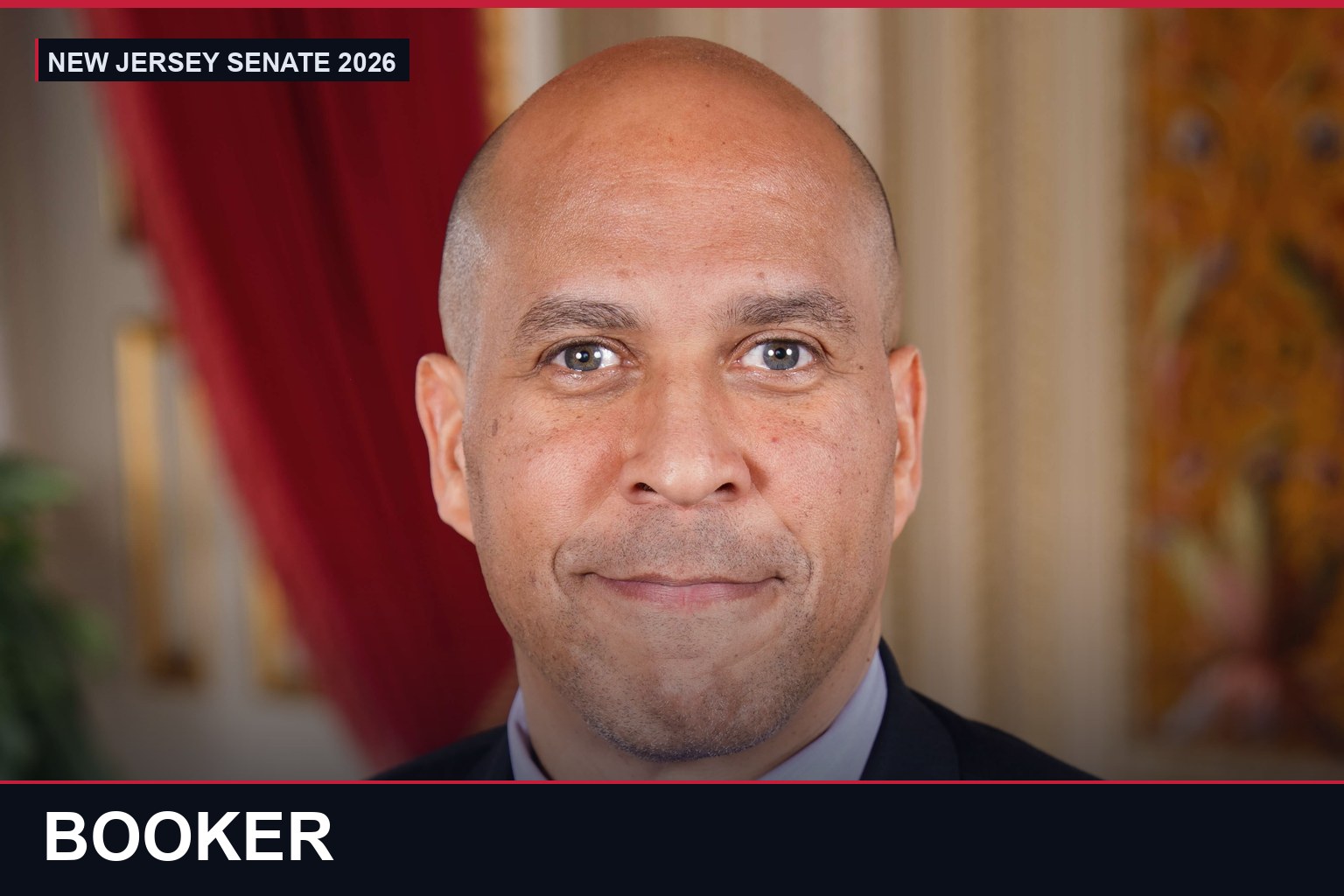
New Jersey Senate 2026 Race Guide: Cory Booker, Justin Murphy, and the 54-Year Pattern Republicans Can't Break
Eleven weeks before Election Day, New Jersey's Senate race presents a study in structural asymmetry. Democratic incumbent Cory Booker holds more than $23 million in campaign cash. His Republican opponent, attorney and Navy veteran Justin Murphy, won his June primary with essentially no money in his account — the Federal Election Commission recorded a negative balance at the time he secured the nomination. The Cook Political Report rates the seat Solid Democratic. No Republican has won a New Jersey Senate election since 1972.
And yet, the race matters. Every Senate seat up in 2026 feeds into the broader contest for chamber control — and the margin in that fight is tight enough that even structurally safe Democratic states carry stakes for the national map. What happens in New Jersey on November 3 will help determine whether Democrats can close a 53-to-45 Republican majority.
The Candidates
Cory Booker (D, Incumbent)
Cory Booker has represented New Jersey in the Senate since October 2013, when he won a special election following the death of longtime Democratic Sen. Frank Lautenberg. Born in Washington, D.C., and raised in Harrington Park in Bergen County, Booker graduated from Northern Valley Regional High School before earning a bachelor's degree at Stanford, a Rhodes Scholarship to Oxford, and a law degree at Yale. He served as Newark mayor from 2006 to 2013 before entering the Senate.
Booker won his first full Senate term in November 2014, defeating Republican Jeff Bell by 11.4 percentage points. He was re-elected in 2020, defeating Republican Rik Mehta 57.2 percent to 40.9 percent — a margin of 16.3 points. He is now seeking a third full term.
In the Senate, Booker serves on the Judiciary Committee, the Foreign Relations Committee, and the Agriculture, Nutrition and Forestry Committee. He has been a prominent voice on criminal justice reform, including the First Step Act — the bipartisan 2018 bill that he helped negotiate alongside Republican allies and which was signed by President Trump.
The defining moment of his 2026 campaign cycle came on March 31, 2025, when Booker took the Senate floor and spoke for 25 consecutive hours — breaking the all-time Senate record previously held by segregationist Strom Thurmond's 1957 filibuster against the Civil Rights Act. The speech, a sustained critique of the Trump administration delivered while holding a pocket Constitution, generated an immediate fundraising wave. According to the New Jersey Globe, Booker raised $10 million in the speech's immediate wake, most of it from small-dollar donors.
By the second quarter of 2025, Booker had raised $9.7 million in a single quarter — a record for his Senate campaign. His broader fundraising profile reflects the national reach his Senate work has built. According to Federal Election Commission records and reporting by the Philadelphia Inquirer, Booker raised the second-largest amount of any 2026 Senate or House candidate through the end of 2025, trailing only Georgia Sen. Jon Ossoff. His largest donor states, per FEC data, are California and New York — not New Jersey — illustrating the extent to which his fundraising base is a national Democratic activist network, not just a home-state constituency.
As of June 30, 2026, Booker's campaign committee held $23,060,940 in cash on hand, with no debt, according to FEC records. His campaign has drawn more than 200,000 unique donors, with 76 percent giving $25 or less.
Booker, 57 years old on Election Day, is widely discussed as a potential 2028 Democratic presidential candidate. He ran unsuccessfully for the nomination in 2020, withdrawing before the Iowa caucuses after failing to meet polling thresholds for debates. His current fundraising pace — and the extent to which it outpaces what a safe-seat incumbent typically needs — is consistent with a politician building a national profile for a future race. He has introduced legislation to significantly expand the standard tax deduction and has taken high-profile positions on Trump administration policies throughout his current term.
Justin Murphy (R, Challenger)
Justin Murphy, 59, is an attorney from Tabernacle, a small township in Burlington County in the heart of the New Jersey Pinelands. He enlisted in the United States Navy at age 17 and served a four-year active-duty tour aboard the USS Comte de Grasse, reaching the rank of E-5 Second Class Petty Officer and including a six-month deployment in the Arabian and Persian Gulf during the Iran-Iraq War. He was honorably discharged in 1987.
Murphy subsequently pursued a career in law and local Republican politics. He earned a bachelor's degree in political science from Rowan University, a Juris Doctor from Widener University School of Law, and an LL.M. in Energy and Natural Resources Law from the University of Oklahoma. He was elected to the Tabernacle Township Committee in 2000, serving a three-year term that included a stint as deputy mayor. He practiced Republican Party politics throughout Burlington County during the 1990s and 2000s, including as co-chair of the county's Dole-Kemp effort in 1996. He has practiced law since 2006, focusing on estate planning, real estate transactions, contract law, energy consulting, and EB-5 economic development projects.
Murphy ran unsuccessfully for the Republican Senate nomination in 2024, finishing third in a crowded primary. He entered the 2026 cycle determined to build a broader coalition, securing endorsements from several county Republican organizations while splitting the convention endorsement process with rivals Richard Tabor and Alex Zdan. On June 2, 2026, Murphy won the four-way Republican primary with 33.3 percent of the vote — ahead of Tabor at 29.4 percent, Zdan at 26.9 percent, and physician Robert Lebovics at 10.7 percent, according to results reported by NJ.com. The Associated Press called the race at 11:25 p.m.
At the time of his primary victory, Federal Election Commission records showed Murphy's campaign account carried a negative $24 balance. His total campaign fundraising for the 2026 cycle, per FEC records, stood at $3,557 — against Booker's $23 million cash on hand. The four Republican primary candidates combined had raised approximately $216,000 through the pre-primary filing period, according to reporting by the New Jersey Globe, compared with Booker's tens of millions.
Murphy's platform calls for abolishing the Internal Revenue Code and replacing it with a flat tax of 10 to 12 percent; eliminating the federal Department of Education; expanding nuclear energy production; opposing offshore wind development along the Jersey Shore; protecting the New Jersey Pinelands; strengthening Medicare for seniors; and border security measures including fentanyl interdiction. He has described his candidacy as a commitment to voters that the last Republican Senate win in New Jersey — 1972 — does not have to define the future of Garden State politics.
Murphy has no major endorsements from national Republican figures, and the National Republican Senatorial Committee has not publicly committed resources to the race. Reporting by the New Jersey Globe in the period around the primary noted that GOP donors had not opened their wallets for the field, a signal that party infrastructure views a New Jersey Senate flip as a low-probability investment in the current cycle.
The Structural Math
New Jersey's electoral map starts with demographic and registration realities that make Senate-level Republican wins extremely difficult. According to WHYY's reporting ahead of the primary, the state has approximately 2,382,611 registered Democrats, 1,577,940 registered Republicans, and 2,293,661 independents and others — out of 6,254,212 total registered voters. Democratic registration holds roughly a 50 percent edge over Republican registration.
The state's presidential partisan baseline has shifted — Kamala Harris won New Jersey by 6.1 percentage points in 2024, a significant compression from Joe Biden's 16.1-point margin in 2020. That shift has prompted some observers to label New Jersey as a state worth watching in future cycles. But a 6-point presidential lean still represents a formidable structural advantage for a Democratic incumbent senator. Booker's own 2020 margin — 16.3 points, in the same environment where Biden ran up 16.1 nationally — suggests his personal brand has run at or above the presidential baseline, not below it.
The media market is a further structural factor. New Jersey sits between two of the most expensive media markets in the country — New York City and Philadelphia. A competitive Senate campaign in New Jersey requires the resources to buy advertising in both markets, a cost that typically demands tens of millions of dollars. That financial reality, combined with the registration disadvantage, has historically deterred top-tier Republican candidates from entering the race. The absence of a nationally known, well-funded Republican challenger in 2026 is less a surprise than a structural consequence of the state's economics and partisan lean.
The Cook Political Report rated the seat Solid Democratic as of February 2025 — before the primary field was even set — and has not updated that rating since, a signal that the outcome of the Republican primary did not alter the structural calculus.
What Would It Take
For Murphy to win this race, several conditions that do not currently appear to be in place would all need to converge. A national political environment severely unfavorable to Democrats — comparable to or worse than the 2010 wave — would need to materialize. Murphy would need to raise enough money to communicate statewide in the New York-Philadelphia media corridor. He would need crossover appeal in the Democratic-leaning suburban counties of Bergen, Morris, and Middlesex that have increasingly determined New Jersey's federal election outcomes. And Booker would need to somehow underperform the partisan baseline by a margin no New Jersey Democratic senator has approached in decades.
None of those conditions exist in measurable form today. Booker's financial advantage is functionally insurmountable. His incumbency advantage is real and documented across three prior New Jersey elections. Murphy's primary, while a genuine win, was a plurality victory in a fragmented four-way field — Tabor and Zdan together outpolled Murphy — which does not necessarily signal a unified or energized Republican base heading into November.
The Senate seat that looks most intriguing on paper from the national Republican perspective — a 6-point presidential margin — is, in practice, defended by one of the most well-funded incumbents in the country, in a state that has not returned a Republican senator in more than half a century.
The 2028 Shadow
Booker's 2026 Senate campaign exists in the context of what many Democratic insiders expect to be a run for president in 2028. His fundraising pace — $30 million-plus raised since 2021 for a race in a state he is heavily favored to win — far outpaces what a safe-seat incumbent typically requires. The donor base he has assembled, 200,000 individuals with 76 percent giving $25 or less, is the infrastructure of a national campaign.
A lopsided New Jersey victory in November — the kind of double-digit margin the partisan baseline and fundraising gap suggest is plausible — would give Booker momentum, a national profile boost, and a Senate platform from which to consider a presidential campaign. His 2020 bid ended early due to fundraising difficulties; the 2025 floor speech and subsequent $10 million haul demonstrated that he has solved the small-dollar fundraising problem that cost him in the previous cycle.
Whether Booker ultimately runs for president in 2028 will be determined by factors well beyond this Senate race. But the 2026 campaign is being run, in many respects, as a national audition as much as a local race.
Historical Results — New Jersey Class 2 Senate Seat
- 2020: Booker (D) 57.2% def. Rik Mehta (R) 40.9% — D+16.3
- 2014: Booker (D) 54.9% def. Jeff Bell (R) 44.3% — D+10.6
- 2008: Frank Lautenberg (D) 56.0% def. Dick Zimmer (R) 42.6% — D+13.4
- 2002: Frank Lautenberg (D) 54.0% def. Doug Forrester (R) 44.0% — D+10.0
- 1996: Robert Torricelli (D) 53.0% def. Dick Zimmer (R) 48.0% — D+5.0
- Last Republican win: Clifford Case (R), 1972
The pattern is consistent. New Jersey's Class 2 Senate seat has gone Democratic in every election since 1978. No Republican has come within 5 percentage points of winning it in 30 years. Murphy's path to becoming the first exception since the Nixon era runs through a structural environment that has not produced a Republican Senate winner here in over half a century.
Race Ratings
- Cook Political Report: Solid Democratic
- General election date: November 3, 2026
Senate Control Context
While New Jersey itself is not a competitive battleground, its outcome feeds into the national Senate control picture. Republicans entered 2026 holding a 53-to-45 majority, with independents Bernie Sanders and Angus King caucusing with Democrats. Democrats need to net four seats to reclaim the majority. The New Jersey seat is not among the seats Democrats need to flip — it is a hold — but a Booker victory at the expected margins strengthens the Democratic base from which to build a majority.
The Senate control race is genuinely competitive in 2026, turning on contests in Michigan, Alaska, Montana, Nebraska, Iowa, New Hampshire, North Carolina, and other states where margins are tight and both parties have realistic paths. New Jersey is not one of those states. It is, however, a place where a landslide Democratic win would contribute votes to the national map and signal the ceiling of Republican momentum heading into November.
Sources
- WHYY, "Justin Murphy wins New Jersey's Republican Senate primary. He'll face Cory Booker in November," June 3, 2026. https://whyy.org/articles/new-jersey-election-2026-primary-senate-republican-nomination/
- NJ.com, "This Republican will now face Sen. Cory Booker in November," June 3, 2026. https://www.nj.com/politics/2026/06/this-republican-will-now-face-sen-cory-booker-in-november-and-weve-got-more-nj-house-primary-results.html
- New Jersey Globe, "Cory Booker has a Brobdingnagian $22.2 million warchest for re-election campaign," July 14, 2026. https://newjerseyglobe.com/congress/cory-booker-has-a-brobdingnagian-22-2-million-warchest-for-re-election-campaign/
- Philadelphia Inquirer, "Cory Booker has raised more than nearly every candidate for Congress running in 2026," February 4, 2026. https://www.inquirer.com/politics/new-jersey/cory-booker-2026-campaign-fundraising-20260204.html
- Federal Election Commission, Cory Booker for Senate committee overview, coverage dates January 1, 2025 to June 30, 2026. https://www.fec.gov/data/committee/C00540500/
- Federal Election Commission, Justin Murphy LL.M. candidate overview. https://www.fec.gov/data/candidate/S4NJ00532/
- Cook Political Report, New Jersey Senate 2026 race page. https://www.cookpolitical.com/senate/race/488641
- The Hill, "Booker to face off against Justin Murphy in New Jersey Senate race," June 3, 2026. https://thehill.com/homenews/campaign/5907440-cory-booker-justin-murphy-new-jersey-senate-race-2026/
- Insider NJ, "Murphy Wins Republican Primary for U.S. Senate," June 3, 2026. https://www.insidernj.com/murphy-wins-republican-primary-us-senate/
- Insider NJ, "Booker Raises $10 million in Q2," July 10, 2025. https://www.insidernj.com/booker-raises-10-million-in-q2/
- WHYY, "New Jersey election 2026: These 4 Republicans hope to unseat U.S. Sen. Cory Booker," April 20, 2026. https://whyy.org/articles/new-jersey-election-2026-primary-senate-candidates/