New York Governor 2026 Race Guide: Kathy Hochul, Bruce Blakeman, and the Shadow of 2022
Hochul leads Blakeman 93-7 on prediction markets. The 2022 near-miss — Zeldin came within 5.9 points — shows New York's blue lean isn't bulletproof.
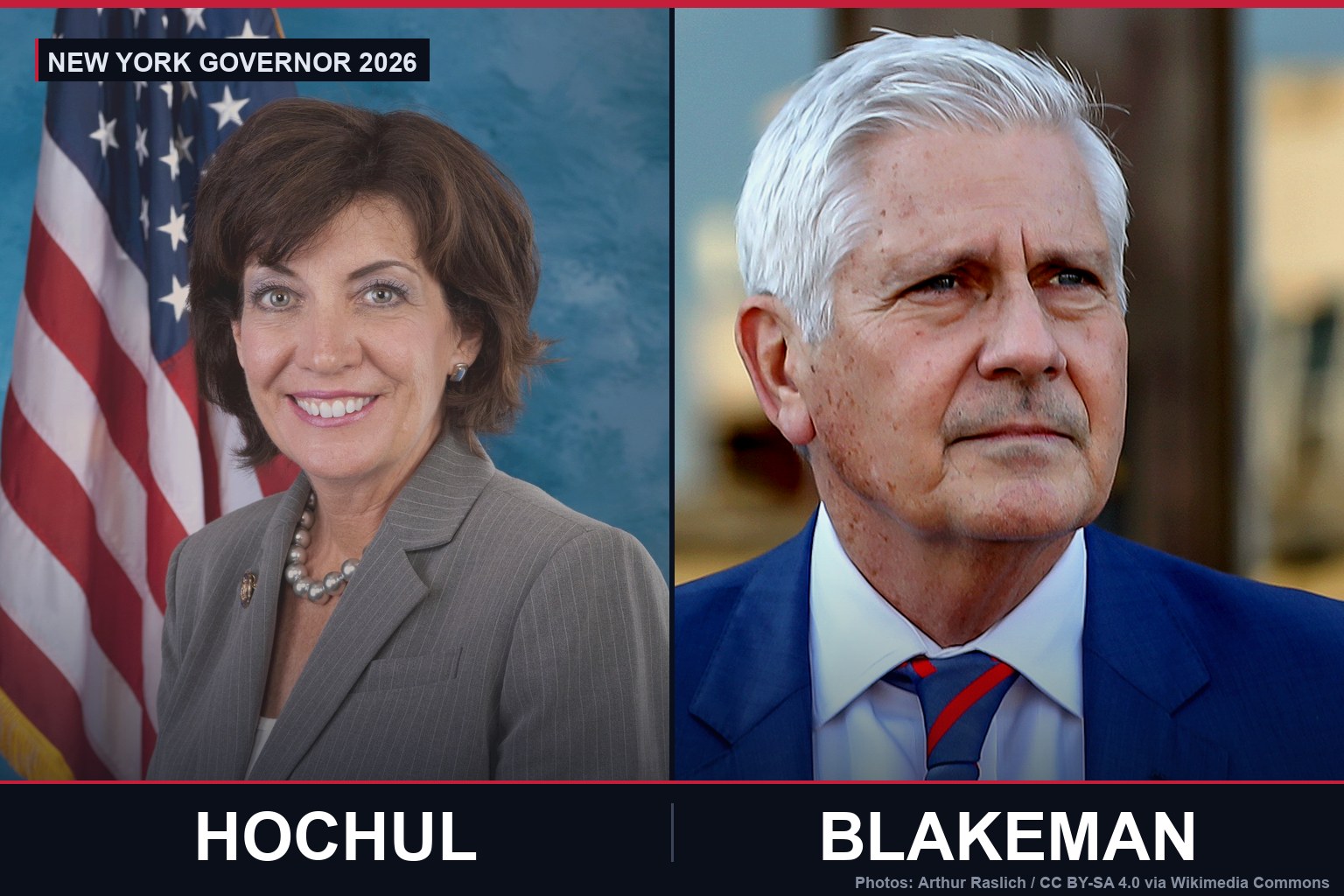
Four years ago, New York's governor's race was supposed to be a formality. Instead, Democrat Kathy Hochul barely survived a Republican challenge that carried Lee Zeldin to within 5.9 points of Albany — the closest New York gubernatorial contest in two decades. That near-miss hangs over the 2026 race like a low storm system. Hochul enters the fall as a heavy favorite, but Republican Nassau County Executive Bruce Blakeman is counting on an affordability wave, Trump's endorsement, and one of the most powerful county GOP machines in the country to defy the structural math.
The general election is November 3, 2026.
Where the Odds Stand
Prediction markets price Hochul's re-election at approximately 93 cents — roughly a 93% probability of winning — with Blakeman sitting at about 7 cents. That pricing reflects the state's structural Democratic lean, Hochul's commanding fundraising advantage, and a polling average that has her up roughly 10 points in independent surveys.
The Candidates
Kathy Hochul (D, incumbent)
Hochul, 67, became governor in August 2021 when Andrew Cuomo resigned amid harassment allegations. She won a full four-year term in November 2022 by 5.9 percentage points over Republican Lee Zeldin — a narrower-than-expected margin that made national news and prompted extended soul-searching inside the state Democratic Party.
Hochul has governed from the center of the Democratic spectrum, focusing on affordability, housing, and public safety. She shepherded the $1.7 billion Buffalo Bills stadium deal — a state subsidy that drew fiscal criticism but built loyalty across Western New York. She has clashed with the progressive wing of her party on bail reform, criminal justice, and mayoral endorsements, positioning herself as a pragmatic manager rather than an ideological standard-bearer.
Her favorability has tracked at roughly 49-39 favorable-to-unfavorable among likely voters in August 2026 polling, according to Siena College Research Institute. A recent controversy involving $72,500 in donations from political appointees — returned after a media inquiry — provided a brief negative storyline, but hasn't visibly moved the toplines.
Hochul has declined to participate in New York's new public campaign matching funds program, her campaign citing a preference to direct taxpayer dollars elsewhere — a decision that also insulates her fundraiser records from additional public disclosure requirements.
Bruce Blakeman (R)
Blakeman, 70, has served as Nassau County Executive since 2022 after a long career in Long Island Republican politics, including a stint on the Nassau County Legislature and a 2010 Senate primary loss. Nassau County — the dense, heavily suburban territory immediately east of Queens — has long fielded one of the strongest Republican county organizations anywhere in the country, and Blakeman has leaned into that infrastructure throughout his campaign.
He entered the race in December 2025 after the potential field-clearing challenge from Rep. Elise Stefanik never materialized. Blakeman won the June 2, 2026 Republican primary with 33.4% over a four-candidate field that included state trooper Richard Tabor (29.2%) and journalist Alex Zdan (26.8%), according to primary results reported by NBC News. He is running with Madison County Sheriff Todd Hood as his lieutenant governor.
Blakeman is running on an explicitly Trump-aligned, affordability-first platform. His messaging targets utility bills, grocery prices, property taxes, and what he frames as Democratic overspending on immigration — a theme the "Make it Cheaper" super PAC supporting him has amplified across the state.
His campaign ran into a high-profile stumble earlier this year: the Democrat-majority state Public Campaign Finance Board voted 4-3 along party lines to deny him access to the state's new matching funds program over a paperwork error related to his lieutenant governor running mate. Blakeman sued, prevailed in court, and re-enrolled — receiving an initial matching funds payment of approximately $770,000 out of a possible $3.5 million, according to NY1 and state Board of Elections records.
Fundraising disclosures have also created friction. A top campaign official initially told media outlets that Blakeman had raised approximately $11 million — a figure that state filings did not support. The campaign subsequently filed an amended report adding $1.6 million in contributions and acknowledged the discrepancy, as reported by City & State New York.
As of early July 2026 state Board of Elections filings, Blakeman holds approximately $4.6 million cash on hand — compared to Hochul's campaign committee alone holding more than $21 million.
The Polling Landscape
Polling in this race spans a wide range, driven significantly by sponsor alignment.
The most consistent independent tracker is the Siena College Research Institute. Its August 3-6, 2026 survey of 811 likely voters showed Hochul leading 49%-39% — a 10-point margin. That same pollster showed a 52-32 lead in late June, suggesting modest tightening over the summer.
Republican-aligned surveys have told a different story. Red Oak Strategic, polling on behalf of a pro-Blakeman super PAC in mid-July, put the race at 47-43 (4 points). co/efficient, another R-affiliated pollster, showed 47-41 (6 points) in late June. Independent analysts attribute the spread more to methodological differences — sample composition, likely voter screens, and house effects — than to clear evidence of real movement.
Aggregated polling averages through early August show Hochul leading by roughly 9-10 points across nonpartisan trackers:
- FiftyPlusOne (through August 6): Hochul +10.4 (49.0% vs. 38.6%)
- Race to the WH (through August 6): Hochul +9.6 (48.8% vs. 39.2%)
- RealClearPolitics (through July 8): Hochul +10.3 (50.3% vs. 40.0%)
Among independents, the most recent Siena survey showed Blakeman leading 45-40 — a mirror of the 2022 dynamic, when Zeldin ran ahead with independents while still losing the state by nearly 6 points.
The 2022 Ghost
No analysis of this race is complete without the 2022 context. Lee Zeldin's 5.9-point loss — in a cycle where Republicans performed modestly nationally — shook New York Democrats deeply and demonstrated that the state's structural blue lean can compress sharply under the right conditions.
Zeldin ran on crime and bail reform in a moment when New York City crime statistics were rising and Democrats nationally were on defense. Blakeman is running on affordability and immigration in a different national environment — one where Trump is in the White House and Democrats have reoriented around resistance rather than incumbency defense. The atmospheric conditions that nearly flipped New York in 2022 may not fully replicate in 2026.
Hochul has also adjusted. Her administration has leaned into the anti-Trump frame more aggressively, and her August 13 announcement of $7.25 million in state legal aid for migrant children facing deportation proceedings — met with a defiant "Damn right I did" social media response to critics — drew sharp attacks from Blakeman but energized her base and drew standing support from NYC Mayor Zohran Mamdani and state Attorney General Letitia James.
The Structural Math
New York has not elected a Republican governor since George Pataki's final term ended in January 2007. No Republican has won a statewide election in New York since 2002.
Democrats outnumber Republicans in the state by more than two-to-one in voter registration. Kamala Harris carried New York by approximately 14.6 points in 2024. The Cook Political Report's partisan voting index shows Democratic strength across New York City's boroughs and most suburban seats.
All major nonpartisan forecasters — including Cook Political Report (Solid D) — rate this race solidly in Hochul's column.
Blakeman's path requires several conditions to align simultaneously: Hochul's favorability must continue to erode through the fall, independent voters must swing significantly more Republican than in any recent non-Zeldin cycle, and the national environment must generate headwinds for Democrats strong enough to overcome the state's baseline.
The Fundraising Chasm
The financial disparity in this race ranks among the widest in any 2026 governor's contest nationally. Hochul's campaign committee plus the New York State Democratic Party hold over $42 million in combined cash on hand, according to the campaign's July 15, 2026 filing announcement. Blakeman's campaign holds $4.6 million.
New York's media markets — especially New York City's — are among the most expensive in the world. The fall ad wars will require sustained spending at a scale Blakeman can't match dollar-for-dollar. His team is counting on state matching funds (up to $3.5 million), super PAC support from Make it Cheaper and similar groups, and earned media from campaign events to close the communication gap.
Hochul's own fundraising has drawn scrutiny. She declined the public matching funds program — exempting her from related fundraiser disclosure rules — and raised large sums from real estate developers, lobbyists, and interest groups with state business pending. The Buffalo Bills owners, whose stadium received $850 million in state support, contributed to her campaign, as reported by WXXI Public News. She has framed those donations as reflecting broad support for her economic agenda.
Key Issues Heading into Fall
Affordability: Both candidates center their messaging on reducing the cost of living for New Yorkers. Hochul points to child care funding, energy assistance, and housing construction initiatives; Blakeman, echoing his county-level record, promises property tax relief and utility bill reductions. Polling consistently places cost of living as the top concern for New York voters.
Immigration: Hochul's handling of the migrant shelter crisis and her active resistance to federal deportation operations have become central contrasts. Blakeman has attacked her spending on legal aid for migrant children as reckless; Hochul has positioned herself as a bulwark against what she calls the Trump administration's "inhumane" enforcement posture.
Crime and public safety: Bail reform and progressive criminal justice policies remain a subtext, though the acute crime surge that defined 2022 has eased in most major metrics. Blakeman hammers crime as an ongoing vulnerability; Hochul highlights declining crime rates in New York City and points to her record on gun violence legislation.
What to Watch
The Nassau-to-borough spread: Blakeman's path runs through Long Island, exurban upstate counties, and independent-leaning suburbs. Hochul needs to limit his margins in those geographies while running up massive leads in the five boroughs. In 2022, Zeldin carried Nassau County — the kind of suburban sweep Republicans need but rarely achieve at the statewide level.
Independent voter movement: Both the Siena tracker and partisan surveys agree that Blakeman is outrunning Hochul among independents — a necessary but not sufficient condition for a Republican win in New York. The question is whether that gap is large enough and durable enough to matter.
National environment: In 2022, a modest red wave was enough to compress New York's margin to its narrowest in 20 years. In 2026, with Trump in the White House and a volatile national environment cutting multiple directions, it is unclear whether the national backdrop helps Blakeman or Hochul more.
Super PAC money: Blakeman's cash disadvantage may be partially offset by independent expenditure groups. Make it Cheaper filed with the state Board of Elections to support his campaign; its treasurer ran similar efforts for Zeldin in 2022. How much outside money materializes — and when — will shape the fall advertising balance.
The Bottom Line
Kathy Hochul enters the fall as a clear favorite. The 93-cent market pricing reflects a state with a 14-point presidential margin in 2024, a 2-to-1 Democratic registration edge, a $42 million cash advantage, and a polling lead that has remained in double digits in independent surveys. All major nonpartisan forecasters rate this race Solid Democratic.
But 93 cents is not 100 cents. The 2022 race demonstrated that New York is not impervious to national conditions — and that an energized Long Island machine, a cost-of-living message with crosscutting appeal, and a favorable national environment can compress the structural math dramatically. Blakeman's path is narrow. It is not closed.
Sources: Siena College Research Institute polling (July 1, 2025 and August 3–6, 2026); The Hill (August 12, 2026); NY1 / Spectrum News (campaign and fundraising coverage, July 27 and August 12, 2026); NY State of Politics / POLITICO (100-day campaign report, July 27, 2026); Newsday (fundraising analysis); City & State New York (fundraising filing analysis, July 23, 2026); WXXI Public News / New York Public News Network (campaign finance data, July 17, 2026); NBC News (primary results, June 2026); 270toWin polling tracker.