North Carolina Senate 2026 Race Guide: Roy Cooper vs. Michael Whatley
Roy Cooper vs. Michael Whatley for NC's open Senate seat. Forecasters call it the biggest Democratic flip opportunity of 2026—and a linchpin of Senate control.
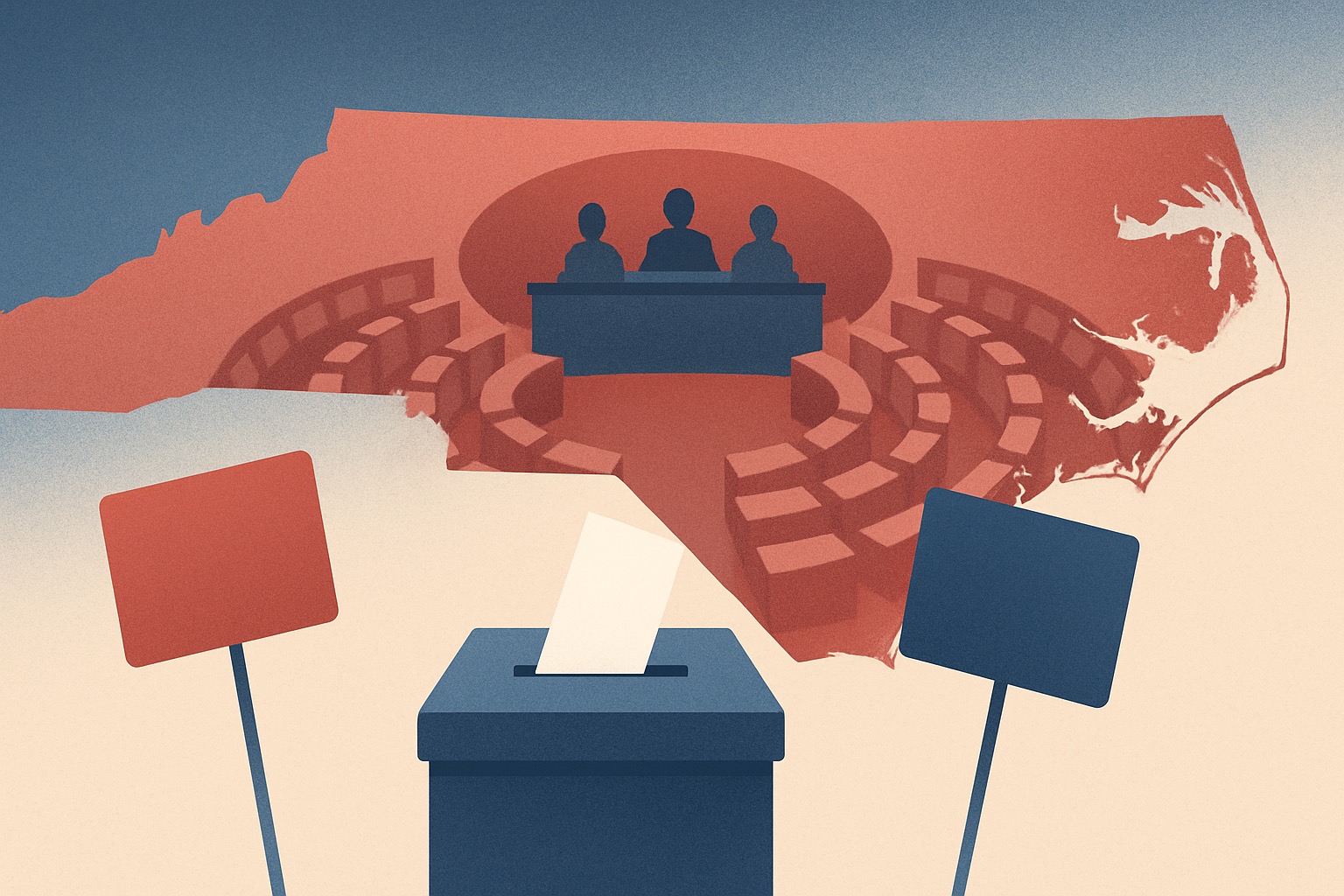
North Carolina has been a Senate graveyard for Democrats. The state sent its last Democrat to the chamber in 2009, when Kay Hagan rode Barack Obama's coattails to unseat Elizabeth Dole. In the seventeen years since, the Tar Heel State has reliably returned Republican senators—even as its presidential-year margins narrowed and its suburbs purpled.
That streak is now the most consequential question in the 2026 Senate cycle.
Former Democratic Governor Roy Cooper is running against former Republican National Committee Chairman Michael Whatley for the open seat being vacated by Republican Sen. Thom Tillis. Prediction markets, forecasters, and operatives on both sides agree: this is one of the handful of races where November could hand Democrats either a path to a Senate majority or confirmation that their Senate hopes stalled at the starting line.
How the Seat Opened
Thom Tillis spent much of 2025 under threat from his own party. A relative moderate who had occasionally broken with the Trump agenda, he announced he would seek reelection—then reversed course after casting a pivotal vote against what Republicans called the One Big Beautiful Bill Act. His subsequent retirement announcement transformed the race overnight: from a competitive incumbent-challenge scenario into a wide-open contest for one of the most coveted seats on the 2026 map, per NPR's March 2026 reporting.
The open-seat dynamic matters enormously. Incumbents carry structural advantages—name recognition, defined brands, donor networks built over years. Both Cooper and Whatley entered this race as the incumbent in a particular sense: Cooper as a two-term governor with near-universal name recognition across the state; Whatley as the establishment candidate with the Trump endorsement but none of the electoral track record.
The Candidates
Roy Cooper served as North Carolina's governor from 2017 through 2025, winning two terms in a state that was simultaneously electing Republican senators and backing Republican presidential candidates. That cross-partisan performance is his central argument: he has demonstrated the ability to win North Carolina statewide, and his Senate candidacy is a direct extension of the political brand that made it possible.
Cooper entered the Democratic primary with the field largely cleared for him. He won with 92 percent of the primary vote, according to NBC News's primary results. His fundraising has been commensurate with his status as one of the cycle's most coveted recruits: NC Newsline reported in July that Cooper has raised roughly $35 million total this cycle, making him the third-best Senate fundraiser in the 2026 midterms. His cash on hand entering the general election dwarfs Whatley's by a significant margin.
Michael Whatley served as co-chair of the Republican National Committee and chair of the North Carolina Republican Party before launching his Senate campaign. He secured the Trump endorsement and won his primary with 64.6 percent of the vote, per NBC News's primary results, in a field that tested the depth of his support within the state GOP.
Whatley's central challenge is one that money can address but not fully solve: name recognition. As of Public Policy Polling's July survey, 69 percent of North Carolina voters were familiar with Whatley—up from 64 percent in March, per the Asheville Citizen-Times—but his favorable-to-unfavorable ratio has not improved as his profile has risen. The more voters learn about him, the poll suggested, the more ambivalent they become. As Politico reported in July, North Carolina Republicans are publicly calling for national party investment to solve Whatley's introductory problem before it calcifies.
What the Polls Show
Polling in North Carolina has been strikingly consistent across a wide range of survey methodologies and partisan sponsors: Cooper leads in virtually every public survey.
The New York Times/Siena College poll conducted June 15–27 among 601 likely voters found Cooper at 50 percent to Whatley's 43 percent—the largest lead any Democratic Senate candidate holds over a Republican-held open seat this cycle, the Times noted. A Public Policy Polling survey conducted July 10–11 found Cooper at 48 percent to Whatley's 44 percent, with 8 percent undecided—a four-point margin that is narrower than most surveys but still reflects a consistent Cooper advantage.
Polling aggregates confirm the pattern. Race to the WH's average through mid-July showed Cooper at 48.6 percent to Whatley's 41.2 percent. The 270toWin average from late June through early July had Cooper at 49.0 percent to Whatley's 38.5 percent.
The range spans roughly four to eleven points across surveys. Partisanship of the pollster matters at the edges: Republican-sponsored surveys show the tightest margins; nonpartisan and Democratic surveys show Cooper with a double-digit advantage at times.
Forecasters have responded accordingly. Cook Political Report rates the race Lean Democratic. Decision Desk HQ similarly gives Cooper the edge, per The Hill's July 26 analysis, while noting that North Carolina's structural right-lean means the race is likely to tighten as Election Day approaches.
The Structural Obstacle
Cooper's polling lead exists against a deeply uncomfortable backdrop. North Carolina has not elected a Democrat to the U.S. Senate since 2008—and Hagan's win that year required an unusually favorable national environment and a Democratic presidential nominee who carried the state. Donald Trump won North Carolina in 2024, and while forecasters rate the state competitive at the margins, it remains a Republican-leaning federal electorate.
Catawba College politics professor Michael Bitzer offered a sober assessment to the Citizen-Times in July: voters in statewide North Carolina contests tend to return to their partisan corners by November. The question isn't whether the race will tighten—it will—but whether it will tighten enough to overcome Cooper's current lead.
Cooper's own campaign is running as if the race is tied. Campaign manager Jeff Allen told the Citizen-Times: "A Democrat has not won statewide federal office in North Carolina in nearly two decades. We know this race will be very close, which is why we're building a campaign to earn every vote and make sure North Carolinians know that Roy Cooper will fight for them in the Senate."
The Money Gap and What It Means
The fundraising disparity is the most concrete number in this race, and it's substantial. Cooper's $35 million cycle total against Whatley's approximately $11 million represents roughly a 3-to-1 advantage, per NC Newsline's July report based on FEC filings. Cooper entered the second quarter with $18.5 million in cash on hand; Whatley reported more than $2.5 million.
In North Carolina's media markets—Charlotte, Raleigh-Durham, Greensboro—advertising early and often is how candidates build the contrast that shifts late-deciders. Whatley's allies have publicly acknowledged that outside money from the NRSC and aligned super PACs will need to compensate for the candidate's own fundraising deficit, per Politico's July report.
A Supreme Court ruling referenced in the NC Newsline report has removed certain limits on national party committee spending in individual races, opening a potential avenue for the NRSC to close the resource gap. Whether that mechanism deploys at sufficient scale and speed is a central question for the fall.
Why North Carolina Is Central to Senate Control
Democrats need to net four seats to win a Senate majority. With Vice President JD Vance serving as the Republican tiebreaker in a 50-50 Senate, reaching 50 seats is not enough—Democrats need 51, as NPR explained in its July 27 Senate overview.
North Carolina is an open Republican-held seat in a state that forecasters identify as one of the clearest Democratic flip opportunities of the cycle, alongside Maine, Ohio, and Alaska. If Cooper wins, Democrats gain one of the four seats they need. If he loses, the path to majority narrows considerably—Democrats would need to sweep remaining targets while also defending vulnerable seats in Georgia and Michigan.
The aggregate Senate control market reflects how individual race probabilities combine. Live consensus odds on which party will control the Senate are tracked below.
Live candidate markets
The market currently prices a competitive but modestly Republican-leaning Senate outcome. That lean reflects the difficulty of the overall Democratic path: winning North Carolina alone is insufficient. The Senate majority requires sweeping most or all of the other battleground races simultaneously.
What to Watch
Several near-term developments will shape the race's trajectory.
Michigan's August 4 primary is the most immediate Senate variable nationally. Decision Desk HQ's model gives Republicans an 86 percent chance of holding the Senate if they win the open Michigan seat, per The Hill's July 26 report. A Republican Michigan win would transform the dynamics across all remaining battlegrounds, including North Carolina, by narrowing the viable Democratic path to a majority.
Whatley's name ID trajectory will be the critical September data point. If outside money successfully introduces Whatley as a credible contrast candidate—rather than allowing Cooper to define him in an advertising environment Cooper currently dominates financially—the race enters the homestretch as a genuine toss-up. If Whatley's favorability numbers remain flat or decline as he becomes better known, the structural polling leads Cooper holds could prove durable.
The national environment will continue to shape the race's ceiling. The Iran conflict—escalating again as of late July, per The Hill's reporting—has contributed to a D+4 to D+7 generic ballot advantage for Democrats in various surveys. That environment is broadly favorable to Cooper. A significant shift toward Republicans in the fall would compress leads across the entire Senate battleground.
The Cooper playbook itself will face scrutiny. In his gubernatorial campaigns, Cooper ran aggressively on education, Medicaid expansion, and economic development—issues where he built a bipartisan coalition that his statewide results reflected. Senate races nationalize more readily than gubernatorial contests, and voters who split their ticket for Cooper in 2017 and 2021 may revert to party preference when chamber control hangs in the balance.
The Bottom Line
North Carolina's Senate race is one of the most consequential of the 2026 cycle—a conclusion that fundraising totals, polling averages, and forecaster ratings all converge on. Roy Cooper enters the fall with significant advantages: a known brand built over a decade in state government, a roughly 3-to-1 fundraising edge, and consistent polling leads across every major survey.
The structural obstacle is real. No Democrat has won a North Carolina Senate seat in seventeen years, and the state's partisan lean toward Republicans in federal elections has not reversed. The race almost certainly gets closer before November. The question the Senate control market is pricing—and the question that will resolve itself on Election Day—is how much closer it gets.
Sources: NPR, "Roy Cooper, Michael Whatley set to compete for a high-stakes North Carolina U.S. Senate seat" (npr.org, March 3, 2026); NPR, "With just a few primary elections to go, the competitive Senate map keeps shifting" (npr.org, July 27, 2026); The Hill, "Democrats favored to win House, underdogs in Senate 100 days out" (thehill.com, July 26, 2026); Politico, "The high-stakes, battleground Senate race that no one is talking about" (politico.com, July 12, 2026); NC Newsline, "Cooper's money lead over Whatley continues to grow in NC's US Senate race" (ncnewsline.com, July 17, 2026); Asheville Citizen-Times, "GOP NC Senate candidate Michael Whatley gaining on Roy Cooper: Poll" (citizen-times.com, July 16, 2026); CNBC, "Roy Cooper's North Carolina Senate race could help decide control of the Senate" (cnbc.com, June 18, 2026); The Assembly NC, "Michael Whatley and Roy Cooper To Face Off In N.C. Senate Race" (theassemblync.com, March 25, 2026); Emerson College Polling, "North Carolina 2026 Poll: Cooper Starts US Senate Race with Six-Point Lead" (emersoncollegepolling.com, August 1, 2025); The New York Times, "Roy Cooper and Michael Whatley Advance in North Carolina Senate Race" (nytimes.com, March 3, 2026); The New York Times, "Who Is Ahead in the U.S. Senate Race in North Carolina?" (nytimes.com, July 24, 2026); Ballotpedia, "United States Senate election in North Carolina, 2026" (ballotpedia.org). Market prices: consensus cross-platform tracker at electionpredictions.us, July 28, 2026.