

Ohio Governor 2026 Race Guide: Vivek Ramaswamy vs. Amy Acton and the Toss-Up That's Defying Ohio's Red Drift
Ohio's open governor seat has become the year's most surprising battleground. Vivek Ramaswamy and Amy Acton are deadlocked — in a state Trump won by 11.5 points.
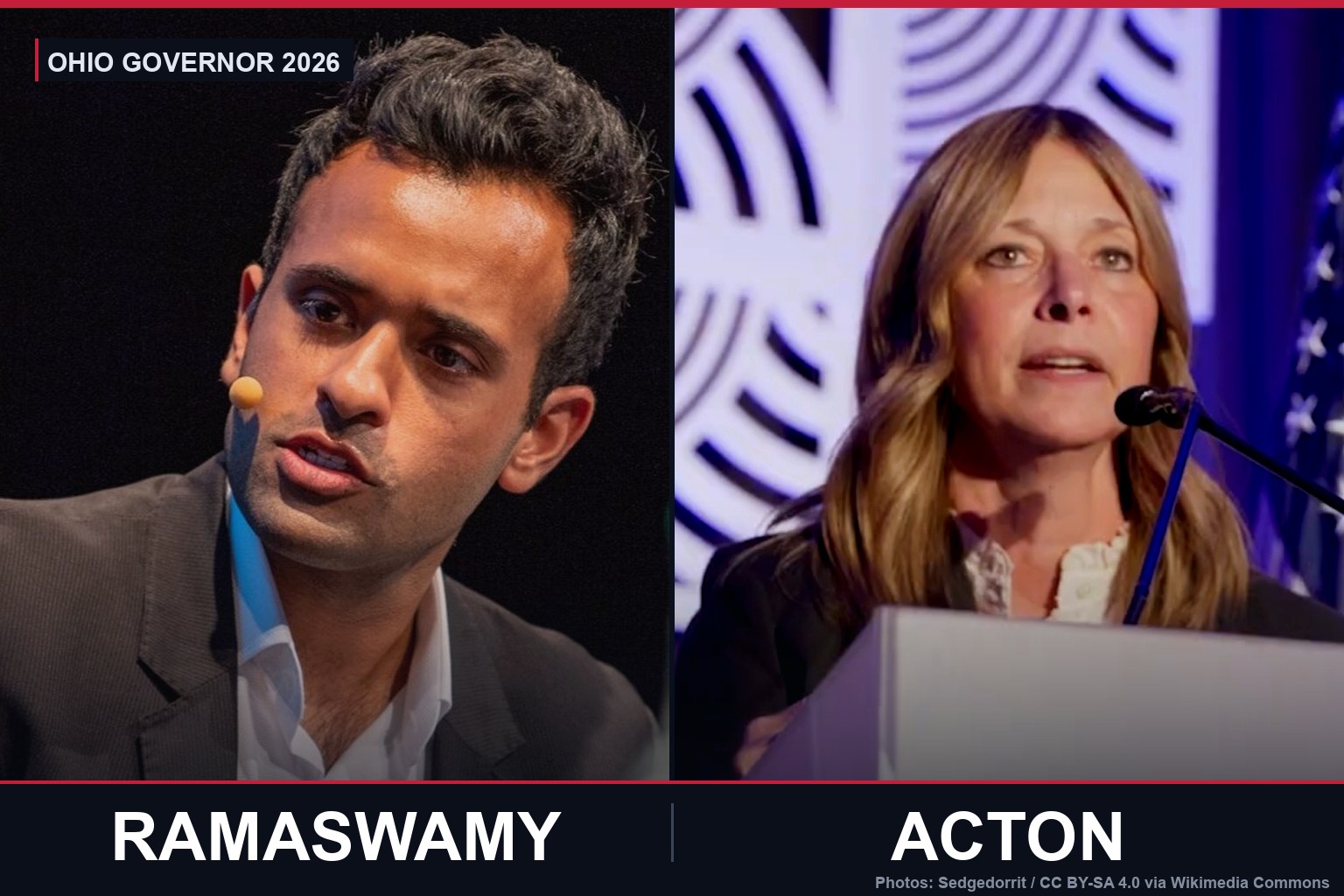
Ohio was supposed to be easy for Republicans in 2026. Donald Trump won the Buckeye State by 11.5 points in 2024 — a margin that has made Ohio's gubernatorial race feel, for much of the past decade, like a foregone conclusion. It isn't.
The race to replace term-limited Republican Governor Mike DeWine has become one of the most closely watched contests of the 2026 midterms, with Republican nominee Vivek Ramaswamy and Democratic nominee Dr. Amy Acton deadlocked in polling through early August. On July 10, the Cook Political Report moved the race from "Lean Republican" to "Toss-Up" — the first time Ohio's governor race has carried that rating since 2018, when DeWine won by just under four points.
Election markets reflect the same uncertainty. With the question of who controls Congress hanging in the balance, competitive governor races like Ohio's are part of the same political ecosystem that has traders watching the midterms day by day.
Who's Running
Vivek Ramaswamy (Republican) is a Cincinnati-born biotech entrepreneur and 2024 presidential candidate who finished behind Donald Trump in the Republican primary before dropping out. Trump has endorsed him for governor, and the Ohio Republican Party backed him more than a year before the May 5 primary. His running mate is Ohio Senate President Rob McColley, a veteran Republican legislator from northwest Ohio. Ramaswamy, 41, has framed his campaign around tax cuts, deregulation, and school choice.
Dr. Amy Acton (Democrat) is the former director of the Ohio Department of Health, the position she held at the height of the COVID-19 pandemic alongside Gov. DeWine in 2020. Her daily briefings with DeWine made her one of Ohio's most recognized public figures — praised across party lines for her composure and empathy during the crisis. Acton, 57, has centered her campaign on affordability, health care costs, and economic relief for working families. Her running mate is David Pepper, the former chair of the Ohio Democratic Party. Cross-partisan endorsements — including former Republican Ohio Attorney General Jim Petro — give her campaign a distinct bipartisan texture.
The Structural Landscape
No Democrat has won Ohio's governorship since Ted Strickland's victory in 2006. Republicans have controlled the statehouse for two decades, and Ohio has moved steadily redder at the presidential level — from a genuine swing state in the Obama years to a state Trump carried by 8 points in 2020 and 11.5 in 2024.
That history makes Acton's polling position genuinely remarkable. Every general-election survey released since June 2026 has placed the race within the margin of error. A New York Times/Siena College poll of 601 likely voters (June 15–28) found it tied at 47 percent each. A bipartisan AARP poll by Impact Research and Fabrizio Ward found Acton leading 47–44. The most recent survey, from Beacon Research and Shaw & Co. (August 6–10, 1,008 registered voters), gave Ramaswamy a narrow 50–48 edge — inside the ±3.0 percent margin of error. A Tulchin Research poll of likely voters (July 29–August 4) had Acton up 46–44.
Polling aggregates through August 12 by Decision Desk HQ showed Acton with a 2.6-point lead; Silver Bulletin and Race to the WH both showed near-ties, with Acton margins under one point.
Forecaster Ratings
Cook Political Report: Toss-Up. The July 10 shift from Lean Republican was the most consequential development of the race so far. Cook editor Jessica Taylor cited Ramaswamy's "clear likeability problem with Ohio voters, even some in his own party," noting that despite millions in advertising, polls "have still shown Acton narrowly ahead or tied." Cook quoted an Ohio GOP source: "This was the wrong guy to roll the dice with in this political environment." Taylor wrote: "Ohio will test whether limitless spending can buy a governor's race even if the candidate has obvious flaws."
ABC News: Toss-Up. ABC moved the race alongside Cook, matching that designation.
Sabato's Crystal Ball: Lean Republican. Sabato's still gives Ramaswamy the edge, citing the state's structural Republican lean and Trump's 2024 presidential margin as factors that create an uphill climb for any Democrat — even one as competitive as Acton.
Daniel Birdsong, professor of political science at the University of Dayton, told Newsweek the shift is well-supported by the data. "Cook Political Report and ABC News have both moved it into toss-up territory. That's remarkable in a state where no Democrat has won governor in 20 years," he said, adding that Ramaswamy's favorability challenges and Acton's crossover appeal explain the race's unexpected competitiveness.
Money and Advertising
This race is on track to be the most expensive gubernatorial contest in Ohio history, shattering the $24 million record set in 2018.
According to campaign finance reports filed with the Ohio Secretary of State, Ramaswamy's total campaign fundraising — including $25 million of his own money — has reached approximately $50 million through mid-2026, with $30.7 million in cash on hand as of June 5. A supportive super PAC has raised an additional $18.6 million, with major donors including Philadelphia investor Jeff Yass ($10 million total), entrepreneur Ratmir Timashev ($5 million), and hedge fund manager Bill Ackman ($1 million), according to Ohio Capital Journal reporting.
Acton's campaign reported raising more than $18 million total through July 10 — a record for an Ohio Democratic gubernatorial candidate. Her cash on hand stood at approximately $8.1 million as of June 5. In terms of donor-only receipts for 2026, Acton has actually outraised Ramaswamy from individual contributors — approximately $11.5 million vs. $9.6 million — per Signal Ohio's reporting on Ohio Secretary of State filings. Seventy percent of her contributions came from Ohioans, with an average donation of $24.
The advertising gap has been dramatic. Between mid-May and the end of June, Ramaswamy's campaign and allied super PAC spent nearly $9 million on television advertising, compared with roughly $100,000 by Acton, according to Ohio Capital Journal reporting. Acton's campaign acknowledged the disparity but signaled a major fall advertising push. "Dr. Acton's record-breaking fundraising numbers, her historic grassroots support and poll after poll make it clear: Ohioans are ready for change," said Acton campaign spokesperson Addie Bullock.
The ad barrage has largely targeted Acton's record as Ohio health director during the pandemic — a strategy that, based on polling through early August, has not moved the numbers in Ramaswamy's favor.
The COVID Battleground
COVID-19 is the central tension of this race, and it cuts in unexpected directions.
Ramaswamy's campaign ads have blamed Acton for school closures and pandemic restrictions. But Gov. DeWine — who remains personally popular in Ohio — publicly stated that any decisions made to shut down schools and businesses were "his and his alone," according to WVXU Ohio Public Radio, effectively blunting the attack's central premise.
Acton's COVID tenure gave her something more durable than a policy record: statewide name recognition and cross-partisan goodwill built during one of the most anxious periods in Ohio history. University of Akron political scientist David B. Cohen told WOSU Public Radio that Acton has "leaned into the role of listener and healer" in a way that resonates broadly. Ramaswamy, Cohen added, has been his own worst enemy.
Abortion: Ohio's 2023 Signal
In November 2023, Ohio voters passed Issue 1, a constitutional amendment enshrining abortion rights, with 57 percent support — an outcome that created a visible paradox: a state that hands Republicans double-digit presidential margins has constitutionally protected abortion access.
As a 2024 presidential candidate, Ramaswamy backed a six-week abortion ban at the state level — precisely the type of restriction Ohio voters rejected via Issue 1. He has called himself "unapologetically pro-life." Acton has pledged to defend abortion rights, contraception access, and fertility treatments if elected, per her campaign site, as reported by Cleveland.com.
The Issue 1 result is a structural advantage for Acton, particularly with women voters. A NYT/Siena survey found Acton leading independents by 28 percentage points — a critical number in a state where statewide margins have been determined by independent voter movement for the past three election cycles.
Ramaswamy's Likeability Problem
Cook Political Report's framing — "clear likeability problem" — has become a recurring theme in coverage of Ramaswamy's campaign. The AARP bipartisan poll found Ramaswamy underwater on favorability: 40 percent unfavorable vs. 36 percent favorable. Acton's numbers were 36 percent favorable and 33 percent unfavorable — a narrower spread.
A specific episode crystallized the contrast. Ramaswamy flew his campaign's private jet to Paris for the Fourth of July weekend while Acton attended Ohio Independence Day events in-state. Acton's campaign has since used the image to reinforce her affordability narrative. "Unlike Vivek Ramaswamy who has spent 40% of his time this year traveling outside of Ohio," said campaign manager Philip Stein in a statement to Newsweek.
The Washington Examiner noted that despite $9 million in advertising, Ramaswamy had failed to close the polling gap or improve his favorability numbers — producing a headline that captured the Republican unease: "Is Vivek Ramaswamy throwing away his chance in Ohio?"
What to Watch Through November
Acton's advertising launch. As of mid-August, Acton holds roughly $8 million in cash and has spent almost nothing on broadcast television. Her campaign has signaled a major fall push. The central question: can an affordability-focused ad campaign with grassroots-funded resources consolidate her polling margin before Ramaswamy's super PAC spends another wave?
The gender gap. Women have been the primary driver of Acton's polling competitiveness. If her advantage with female voters holds or widens — particularly among suburban women who voted for Issue 1 in 2023 — her structural position becomes formidable. If Ramaswamy's COVID attacks shift those voters, the dynamic changes.
Independent voters. A 28-point edge with independents would be decisive if it reflects where the electorate lands on Election Day. Acton's cross-partisan coalition strategy — the former Republican AG endorsement, the moderate-healer branding — is specifically designed to hold those voters.
National environment. Cook's Toss-Up designation came against a backdrop of declining presidential approval ratings. Historically, the president's party loses ground in midterm elections when his approval is low. Newsweek's August 12 analysis noted that Democrats believe deteriorating presidential poll numbers are giving their party genuine competitive opportunities in states like Ohio.
The 20-Year Streak
Democrats haven't won Ohio's governorship since 2006. The structural case for Ramaswamy is real: Ohio's rightward presidential drift, the absence of a Democratic executive track record in Columbus, and the sheer volume of Republican money available for the fall all point in his direction. Sabato's Crystal Ball rates this Lean Republican precisely because of those factors.
But Acton is clearly the strongest Democratic gubernatorial candidate Ohio has fielded in at least a generation — a candidate with $18 million raised, record-setting grassroots support, and cross-partisan appeal that reflects genuine favorable numbers even with Republican voters. Robert Alexander, professor of political science at Bowling Green State University, told Newsweek he expects a competitive race. "Given the dominance Republicans have had in the state over the past 20 years, I think it would still be an upset if Acton is able to win the race," he said — which is another way of saying it is not impossible.
Ohioans vote on November 3.
Sources
- Ohio Capital Journal. Multiple reports, February–August 2026. ohiocapitaljournal.com
- The Columbus Dispatch. "Who will win race for Ohio governor? Key forecaster calls it a toss-up." July 10, 2026. dispatch.com
- WVXU Ohio Public Radio / WOSU Public Radio. "Analysis: Cook Political Report moves Ohio's governor race from 'leans Republican' to 'toss up.'" July 16–17, 2026. wvxu.org / wosu.org
- Signal Ohio. "In Ohio gubernatorial race, Amy Acton outraises Vivek Ramaswamy in 2026." June 22, 2026. signalohio.org
- NBC4i Columbus. "Where Acton, Ramaswamy's reported donations came from in Ohio governor's race." June 30, 2026. nbc4i.com
- Emerson College Polling. "Ohio 2026 Poll: Democrats Make Gains in Races for Governor and US Senate." December 17, 2025. emersoncollegepolling.com
- Washington Examiner. "Acton fundraising matches Ramaswamy as Democrats see hope in Ohio polling." June 29, 2026. washingtonexaminer.com
- Newsweek. "Vivek Ramaswamy's chances of losing to Amy Acton in Ohio — New poll." August 12, 2026. newsweek.com
- Cleveland.com. "Where do Ohio's governor candidates stand on abortion, marijuana and data centers?" July 8, 2026. cleveland.com
- PBS Ohio. "2026 Ohio governor's race snaps into focus." January 2026. pbs.org