
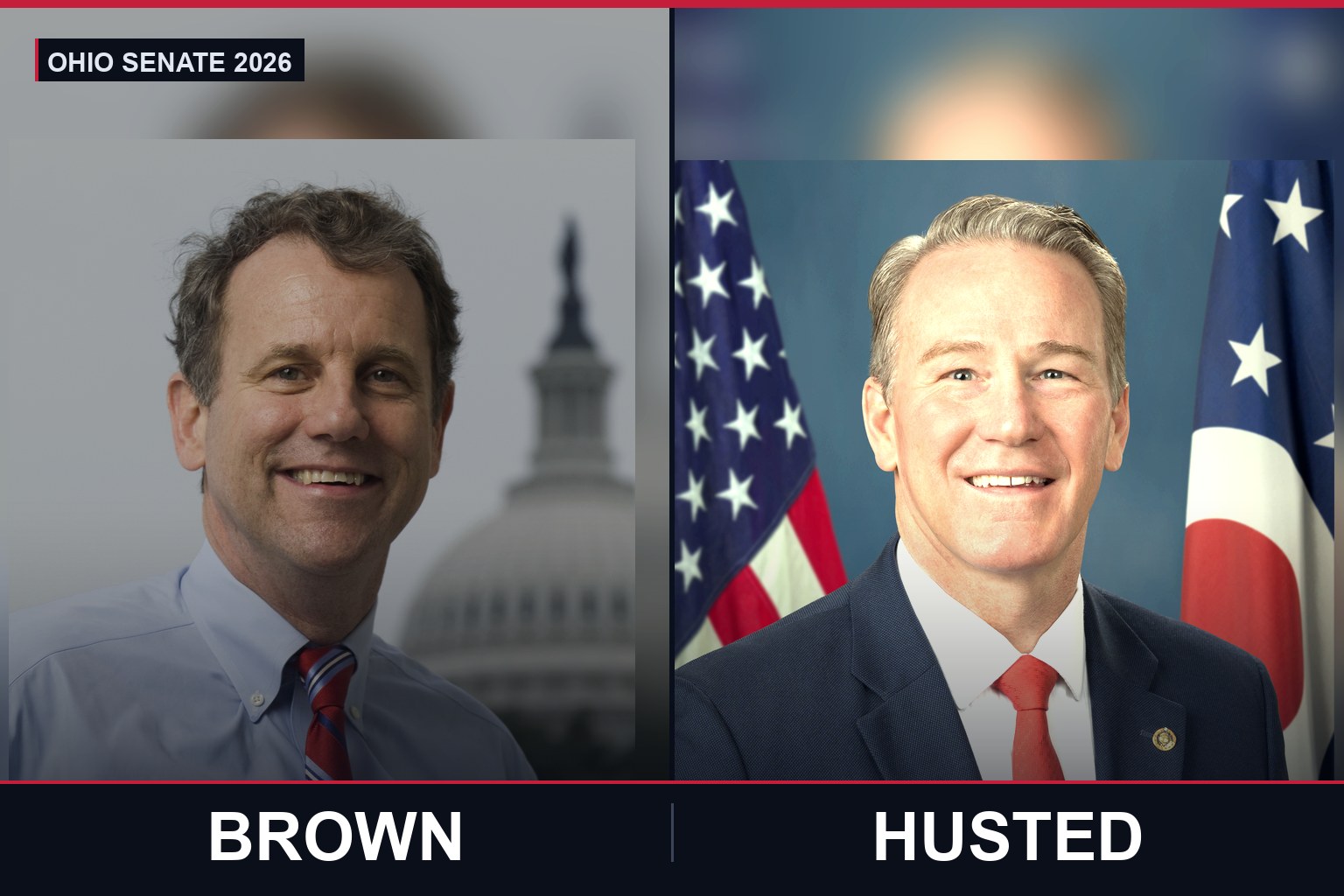
Ohio Senate 2026 Special Election Race Guide: Sherrod Brown vs. Jon Husted
Sherrod Brown vs. Jon Husted in Ohio’s November 3 Senate special election — a Vance vacancy race that could reshape the Senate majority.
Ohio wasn't on the original Senate map for 2026. When JD Vance won the Buckeye State's Class 3 Senate seat in 2022, his six-year term wasn't set to expire until January 2029. But Vance became Vice President in January 2025 — and the moment he vacated that seat, Ohio became one of the most consequential Senate battlegrounds in the country.
The result: a November 3, 2026 special election pitting Republican incumbent Jon Husted — appointed to hold Vance's seat — against former Democratic Senator Sherrod Brown, who is mounting a remarkable political comeback less than two years after losing a different Senate seat to a different Republican. With Senate majority control hanging in the balance and a national political environment that has shifted sharply against the party in the White House, the race is genuinely competitive in a state that Donald Trump won by 11 points just two years ago.
How Ohio Ended Up With an Unscheduled Senate Race
Vance's path from Ohio senator to vice president created the vacancy through straightforward constitutional succession: when he resigned his Class 3 Senate seat in January 2025, Governor Mike DeWine was tasked with appointing a replacement. DeWine chose Jon Husted, his lieutenant governor and a longtime Ohio Republican officeholder, on January 17, 2025.
Under Ohio law, that appointment is temporary. Because Vance's term does not expire until January 2029, a special election is required in November 2026 for voters to choose who finishes the term. The winner will serve approximately two years — through January 2029 — and will then need to run for a full six-year term in 2028 to keep the seat.
It is Ohio's first Senate special election since 1954.
A notable wrinkle for voters: this race involves a seat entirely separate from Ohio's other Senate seat. Republican Bernie Moreno, who defeated Sherrod Brown in November 2024 in the Class 1 race, is not on this ballot. His term runs through 2031. The November 3 special election is solely about who completes JD Vance's Class 3 term.
Jon Husted: The Appointed Incumbent
Jon Husted brings one of the longer political résumés in Ohio to this race. He served as a state legislator, rose to Speaker of the Ohio House, then won two terms as Ohio Secretary of State (2011–2019) before DeWine selected him as lieutenant governor in 2019. His profile is that of a mainstream institutionalist Republican — different in tone and style from the Trump-aligned populism associated with Vance or Moreno — though he holds President Trump's endorsement for this race.
Husted's first campaign advertisement leaned into a biographical frame. "I started my life in a foster home," he says in the ad. "I tell young people, where you start in life doesn't limit your future." His campaign themes center on job growth, economic development, and what his team describes as applying Ohio values to fix Washington.
On fundraising, Husted raised $3.7 million in the third quarter of 2025 alone — described by his campaign as a record for a Republican Ohio Senate candidate at that stage of a race. His campaign held approximately $8.1 million as of mid-April 2026, according to Federal Election Commission filings.
His principal vulnerability, according to multiple polls and persistent Democratic attack lines, is his vote for the federal budget reconciliation bill that reduced Medicaid and other federal safety net spending. Brown has made that vote a centerpiece of his campaign. Husted has also faced a name-recognition deficit: surveys have consistently shown that roughly 40 percent of Ohio voters are unfamiliar with him, limiting his ability to consolidate the Republican-leaning electorate against one of the state's most recognizable political figures.
Sherrod Brown: The Comeback Candidate
Sherrod Brown's political story in Ohio is unlike almost anyone else in the modern Democratic Party. He served as Ohio Secretary of State in the 1980s, represented Ohio's 13th Congressional District in the House for over a decade, and then won his first Senate term in 2006. He won reelection in 2012 and 2018 — years when Ohio was trending increasingly Republican — by tailoring a "dignity of work" message to the state's blue-collar voters and building a reputation as a tenacious advocate on trade, manufacturing, and healthcare. He was, for years, the last Democrat to win multiple statewide elections in Ohio over a three-decade period.
His 2024 reelection campaign against Bernie Moreno ended in defeat by approximately 3.5 percentage points — even as Brown ran roughly 10 points ahead of the top of the Democratic ticket, a testament to his crossover appeal. After losing, Brown and his wife, journalist Connie Schultz, relocated to Bexley and initially gave no indication of another Senate run.
Senate Minority Leader Chuck Schumer changed that calculus. Schumer traveled to Ohio twice to persuade Brown to choose a Senate bid over a potential run for governor. Brown announced his candidacy in August 2025, citing what he described as worsening conditions for Ohio workers. "I didn't plan to run for office again, but when I see what's going on, I know I can do something about it for Ohio," he said in his launch video.
He raised $3.6 million in the first 24 hours. His campaign held approximately $17 million as of mid-April 2026 — more than double Husted's total — per FEC filings. He won the Democratic primary on May 5, 2026, with roughly 93 percent of the vote against political newcomer Ron Kincaid. Husted ran unopposed on the Republican side.
The Cook Political Report's Jessica Taylor has described the unusual framing of this matchup directly: "Brown functions more as the incumbent in this race, while the appointed Husted is a comparative newcomer." The observation captures something real: Brown has held statewide office in Ohio for longer than Husted has been in any elected role, and his name recognition — even after losing in 2024 — remains substantially higher than Husted's.
Brown has trained his campaign on Husted's Medicaid vote and what he calls a pattern of prioritizing special interests. "The worst has been the big, whatever they call it — big, ugly bill, big, beautiful bill," Brown told NBC News. "By any measure, this is the worst vote he's cast in the Senate, but it's a continuum of his running for special interests his whole career."
How the Polls Have Moved
The polling arc of this race traces the broader national political environment's evolution more clearly than almost any other 2026 Senate contest.
When Brown announced his candidacy in August 2025, he trailed Husted by six points (50–44) in an Emerson College survey — a reasonable starting gap for a candidate who had just entered the race against an appointed incumbent with Trump's backing. Cook Political Report responded to Brown's entry by moving its rating from Likely Republican to Lean Republican.
Through the fall and winter of 2025, surveys tightened. An Ohio Federation of Teachers-commissioned poll conducted by Hart Research in November 2025 showed Brown ahead by three points. A December Emerson survey showed Husted back ahead by three. By early 2026, the race was effectively even across most public polling.
The spring brought further movement toward Brown. A Fox News survey conducted by Beacon Research and Shaw & Company Research (May 28–June 1, 2026, 1,015 registered voters, ±3 points) showed Brown ahead by eight points, 53 to 45 — the largest Democratic lead of any survey to date. The same poll found President Trump's favorability in Ohio at 42 percent, a notable decline from his 11-point margin in the state in 2024.
More recent surveys have pulled back toward a toss-up. A New York Times/Siena College survey of 601 likely voters conducted June 15–28 showed Husted ahead by three points, 50–47 (±4.7 percent). An AARP-commissioned survey released June 25 showed Brown leading 48–45, within the 3.5-point margin of error. The Columbus Dispatch described the latter as a "statistical tie."
Polling aggregators through early July put the race at Brown +0.6 (RealClearPolitics), Brown +0.8 (Race to the WH), Brown +1.5 (Decision Desk HQ), and Brown +2.6 (270toWin) — a narrow and contested lead that reflects a genuine battleground race.
Several demographic patterns have appeared consistently: women, voters under 40, independents, and suburban voters tend to favor Brown; white men without a college degree, rural voters, and white Evangelical Christians favor Husted. Among Republican voters, a notable share — roughly 13 percent of all Republicans and 31 percent of non-Trump-aligned Republicans in the Fox News survey — said they would vote for Brown over Husted.
The Issues Driving Ohio Voters
The Fox News poll asked likely Ohio voters which issue would most influence their Senate vote. Inflation and high prices led by a significant margin: 43 percent named it as the top factor. Healthcare came second at 12 percent, followed by immigration and border security (11 percent), political divisions (9 percent), jobs and unemployment (8 percent), and abortion (4 percent).
The healthcare number is notable. Ohio was an early state to expand Medicaid under the Affordable Care Act — former Republican Governor John Kasich pushed it through in 2013 over opposition from the state legislature. That Medicaid expansion has broad bipartisan support in Ohio. Brown's attacks on Husted's vote for federal Medicaid reductions have found traction specifically in a state where the program's reach is both wide and politically entrenched.
On economic themes, both candidates are making versions of the same argument — that the other represents the wrong direction for Ohio workers — with Brown emphasizing trade, wages, and healthcare costs, and Husted emphasizing job creation, fiscal responsibility, and alignment with Trump's broader economic agenda.
Historical Context: A Seat That Has Been Republican for Two Decades
Ohio's Class 3 Senate seat has been held by Republicans without interruption since 2004. Rob Portman won it by 17.8 points in 2010 and 21 points in 2016. JD Vance won it by 6.6 points in 2022, in a cycle when Democrats held the Senate majority. That history matters: even in favorable national environments for Democrats, this specific seat has not been competitive at the top of the ballot within living memory of most Ohio voters.
Brown's singular quality — as a Democrat who has consistently broken through Ohio's Republican-leaning federal electorate — is the core reason forecasters moved the race out of the Likely Republican column the moment he entered. His 2018 reelection win of 6.8 points came while Ohio moved further right in presidential elections and while his party was on the defensive in Senate races across the Midwest. Whether that coalition holds for a seat he has never previously held, in a cycle where he is technically the challenger, is the central open question.
Senate Majority Implications
Republicans currently hold a 53–47 Senate majority. Because Vice President Vance breaks ties in favor of Republicans, Democrats would need to reach 51 seats — a net gain of four — to retake functional majority control after the 2026 elections.
The Ohio special election is one of the relatively rare 2026 races where a Democratic victory would constitute a true net flip: Husted technically holds the seat, so a Brown win would move a Republican-held seat into the Democratic column. For Republicans, holding Ohio is a meaningful contribution to keeping that 53–47 wall intact even if other seats — Maine, North Carolina, Alaska — fall their way. For Democrats, Ohio is not a required win on every path to a majority, but it shortens the path considerably.
For a live look at Senate majority odds and the broader 2026 race landscape, the Senate control tracker and full races hub at electionpredictions.us track the most current data.
What to Watch Between Now and November
Outside spending. Brown's $17 million to Husted's $8.1 million fundraising gap is substantial heading into the summer, but Republican super PACs and Senate leadership PACs have designated Ohio as a top priority. The first wave of large outside ad buys — expected by late August — will signal how much the national party is willing to spend to hold this seat.
Healthcare and the Medicaid vote. Ohio's Medicaid expansion has cross-partisan support. How Husted addresses the Brown campaign's attacks on his vote for Medicaid reductions — and whether he can reframe the issue around fiscal responsibility versus beneficiary access — will be central to the fall campaign's shape.
Trump's Ohio approval. The June Fox News poll showed Trump's favorability at 42 percent in a state he won by 11 points just 18 months earlier. If his approval stays below 45 percent in Ohio through October, the drag on Husted is real and persistent. A recovery in Trump's numbers would push the structural lean of the state back toward Husted.
The governor's race interaction. Ohio voters will simultaneously choose between Republican Vivek Ramaswamy and Democrat Dr. Amy Acton for governor on November 3. How voters split — or don't — between the Senate and governor's races will be one of the genuinely interesting dynamics to watch. Some surveys have found Brown voters who say they plan to cross over and vote for Ramaswamy for governor, suggesting the two races are not running in lockstep.
The 2028 question. Whoever wins the November special election will face another election in 2028 for a full six-year term. Brown has been publicly noncommittal about whether he would run again in 2028 if he wins in November. That uncertainty adds a strategic layer to how both parties will evaluate the long-term value of the seat relative to their spending decisions this fall.
Sources
- NBC News — Brown campaign launch (August 18, 2025): nbcnews.com
- The Hill — Emerson poll, Husted +6 (August 22, 2025): thehill.com
- Fox 8 Cleveland / Emerson College — Emerson poll detail (August 22, 2025): fox8.com
- NBC4 WCMH Columbus — Race overview and DeWine appointment (January 2, 2026): nbc4i.com
- Ohio Capital Journal — OnMessage poll, Brown +2 (March 18, 2026): ohiocapitaljournal.com
- NBC News — Brown wins Democratic primary (May 5, 2026): nbcnews.com
- Columbus Dispatch — Brown-Husted general election set (May 5, 2026): dispatch.com
- Ballotpedia — Race overview with Cook Political quote (June 8, 2026): news.ballotpedia.org
- The Hill — Fox News poll, Brown +8 (June 4, 2026): thehill.com
- NBC4 WCMH Columbus — Fox News poll detail and issues data (June 5, 2026): nbc4i.com
- Columbus Dispatch — AARP poll (June 26, 2026): dispatch.com
- New York Times — Ohio Senate polling tracker including NYT/Siena June data (July 28, 2026): nytimes.com
- NPR — 2026 competitive Senate map (July 27, 2026): npr.org
- USA Today — Race background (September 16, 2025): usatoday.com