Oklahoma Governor 2026 Runoff Guide: Mike Mazzei vs. Gentner Drummond and the Trump Test on August 25
Trump-endorsed Mazzei vs. AG Drummond in Oklahoma's GOP governor runoff on Aug. 25. Prediction markets favor Mazzei; the latest poll shows a 44-44 dead heat.
Nine Republicans entered Oklahoma's June 16 gubernatorial primary. None left with a nomination.
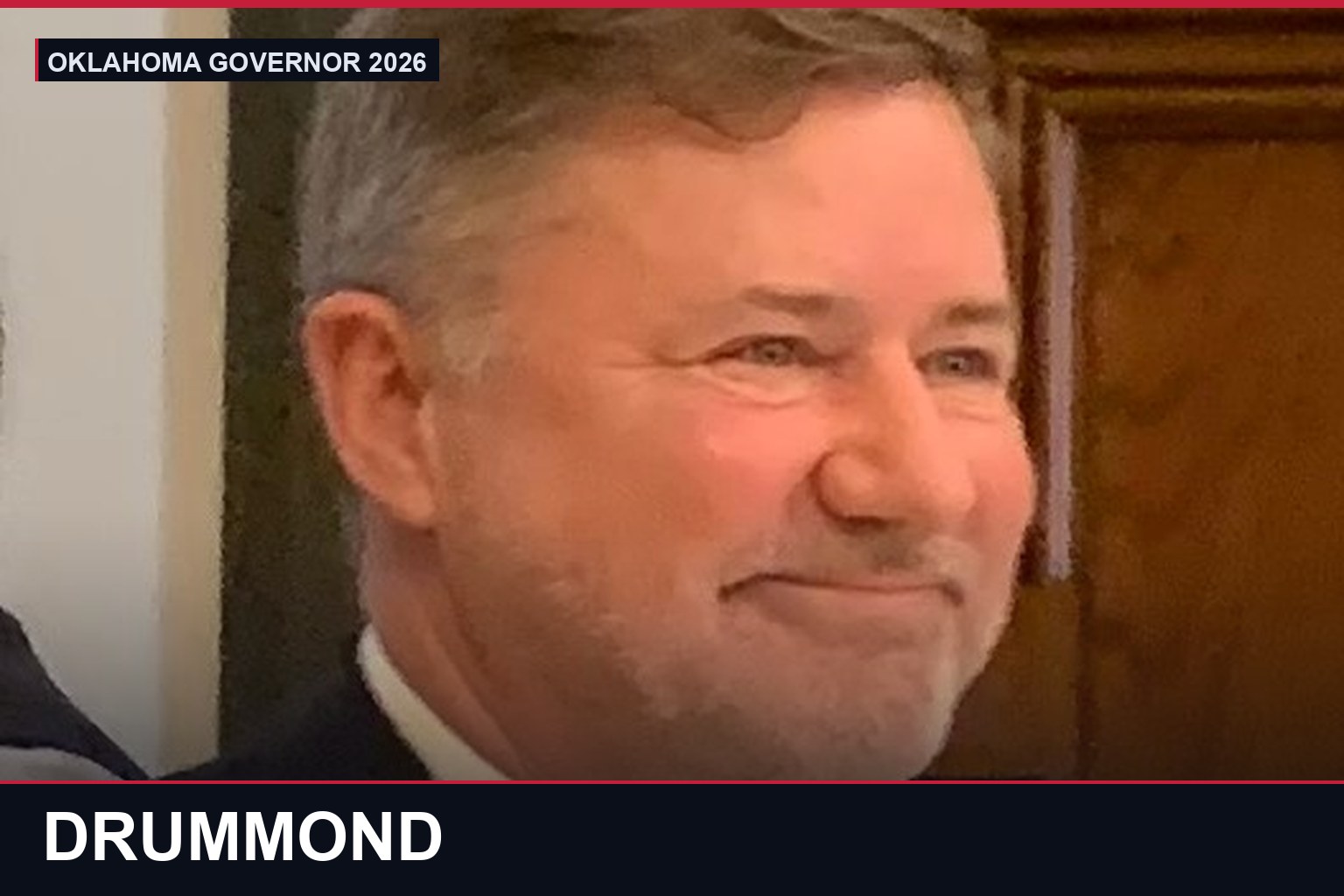
When the votes were counted, Attorney General Gentner Drummond had narrowly edged former state Sen. Mike Mazzei — by fewer than 1,200 votes out of more than 400,000 cast. Both finished at roughly 26 percent, well short of the 50-percent threshold required to avoid a runoff under Oklahoma law. On August 25, they go again.
The August 25 runoff is the functional governor's race in a state where the Republican nominee hasn't lost a general election since 2010. But it has become something larger: a live test of whether a presidential endorsement, delivered at maximum volume, can overcome a candidate with broader institutional support in Oklahoma's own backyard.
How Nine Candidates Became Two
The June 16 primary featured a crowded field with real name recognition, serious money, and genuine policy contrasts. Drummond entered as the long-presumed frontrunner, leading pre-primary polling by double digits through most of 2025. Former House Speaker Charles McCall, former Secretary of Public Safety Chip Keating — son of former Gov. Frank Keating — and former state Sen. Jake Merrick rounded out the top tier.
Then, on May 29, Trump posted his endorsement of Mazzei on Truth Social.
The impact was immediate. Pre-endorsement surveys had placed Mazzei in the high teens. Post-endorsement polling showed him at 26 percent — dead even with Drummond. On election night, Drummond finished first with 105,832 votes (26.3%) and Mazzei second with 104,691 (26.0%), per New York Times primary results. Keating took 18.5%, Merrick 14.5%, and former House Speaker McCall 11.8%, with four additional candidates splitting the remainder.
Self-funding in the Republican field shattered prior Oklahoma records. The top candidates collectively loaned or contributed more than $22 million of their own money to their campaigns, according to Oklahoma Voice — the most expensive self-funded gubernatorial primary in state history. Despite that spending, no one broke through to a majority, and the race narrowed to two.
The Candidates
Gentner Drummond is the current attorney general — a job he has held since 2023 — and a former fighter pilot. He came into the race as the recognized frontrunner, backed by institutional Oklahoma: law enforcement, the legislature, local officials, and editorial boards. His closing message is simple: he has governed, he has delivered, and his endorsements come from people who live and work in the state. "I put Oklahoma first," he has said repeatedly since the primary.
Mike Mazzei served in the Oklahoma State Senate for 12 years, leaving in 2016 after winning six consecutive terms representing District 25. He later served as Gov. Kevin Stitt's Secretary of Budget from 2019 to 2020 before moving into wealth management. His runoff campaign has been organized almost entirely around the Trump endorsement and a promise to move Oklahoma "in a more conservative direction." He frames the race in binary terms: he is the president's choice; Drummond is not.
The Smelter That Split the Race
The clearest policy fault line is a proposed aluminum smelter in Inola, Oklahoma — a Trump-backed industrial project that both candidates have had complicated relationships with.
Mazzei initially had reservations about the project. After Trump's endorsement, he came out in support, calling it part of the president's "big agenda for the state" and arguing it could bring new jobs and investment to Oklahoma. He has been direct about changing his position, citing greater familiarity with the project's details, according to KOCO 5 News.
Drummond, as attorney general, took legal action against the project — a decision his campaign frames as a matter of legal obligation and process rather than opposition to the president. He has cited the flip as central to his case against Mazzei. "This runoff is not about finding a candidate you agree with 100% of the time. It's about choosing a leader you can trust 100% of the time," Drummond said, per KOSU. He has repeatedly called Mazzei "a politician who changes with the political winds."
The contrast has given each candidate a clean rhetorical line. Mazzei can make the Trump endorsement concrete — this isn't just loyalty in the abstract; it's support for a specific project the president wants built. Drummond can press his consistency argument without directly criticizing the president: he's not against Trump, he's for legal process and Oklahoma's interests.
The Endorsement Map
The two candidates have assembled starkly different coalitions — one national, one local.
Mazzei's endorsers include President Trump (who has endorsed him at least three times), Gov. Kevin Stitt, Arkansas Gov. Sarah Huckabee Sanders, U.S. Rep. Josh Brecheen, the Club for Growth PAC, the Oklahoma Second Amendment Association, and former state Sen. Jake Merrick — who finished fourth in the primary with 14.5% of the vote and has since backed Mazzei, according to Tulsa-area political reporting. As of late July, Mazzei held the support of six of the 39 Republican state senators and five of the 81 Republican state representatives, per News9.
Drummond's endorsers include the Oklahoma Fraternal Order of Police, the Professional Fire Fighters of Oklahoma, the Oklahoma State pharmacists association, educators, Tulsa County Sheriff Vic Regalado and 27 other county sheriffs, former Tulsa Mayor G.T. Bynum, Reid Newspapers, and former Oklahoma State football coach Barry Switzer. His legislative support is substantially broader: 10 of 39 Republican state senators and 27 of 81 Republican state representatives as of July 30, per News9 and NewsOn6.
The asymmetry is clear. Mazzei's biggest backers are louder; Drummond's are more numerous within Oklahoma. Mazzei's campaign calls the national backing a feature — proof he can deliver federal resources and alignment. Drummond's response: "While Mike Mazzei gets endorsements from people that don't live in Oklahoma, I have endorsements from Professional Fire, Fraternal Order of Police, the pharmacists, the educators, scores of representatives and senators, the majority of sheriffs."
The Market, the Polls, and the Gap Between Them
Prediction market consensus prices Mazzei as a substantial favorite at 75 cents against Drummond's 25 cents heading into the final nine days.
The polling picture tells a different story.
The most recent independent survey, conducted by CHS & Associates and released August 11 through KFOR, found Drummond and Mazzei tied at 44 percent each among 600 likely Republican runoff voters, with 12 percent undecided. "It's just an incredibly close race right now," pollster Pat McFerron told KFOR.
The same survey found a revealing divide by voter self-identification. Among Republicans who call themselves "Trump Republicans" — 38 percent of the sample — Mazzei leads 62 to 22. Among "traditional Republicans" — 56 percent of the sample — Drummond leads 60 to 30. McFerron made a key observation: "I have always felt that endorsements are generally overrated by political observers more than they are by voters. And I think especially when it comes to a governor's race, that delta is even wider."
A Club for Growth Action poll released in late June — from an organization that has endorsed Mazzei — showed him ahead by six points. That survey should be read with appropriate context given the source's stake in the outcome.
So why does the market price Mazzei so much heavier than the independent poll suggests?
Several factors likely explain the premium. Low-turnout August runoffs favor organized, ideologically engaged voters — precisely the demographic most responsive to a presidential endorsement. The June 16 primary drew roughly 403,000 Republican votes; the August 25 runoff will almost certainly draw fewer. In that smaller, more motivated electorate, national energy can tip the scales.
Merrick's voters — 14.5% of the primary electorate — now have an explicit endorsement pointing them toward Mazzei. And there is a historical data point markets may be pricing: in 2018, Kevin Stitt — then an outsider businessman — defeated the institutionally-backed former Oklahoma City Mayor Mick Cornett in the Republican runoff 54.6% to 45.4%. Stitt is now endorsing Mazzei. The pattern of the insurgent outsider prevailing in Oklahoma Republican runoffs has recent precedent.
The 12 percent of undecided voters hold the critical variable. If they break toward the Trump-endorsed candidate — as undecideds in Republican primaries have frequently done in cycles where presidential alignment carries cultural weight — the final margin could diverge significantly from the current poll average.
Cyndi Munson and the November Math
While Republicans settle their runoff, Democratic nominee Cyndi Munson is already campaigning for November 3.
Munson, the House Minority Leader, has represented Oklahoma City's District 85 since winning a 2015 special election — when she became the first Asian American woman elected to the Oklahoma State Legislature — and won the June 16 Democratic primary with 75.1% of the vote over former Sen. Connie Johnson and a third candidate, per KOSU election results.
Her platform centers on increasing public school funding and teacher pay, cutting taxes for working- and middle-income residents, expanding healthcare access, and putting Oklahoma's near-total abortion ban to voters through a ballot referendum. She raised approximately $1.1 million total ahead of the primary, according to Oklahoma Voice — a fraction of the $22 million the top Republican candidates self-funded — and has framed her small-dollar, ground-game approach as a contrast to the GOP field's "buying your way to the office."
The structural math for Munson is daunting. Republicans have held the Oklahoma governorship since January 2011 and control all statewide elected offices. Joy Hofmeister, the 2022 Democratic gubernatorial nominee, lost to Stitt 55.4% to 41.8%. Trump carried Oklahoma by more than 30 percentage points in 2024, per New York Times presidential results. No Democrat has won the governor's race here since Brad Henry's term ended 16 years ago.
Munson's path runs through a favorable national environment, strong turnout among non-Republican voters, and the possibility that abortion rights — which passed as a referendum at 57% in Ohio in 2023 and has driven Democratic performance in multiple states — generates a similar dynamic in Oklahoma. It is a steep climb. Whether the general election delivers a surprise depends largely on forces that extend well beyond state lines.
What to Watch Before August 25
The final days of the runoff will be defined by turnout mechanics as much as persuasion. Early voting opens August 21. Which campaign better mobilizes its coalition — Mazzei's national-energy MAGA infrastructure or Drummond's deep bench of Oklahoma institutional allies — will likely determine the outcome.
The 12 percent of undecided likely voters deserve special attention. In a race this close, that bloc is the entire margin. McFerron noted that polling shifted during the period of a recent candidate debate, suggesting voters are still processing the contrast and are persuadable in the final stretch.
What is not in doubt: whoever emerges from August 25 becomes the overwhelming favorite to govern Oklahoma beginning in January 2027. The Republican who wins the runoff will face Munson and three independent candidates in November in one of the most reliably red states in the country.
Oklahoma has seen this specific kind of fight before — the Trump-aligned outsider against the institutional frontrunner, in a low-turnout August runoff, with the establishment's endorsements stacked against the national energy. In 2018, the outsider won.
Sources: KOSU Oklahoma Public Radio; KFOR Oklahoma City; News9 (KWTV); NewsOn6 (KOTV); KOCO 5 News; The Oklahoma Voice; Journal Record; Tulsa Flyer; NonDoc Media; C-SPAN gubernatorial debate coverage; New York Times 2026 Oklahoma primary results; NBC News 2026 Oklahoma primary results.