

Oregon Senate 2026 Race Guide: Jeff Merkley Seeks a Fourth Term Against David Brock Smith
Oregon Senate 2026: Merkley seeks a fourth term against Republican David Brock Smith. Race ratings, fundraising gap, prediction market context.
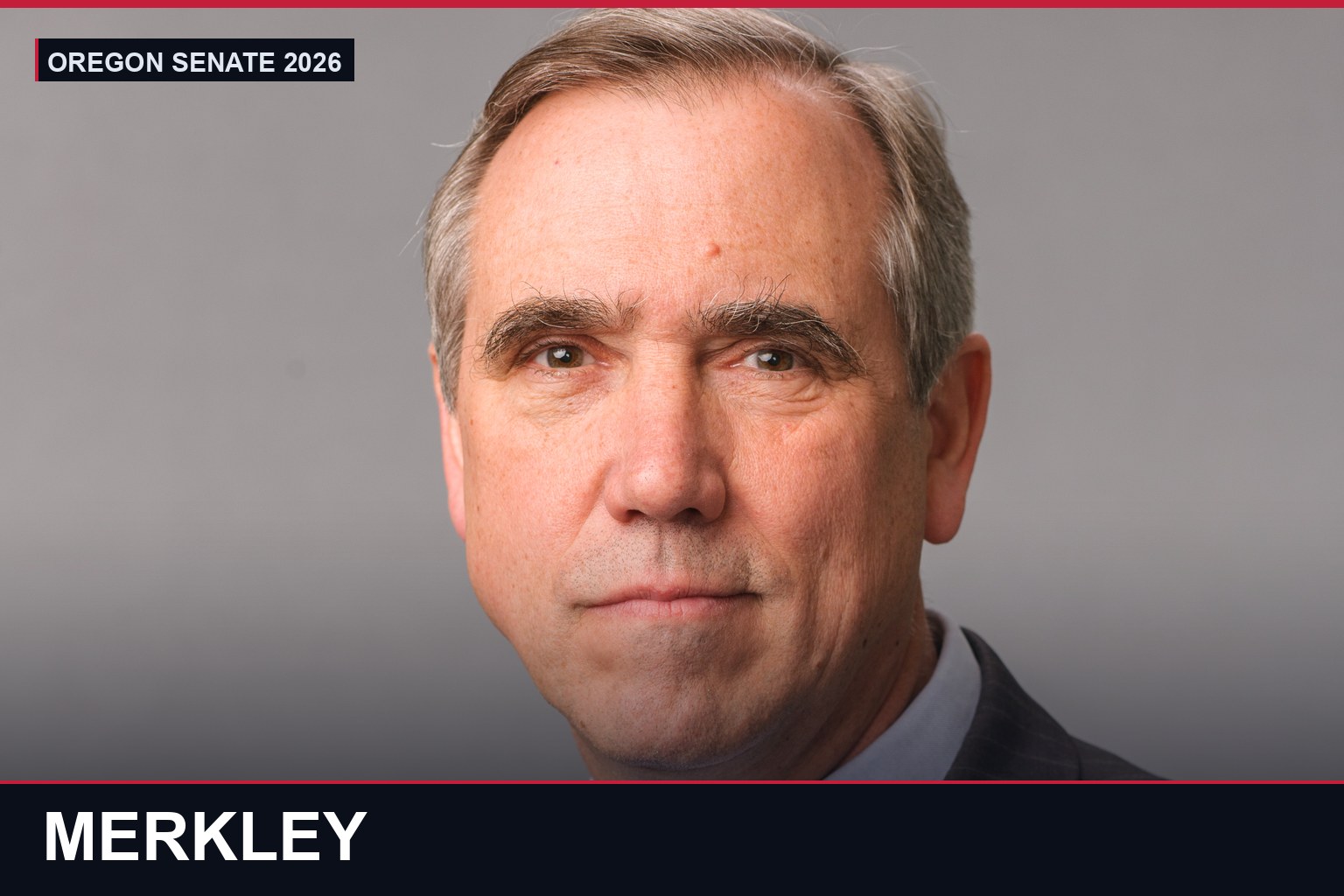
Oregon's 2026 U.S. Senate race arrives at November with one of the most lopsided structural pictures in the country — a 17-year incumbent, a $6.8 million cash-on-hand advantage, and a state that has not elected a Republican senator in nearly a quarter century. Yet every election cycle someone tries. In 2026, that someone is David Brock Smith, a state senator from the southern Oregon coast who survived a seven-way Republican primary to become his party's nominee against Jeff Merkley.
For readers tracking the broader contest over which party controls the Senate after November, prediction markets currently price Republican control at roughly 55 percent — a competitive national environment where individual races can matter at the margins. Oregon, given its structural lean, factors into that picture mainly as a baseline hold for Democrats.
The Race at a Glance
Democratic incumbent Jeff Merkley faces Republican state senator David Brock Smith on November 3, 2026. Every major rating organization — Cook Political Report, Sabato's Crystal Ball, Inside Elections, Decision Desk HQ, Fox News, The Economist, and RealClearPolitics — rates the race Solid or Safe Democratic. No independent public polling has captured a general-election matchup as of early August. Oregon's Cook Partisan Voting Index sits at D+8, and Kamala Harris carried the state by 14.3 points in 2024.
Jeff Merkley: 17 Years, Three Landslides, One Origin Story
Merkley was born in 1956 in Myrtle Creek, Oregon — a small timber community in the Douglas County hills. He holds a bachelor's degree from Stanford University and a master's in public affairs from Princeton's School of Public and International Affairs. Before the Senate, he served as Oregon's House Speaker.
His path to Washington was genuinely hard-won. In 2008, he unseated Republican incumbent Gordon Smith by 3.4 percentage points — one of the closer Democratic Senate wins of that cycle. Subsequent re-elections were not close: he won in 2014 by 17.9 points and in 2020 by 17 points over then-Republican nominee Jo Rae Perkins. He is now 69 years old, seeking a fourth six-year term.
Merkley has built a national profile primarily through Senate procedural reform. He has been the chamber's most persistent advocate for converting the filibuster to a "talking filibuster" — requiring senators to hold the floor continuously rather than invoking a threat and stepping away. On policy, his record spans environmental legislation, housing advocacy, and veterans' affairs. He is the only member of Congress who has spoken openly about spending time in a homeless shelter as a teenager, a personal history that has animated his housing and poverty work throughout his career.
His May 19, 2026 Democratic primary performance reflected the depth of his advantage: 93.2 percent of the vote against token opposition, per certified results reported by The New York Times. Federal Election Commission data through June 30, 2026 shows Merkley's campaign raised $7.89 million cycle-to-date, spent $4.87 million, and held $6.83 million in cash on hand.
David Brock Smith: The Southern Oregon Coast's Best Shot
Smith, a Republican from Port Orford, is a third-generation resident of Southwest Oregon. His biography runs through the region's civic institutions: Port Orford City Council president, Chamber of Commerce president, Curry County Commissioner, Oregon House of Representatives (2017–2023), and Oregon State Senate (appointed January 2023 to fill the vacancy left when Dallas Heard resigned). He serves in Senate District 1, which covers Curry County and portions of Coos, Jackson, and Douglas counties — a heavily Republican stretch of the southern coast and adjacent inland areas.
His professional background before elected office centered on running his family's restaurant in Port Orford for roughly 45 years. He holds an associate's degree from Southwestern Oregon Community College and a bachelor's from Southern Oregon University. His official Oregon Legislature biography lists committee assignments spanning energy and environment, natural resources, agriculture, and veterans' affairs.
Smith announced his Senate campaign on March 3, 2026, describing himself to local media as focused on affordability for working families, wildfire prevention and forest management, public safety, and addiction accountability. In Salem, colleagues across the aisle noted his bipartisan reputation — he sits on the Oregon Legislative Sportsmen's Caucus and the Coastal Caucus, both cross-party coalitions, and cited his work on reforming Measure 110 drug decriminalization law as an example of deal-making across party lines.
He was the only elected official in the Republican primary field and the candidate the party establishment coalesced around — though narrowly. He won the May 19 primary with 29.5 percent of the vote in a seven-way field, per The New York Times' certified primary results. Former two-time nominee Jo Rae Perkins finished second at 27.1 percent; commercial real estate broker Brent Barker took third at 23.3 percent. The spread underscored how thin Smith's name recognition remained outside his coastal district.
FEC data through June 30, 2026 shows Smith's campaign raised $120,760 total, spent $91,781, and held $28,980 in cash on hand. That is a roughly 235-to-1 cash-on-hand disadvantage against Merkley.
What Would It Take?
Republicans have not won an Oregon Senate race since Gordon Smith's 2002 re-election — a drought now approaching 24 years. Since then, the state has shifted from genuinely competitive at the federal level to reliably Democratic. Democrats currently hold both Senate seats, all statewide offices, all but one congressional seat, and supermajorities in both chambers of the Oregon Legislative Assembly, according to available state election records.
The presidential trendline makes the structural picture concrete. Oregon backed Democratic presidential candidates by double digits in each of the last five cycles: Harris +14.3 (2024), Biden +16.1 (2020), Clinton +11.0 (2016), Obama +12.2 (2012), and Obama +16.6 (2008).
For Smith to win, he would need a partisan wave far beyond what the current Senate control market prices — combined with either a Merkley-specific vulnerability or a collapse in Democratic turnout in the Willamette Valley. None of those conditions register as live. No national rating organization has moved the race. No outside Republican spending surge into Oregon has appeared in FEC filings. No public polling as of early August shows a competitive margin.
Willamette Week, endorsing Merkley in the May primary, wrote that "it's unlikely a Republican will unseat U.S. Sen. Jeff Merkley, who hasn't dipped below 55% of the vote in his two successful runs for Congress since his narrow victory over incumbent Gordon Smith in 2008" — identifying Smith as the party's best available option while not characterizing the general election as competitive.
Smith's platform positions also present a structural tension with statewide audiences. His 2025 bill to end Oregon's statewide vote-by-mail system — in place since 2000 and the first such system in the nation — received no traction in the Democratic-controlled legislature and gives opponents a ready contrast on ballot access. His opposition to the POWER Act, aimed at shielding consumers from energy rate increases driven by data center development, drew attention during the primary as candidates debated the state's energy infrastructure trade-offs.
Oregon's Political Geography
Oregon's population is concentrated in the Portland metropolitan area and the Willamette Valley, where the Democratic margin is large and durable. Suburban growth over the past decade has extended that advantage. Eastern and southern Oregon — including Smith's home territory — lean strongly Republican but have far smaller populations. The geographic split is real, but the arithmetic is not close.
Oregon's vote-by-mail system, in place since 2000, produces consistently high turnout across the electorate. High-turnout environments generally benefit the party with the structural population advantage. Oregon's Democratic majority in the legislature has no interest in revisiting the system, and any effort to do so would face a governor's veto.
Historical Context: The 2002 Dividing Line
Gordon Smith was the last Republican to win an Oregon Senate seat, re-elected in 2002. Merkley ended Smith's tenure six years later. Smith was himself a notable case — a moderate Republican who represented Portland's suburbs and built cross-partisan appeal at a time when Oregon's suburban voters had not yet aligned as firmly with Democrats as they would by the 2010s and beyond.
The lesson from Smith's career — and from Merkley's narrow 2008 win — is that Oregon Senate races can be competitive when the right candidate, right environment, and right opponent line up simultaneously. Smith lost his 2008 race despite strong name recognition and incumbent advantages, in part because the national Democratic wave was significant and Merkley ran a disciplined campaign against a moderate Republican whom Oregon Democrats could credibly contest.
In 2026, the conditions run in the opposite direction for Republicans: Merkley holds the structural advantages of incumbency and fundraising, the state has moved further Democratic since 2008, and Smith lacks the name recognition, resources, or statewide profile that Smith had when he fell.
The Market Context
No active prediction market on the Oregon Senate general election is currently offered, which reflects how little perceived uncertainty surrounds the outcome. Oregon's result matters to Senate control only in a scenario where the Democratic wave is so catastrophic that it reaches well beyond the genuine toss-up states.
The Senate control market — which aggregates expectations across all 35 seats in play — provides the meaningful frame:
The 55 percent Republican pricing on Senate control reflects the competitive states: Alaska, Michigan, Texas, Maine, Ohio, Georgia, Iowa, and North Carolina. Oregon is not among them.
Dates and What to Watch
The general election is November 3, 2026. Oregon's all-mail voting means ballots begin arriving at voters' homes approximately two weeks before the deadline, with the state election division typically delivering the first wave around October 20.
FEC Q3 report (due late October): A significant infusion of outside Republican money into Oregon between July and September would be the clearest early signal that national Republican strategists have revised their assessment of the race. The absence of such spending would confirm the current consensus.
Public polling: No independent pollster has released a general-election survey as of early August. Any credible poll showing a margin inside 10 points would represent a significant development and would likely prompt re-ratings from national organizations.
National environment: If the broader midterm environment shifts substantially toward Republicans in the fall — driven by economic data, foreign policy, or candidate-specific events in other states — Oregon would be one of the last states to move, but could be worth watching at the margins.
Smith's fundraising trajectory: At $28,980 in cash on hand as of June 30, Smith will need a significant outside-money infusion to run a visible statewide campaign in Oregon's media markets. Without it, he will struggle to reach voters beyond his base.
The Oregon Senate race is, in most plausible scenarios, one of the more predictable outcomes in the 2026 cycle. The more useful question it poses is what conditions would need to be in place for a Republican to be competitive in a D+8 state — and whether any of those conditions are emerging on the current map.
The general election is November 3, 2026.
Sources
- Federal Election Commission — 2026 Oregon U.S. Senate campaign finance filings (as of June 30, 2026): https://www.fec.gov/data/candidate/?state=OR&district=00&election_year=2026&office=S
- Oregon Public Broadcasting — "David Brock Smith wins GOP primary for US Senate in Oregon" (May 22, 2026): https://www.opb.org/article/2026/05/22/david-brock-smith-us-senate-oregon/
- Oregon Capital Chronicle — "Coastal Oregon conservative announces run for U.S. Senate" (March 3, 2026): https://oregoncapitalchronicle.com/2026/03/03/coastal-oregon-conservative-announces-run-for-u-s-senate/
- Oregon Capital Chronicle — "Oregon's U.S. Sen. Jeff Merkley will seek re-election in 2026" (July 10, 2025): https://oregoncapitalchronicle.com/briefs/oregons-u-s-sen-jeff-merkley-will-seek-re-election-in-2026/
- The New York Times — Oregon U.S. Senate Primary Election Results (May 19, 2026): https://www.nytimes.com/interactive/2026/us/elections/results-oregon-us-senate-primary.html
- Cook Political Report — Oregon Senate 2026 (Solid D, updated April 13, 2026): https://www.cookpolitical.com/senate/race/488661
- USA Today — "Meet the Republican candidates running for US Senate in Oregon" (April 28, 2026): https://www.usatoday.com/story/news/politics/2026/04/28/meet-the-republican-candidates-running-for-us-senate-in-oregon/89774436007/
- Oregon Legislature — David Brock Smith official biography: https://www.oregonlegislature.gov/smithd/Pages/biography.aspx
- Oregon Votes (Oregon Secretary of State) — David Brock Smith 2026 voter guide statement: https://oregonvotes.gov/voters-guide-military/davidbrocksmith.html
- Willamette Week — "WW's May 2026 Endorsements: Congress" (April 29, 2026): https://www.wweek.com/news/2026/04/29/wws-may-2026-endorsements-congress/
- KOIN 6 News — "Oregon Republican lawmaker running to unseat Merkley in US Senate race" (March 3, 2026): https://www.koin.com/news/politics/oregon-republican-lawmaker-running-to-unseat-merkley-in-us-senate-race/
- Oregon Public Broadcasting — "Coastal Oregon conservative announces run for U.S. Senate" (March 4, 2026): https://www.opb.org/article/2026/03/04/oregon-senator-david-brock-smith-runs-for-us-senate/