Pennsylvania Governor 2026 Race Guide: Josh Shapiro Defends the Keystone State Against Trump-Backed Stacy Garrity
Shapiro holds a 34-to-1 cash edge and a polling lead of +7 to +25 over Garrity in a race that doubles as the country's most-watched 2028 presidential audition.
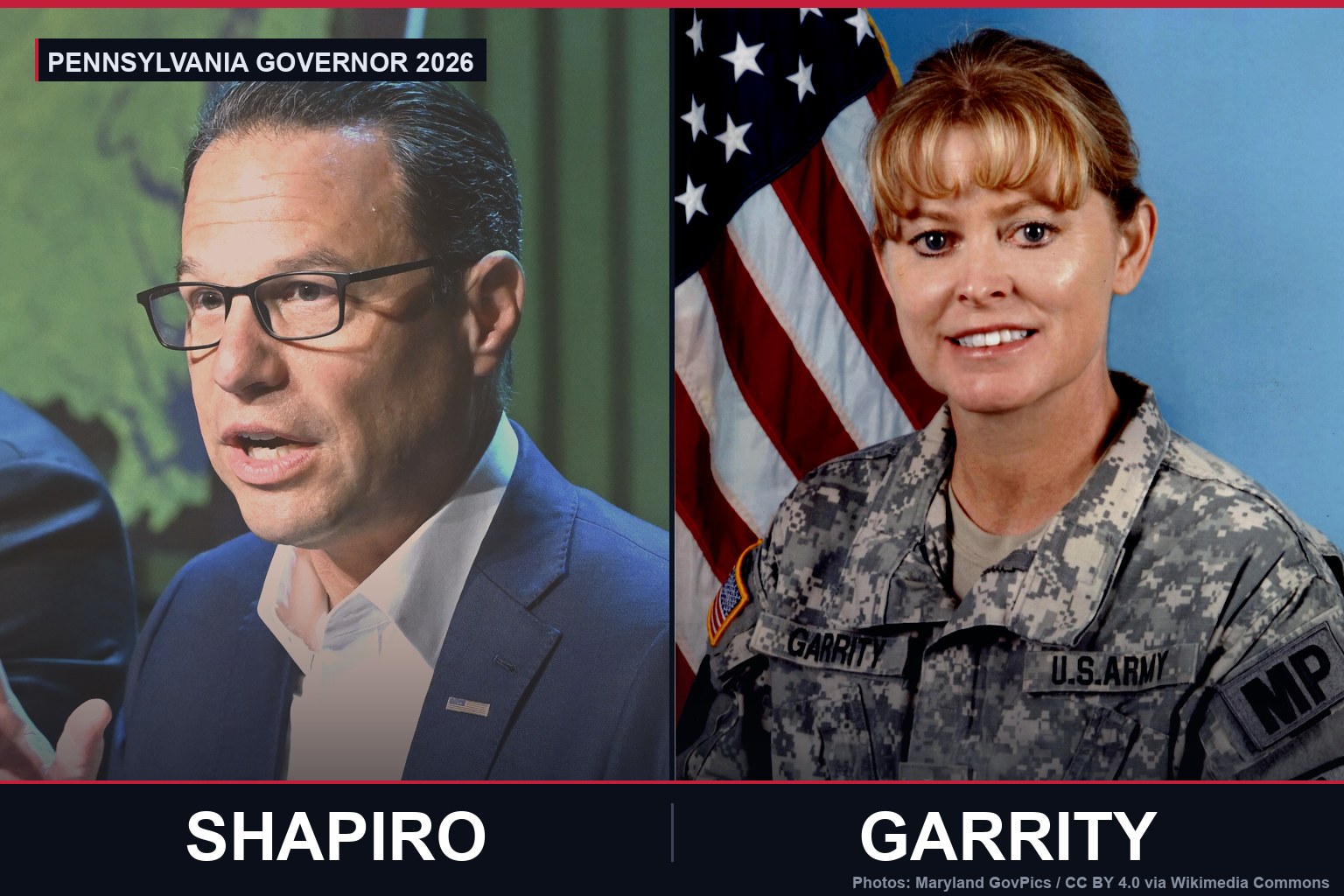
Pennsylvania has been the proving ground of American presidential politics for thirty years — and in 2026, the governor's race is carrying more than its usual electoral weight. Democratic Gov. Josh Shapiro, who won his first term in 2022 by 14.8 percentage points, is seeking re-election against Republican state Treasurer Stacy Garrity in a race that most forecasters rate comfortably in Shapiro's favor. But the contest has a dimension that extends well past Harrisburg: almost every move Shapiro makes is being evaluated as a 2028 presidential audition — and Garrity's campaign is built, in large part, to disrupt it.
The State of the Race
Pennsylvania remains the largest genuine swing state in the country. While Donald Trump won the state in both 2016 and 2024, Democrats have consistently carried statewide offices, including the governor's mansion in every cycle since 2014. Shapiro broke a state fundraising record when he raised $68 million for his 2022 campaign, then defeated Republican nominee Doug Mastriano 56.5% to 41.7%. He has governed with approval ratings hovering near 60%, according to a Quinnipiac University poll from October 2025.
The November 3 general election pits Shapiro — who formally announced his re-election in January, declaring there is "always more to do" — against Garrity, a two-term treasurer and retired Army Reserve colonel who secured the Pennsylvania Republican Party's endorsement and President Trump's public backing. Cook Political Report rates the race Solid Democratic as of March 2026.
No active Pennsylvania governor contract is currently available on our platform. For live 2026 midterm market data, the races hub at electionpredictions.us tracks the full electoral landscape.
Josh Shapiro: The Incumbent and the National Prospect
Shapiro, 52, came to the governor's office after serving as Pennsylvania Attorney General from 2017 to 2023 and as a Montgomery County commissioner before that. His first-term record includes the largest increase in basic public education funding in the state's history, executive action protecting abortion access following the Dobbs decision, and a string of bipartisan budget agreements navigated through a split legislature — a Democratic Senate and Republican House. He announced his re-election bid on January 8, 2026, pointing to what he called a record of getting things done across party lines.
The national interest in Shapiro is unmistakable. Since the 2024 election, he has been mentioned alongside California Gov. Gavin Newsom, Maryland Gov. Wes Moore, Illinois Gov. J.B. Pritzker, and former Transportation Secretary Pete Buttigieg as potential Democratic presidential candidates in 2028. The Guardian described his re-election as "an audition for a future White House run" when he announced in January. In current consensus prediction market data tracked on our platform, Shapiro registers at 5% in the 2028 Democratic presidential nominee market — a field currently led by Newsom at 18%, Georgia Sen. Jon Ossoff at 15%, and Rep. Alexandria Ocasio-Cortez at 14%.
One structural reality anchors the 2028 discussion: under Pennsylvania law, Shapiro cannot transfer state campaign funds to a federal presidential campaign. Whatever he raises for 2026 stays in Pennsylvania. But the donor relationships, organized labor goodwill, and national visibility being built through this race are plainly transferable — and every Republican in the state knows it.
"Josh Shapiro thinks he's got this race locked up," Garrity's campaign wrote in a February fundraising email. "Campaigns aren't powered by Harrisburg insiders. They're powered by people like you." That framing — Shapiro as the connected national-money operation, Garrity as the Pennsylvania-first grassroots challenger — has become the Republican's core argument heading into a fall campaign where traditional metrics strongly favor the incumbent.
Stacy Garrity: The Challenger's Case
Garrity, the Republican nominee, is not a political unknown. She won election as state treasurer in 2020, then won re-election in 2024 with the highest raw vote total in Pennsylvania history for any statewide office — a number that previously belonged to Shapiro. She is a retired Army Reserve colonel with roughly three decades of service and a background in private-sector manufacturing.
She entered the governor's race with the backing of the Pennsylvania Republican Party and secured Trump's endorsement. On August 4, 2026, she visited the White House Oval Office, where Trump declared to the camera that she is "a spectacular person" and predicted she would win. The visit represented a more public alliance after what the Philadelphia Inquirer described as a period of "little enthusiasm" from Trump toward Garrity earlier in the year. Garrity has closely tied her campaign to Trump, supporting his tax legislation and other policy priorities.
If elected, Garrity would become Pennsylvania's first female governor. She is running on a platform centered on expanding natural gas production to address rising energy costs and what she calls the state's structural budget deficit, school choice legislation, fiscal restraint, and voter ID laws. She supports eliminating a 5.9% state tax on electricity sales — a move the state's Independent Fiscal Office estimates would save the average household $143 per year — to be funded through expanded natural gas revenues. Garrity has also received the endorsement of a national right-to-work organization, positioning her against the union-backed labor posture Shapiro has cultivated across his tenure.
On the attack, Garrity has hammered a single message: "We need somebody that is more interested in Pennsylvania and not on Pennsylvania Avenue." The Republican Governors Association echoed the line, accusing Shapiro of being "out of touch" while chasing "political ambitions." Trump, at a Pennsylvania fundraiser for Republican Sen. Dave McCormick, called Shapiro "totally overrated" and said he "doesn't have what it takes."
The Fundraising Gap
By traditional campaign finance metrics, this race isn't close. Shapiro's campaign reported raising more than $50 million since the start of 2025, according to a July 15 Philadelphia Inquirer report. That includes $10.5 million raised in the first quarter of 2026 alone — a Pennsylvania state record, according to WHYY — against Garrity's approximately $1 million over the same period. As of the June 8 reporting deadline, Shapiro held $38.3 million in cash on hand compared to Garrity's $1.1 million — a ratio of more than 34 to 1.
The donor profiles tell a story. While 96% of Garrity's contributors live in Pennsylvania and 90% gave $100 or less — a genuinely grassroots fundraising base — Shapiro's total has been propelled by large national checks. A single contribution from billionaire Mike Bloomberg at $2.5 million equaled roughly 2.5 times Garrity's entire Q1 haul. Pennsylvania's construction trade unions, which had previously supported Garrity's treasurer bids, collectively contributed $1.4 million to Shapiro in Q1 2026 alone, with none writing Garrity a check since July 2025, according to Spotlight PA.
Shapiro has privately told donors he aims to raise between $90 million and $100 million total — a figure that would shatter the state record he himself set in 2022. Garrity's campaign has turned the disparity into an argument: the out-of-state billionaires backing Shapiro prove, they say, that this is a race about national ambition, not Pennsylvania.
The Polling Picture
Shapiro leads every public survey, but the spread between polls is notable.
The most recent poll, released August 6 by PennLive, was conducted by National Public Affairs — a Republican-leaning firm — from July 26-30 among 600 likely voters. It showed Shapiro ahead 50% to 43%, a 7-point margin within the poll's ±4-point margin of error. Garrity's campaign said the survey was independent and not commissioned by them, and pointed to it as evidence that the race is tightening. PennLive noted that previous surveys had shown Shapiro with an average advantage of roughly 20 points.
The broader polling summary:
- Quinnipiac University (July 9–13, 895 registered voters, ±4.3%): Shapiro 53%, Garrity 40%
- PennLive/Bravo Group (June 18–25, 644 registered voters, ±4.1%): Shapiro 54%, Garrity 29%
- Franklin & Marshall College (June 8–14, 546 registered voters, ±5.1%): Shapiro 50%, Garrity 28%
- MAD Global Strategy (June 9–11, 600 likely voters, ±4.0%): Shapiro 48%, Garrity 31%
- National Public Affairs, R-leaning (July 26–30, 600 likely voters, ±4.0%): Shapiro 50%, Garrity 43%
Poll aggregators show Shapiro's lead ranging from +14 to +20 depending on the window and included surveys. The NPA result is an outlier worth watching — Republican-leaning firms frequently use tighter likely-voter screens that can produce closer results, and the firm has not released full crosstabs publicly. But the pattern of gradual improvement Garrity's allies describe — incrementally better numbers through summer, then national investment — starts with showing data like the NPA poll. Whether it reflects real movement or a methodological artifact matters enormously for whether the RGA writes major checks in September.
Key Issues
Energy. Data center expansion across Pennsylvania has intensified an already-stressed power grid, making energy costs a central campaign issue. Shapiro has pushed utilities to restrain rate increases and backs an "all of the above" approach including solar and wind alongside fossil fuels. Garrity wants to dramatically accelerate natural gas permitting, call a special legislative session focused on energy, and eliminate renewable energy mandates she calls "duplicative." She has disclosed past income from Chesapeake Energy (now Expand Energy) and Equinor through her financial reports, and frames natural gas as the only realistic solution to both the state's grid strain and its structural budget deficit. The Morning Call reported that both candidates support increased energy production — the divide is on what kind.
Education. Shapiro's first term secured the largest increase in basic education funding in state history. He supports school choice, a rare position for a Democratic governor, though no voucher legislation has cleared the divided legislature under his watch. Garrity supports charter school expansion and what her campaign calls a "fund students, not systems" approach to public education.
Abortion. Shapiro has protected abortion access through executive action and by holding Pennsylvania's existing statutory framework in place after Dobbs. Garrity has supported Republican federal budget proposals that critics say would reduce reproductive health funding, and has backed defunding Planned Parenthood. According to Garrity's campaign, under a Trump tax measure she supports, an estimated 300,000 Pennsylvanians are projected to lose Medicaid coverage, per state government estimates — a figure Shapiro's campaign has repeatedly highlighted.
Labor. Shapiro has held campaign events across the state in union halls and secured major contributions from the state's construction trades. The right-to-work organization endorsement Garrity received on August 6 places her squarely on the other side of Pennsylvania's union-labor divide — a potential liability in a state where organized labor retains significant electoral influence, particularly in the Philadelphia suburbs and the Pittsburgh metro.
What to Watch Through November
The RGA's level of engagement will be the clearest signal of whether Republicans see a path. Party officials and strategists have indicated privately that they are waiting to see sustained polling improvement before committing large resources to a state where Shapiro holds a $38 million cash-on-hand advantage. The NPA poll is the kind of data point the party needs more of — but one Republican-leaning survey does not make a trend.
Garrity's theory of the race is explicit: gradual improvement creates credibility, credibility unlocks national money, and national money creates the conditions for a late-race surge. Former Westmoreland County GOP chair Bill Bretz captured the strategic logic plainly: "He's someone we need to identify the chink in the armor here and need to set back his candidacy for governor so that we can set him back in 2028." Republicans are not pretending this is a race they expect to win easily — they are playing a longer game.
The down-ballot stakes are real for both parties. Democrats are targeting at least four competitive U.S. House seats in Pennsylvania in their effort to flip chamber control — markets currently price Democratic House control at 87%, with Pennsylvania's contested districts part of the pathway. A strong Shapiro performance drives Democratic turnout that helps in those districts; a weaker-than-expected showing creates drag.
Abortion could shift the dynamics in either direction. In 2022, the Dobbs decision turned Pennsylvania's suburban electorate sharply against Republicans; Mastriano's loss by nearly 15 points reflected that environment. In 2026, with Dobbs two years old and Garrity's position on reproductive rights a known quantity, the question is whether the issue retains the same mobilizing power for Democrats, or whether economic concerns — energy costs, utility bills, the state's perennial structural deficit — do more to drive undecided voters toward the challenger.
The Pennsylvania governor's race will be decided on November 3, 2026. Follow the full 2026 midterm prediction market landscape at electionpredictions.us/races.
Sources: Philadelphia Inquirer (Jan. 9, 2026; Feb. 12, 2026; Jul. 15, 2026; Aug. 4, 2026); PBS NewsHour (Jan. 9, 2026); NBC News (May 20, 2026); Quinnipiac University poll release (Oct. 1, 2025; Jul. 9–13, 2026); Spotlight PA (Mar. 5, 2026; Apr. 9, 2026; Apr. 13, 2026); WHYY (Apr. 9, 2026); The Guardian (Jan. 9, 2026); Cook Political Report (Mar. 11, 2026 update); PennLive (Aug. 6, 2026; Feb. 9, 2026); The Morning Call (Aug. 1, 2026); Ballotpedia, Pennsylvania gubernatorial election 2026; Fox43 (May 1, 2026).