

Norman's Overnight Fade: The SC Primary Market Now Points to Graham-Fry for Second Place
Norman dropped 5 cents overnight to 17 cents, effectively tied with Fry for second. The market is reshaping heading into tonight's first major debate.
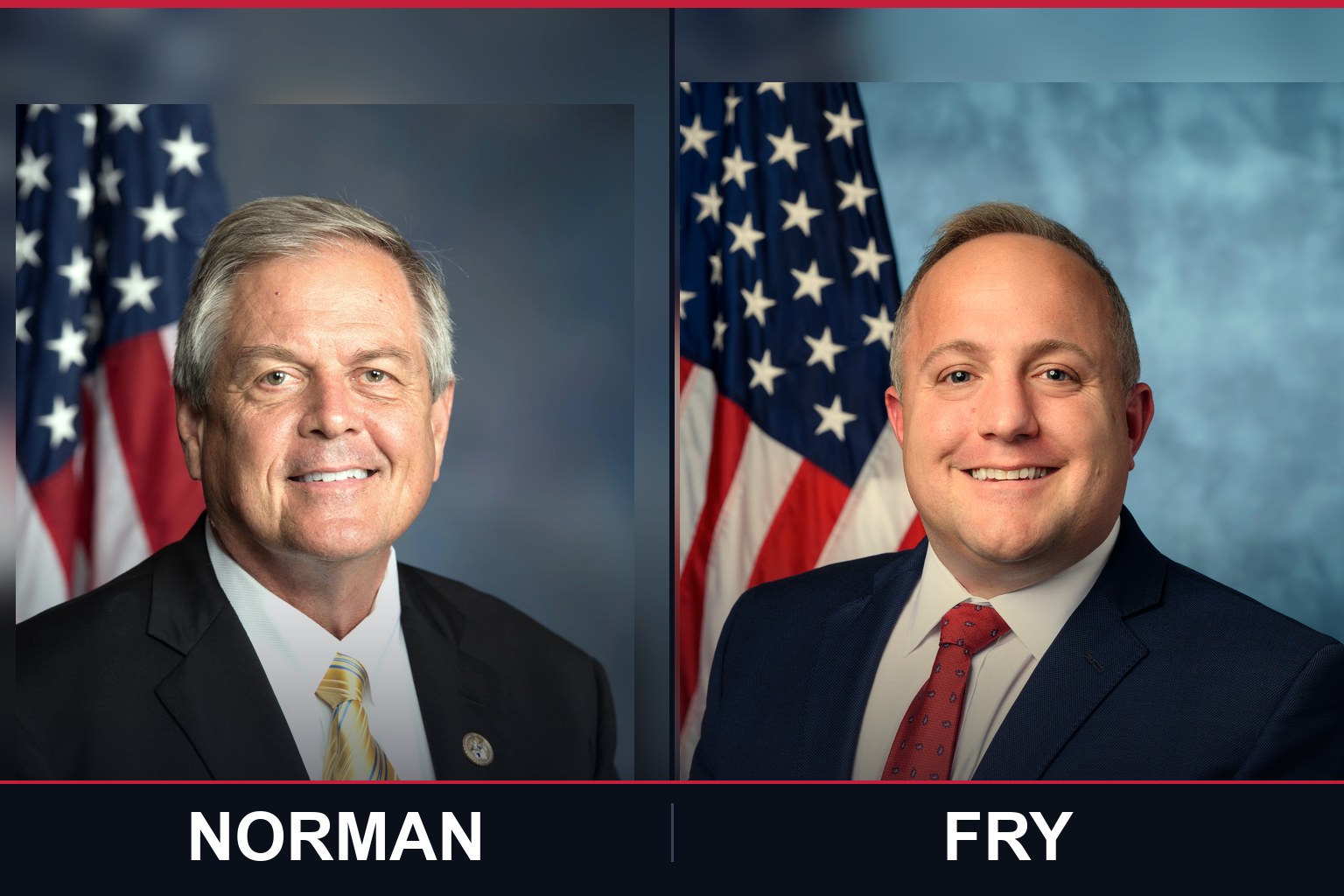
Eight days before South Carolina's Republican Senate special primary, the overnight market pricing changed — and the change wasn't subtle.
Senator Darline Graham enters Sunday at 63 cents, up 1 cent overnight. Russell Fry has climbed to 18 cents. And Ralph Norman — who had been trading as the clear second-place contender just days ago — dropped 5 cents overnight to 17 cents, according to consensus pricing across Kalshi and Polymarket with $4.09 million in total volume.
For the first time in this race, Norman and Fry are statistically tied for second place in the market.
The Straw Poll Signal
On August 1, nine candidates appeared at a stump-speech event where 265 attendees participated in an informal poll. According to the SC Daily Gazette, the results were: Darline Graham 25%, Russell Fry 23%, Norman 20%.
That is not a scientific poll — 265 self-selected attendees at a candidate event is a different instrument than a controlled sample. But the ordering matters. For the first time in any public data point from this race, Fry broke through Norman and placed second behind Graham. The market's overnight move tracks with that result.
The most recent scientific survey of the race is an Emerson College/Nexstar poll conducted July 28-29 among 500 likely Republican primary voters. It still showed Norman leading with 22% support, followed by Graham at 19% and Fry at 12%. With a margin of error of ±4.3 percentage points and roughly a quarter of voters undecided, all three remain within statistical striking distance of one another.
But the market has a sharply different view. At 63 cents, Graham's implied probability is more than triple what the Emerson poll finds for her. Traders have consistently priced Graham as the heavy favorite throughout this race, anchored by Trump's full endorsement and the weight of the Graham family name in South Carolina.
Why Norman Is Fading
The Norman slide tracks a structural pattern. His polling support is concentrated among younger voters — 24% among under-50 voters per Emerson — and in Upstate South Carolina per previous polling. That is a narrower coalition than the statewide support required to outperform a candidate with deeper roots across the state.
Emerson found that 53% of likely primary voters said Trump's endorsement of Graham had no effect on their support, complicating Norman's strategy of positioning himself as the authentic conservative alternative to an appointee backed by the president. And CNN's reporting on August 1 noted hard feelings among South Carolina conservative grassroots toward what they characterized as an "establishment" choice — with energy shifting toward Fry as the change candidate in the race.
Fry, meanwhile, now has a marketable argument heading into debate night: he has more upward momentum in both the informal straw poll data and in the overnight market move than any other candidate.
Tonight's Debate
At 7 p.m. ET on Monday, August 3, all five leading candidates — Graham, Norman, Fry, Sanford, and Lynch — share a broadcast stage for the first time in this campaign, airing on Gray Media stations statewide.
Graham enters as the market's decided frontrunner with the most to lose from a poor performance. Norman enters needing to arrest a 5-cent overnight slide. Fry arrives as the candidate with the cleanest momentum story — up a cent overnight and now effectively tied for second with a candidate who, just 24 hours ago, held a 5-cent cushion.
The runoff arithmetic still points to a two-person race on August 25. With nine candidates in the field, no one is expected to clear 50% on August 11. But the question of who joins Graham in the runoff — the race within the race — is now genuinely open in the market in a way it wasn't at the start of the weekend.
The Danny Ford II court case adds a footnote: a judge signed a temporary restraining order last week, and an August 3 hearing is scheduled for 9:30 a.m. ET. If the court grants a preliminary injunction, the ballot could expand to ten candidates..
Early voting in South Carolina begins August 5.
Sources: SC Daily Gazette (August 1, 2026) — stump event straw poll results; Emerson College Polling/Nexstar Media (July 28-29, 2026) via The Hill (July 30, 2026) — primary polling; CNN (August 1, 2026) — SC GOP grassroots dynamics; WSPA/Gray Media (August 1, 2026) — debate logistics. Market data: Kalshi and Polymarket consensus pricing, August 2, 2026.