South Carolina's Senate Ballot Is Now in Court — and the Market Still Can't Explain Its 23-Cent Gap
A judge signed a TRO restoring a decertified candidate to the SC Senate ballot. A hearing Monday morning. A debate Monday night. And Graham still at 58¢.
South Carolina's Senate special primary just got a new complication.
On Thursday afternoon, a Richland County circuit court judge signed a temporary restraining order protecting a decertified candidate's place on the August 11 ballot — and scheduled a hearing for Monday morning, the same day as the race's first televised debate.
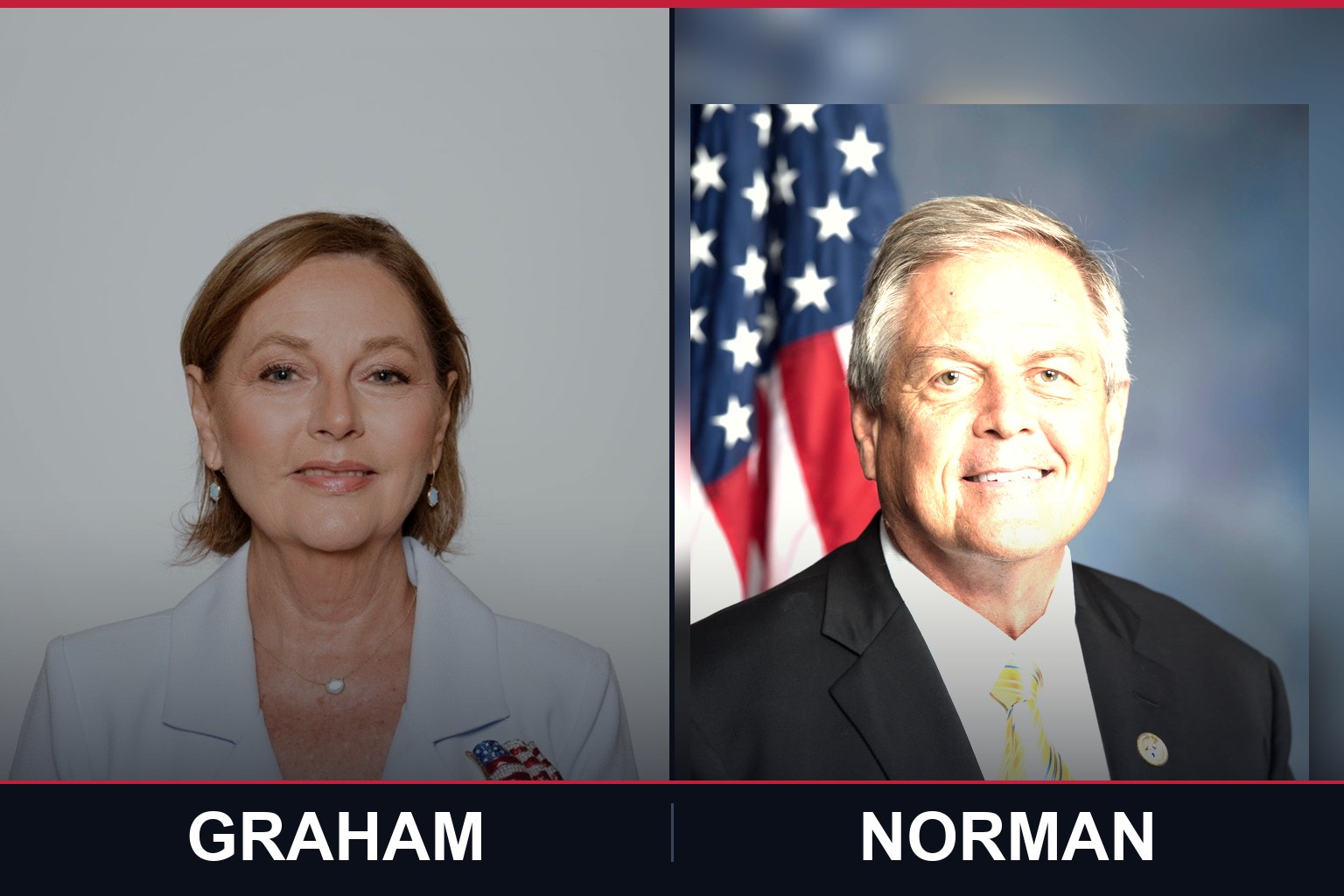
The cross-platform consensus still prices Darline Graham Nordone — the interim senator and sister of the late Lindsey Graham, running under her maiden name — at 58¢ to win the primary. Ralph Norman sits at 38¢. Total volume: $3.46 million across Kalshi and Polymarket.
That 23-cent gap between Graham and Norman persists despite the only public poll of the race showing the two candidates statistically tied.
The Lawsuit and the TRO
Danny Ford II — a farmer from Travelers Rest, son of legendary Clemson football coach Danny Ford, who ran in the South Carolina Republican agriculture commissioner primary this spring and advanced to the June 23 runoff — sued the South Carolina Republican Party on Thursday in Richland County Circuit Court.
His claim: the SCGOP's new Rule 11(a)(6), adopted in June and effective July 1, is unconstitutional. The rule requires candidates to have voted in at least two of the last three statewide Republican primaries. The party determined Ford didn't qualify because his two documented primary votes — in the June 9 agriculture commissioner primary and its June 23 runoff — counted as a single "cycle," not two separate primaries. [SC Daily Gazette, July 30; Post and Courier, July 30]
Ford voted in both rounds and was certified as a candidate in the agriculture race without issue under rules that existed at the time. A new rule, adopted after he entered that race, was then applied to bar him from the Senate ballot after filing closed July 28. "I thought I learned in high school what it took to be a U.S. senator," Ford told the SC Daily Gazette. [SC Daily Gazette, July 30]
Circuit Court Judge Daniel M. Coble signed the TRO Thursday afternoon, ruling that immediate and irreparable harm would result if Ford were excluded. A hearing is set for Monday, August 3, at 9:30 a.m. at the Richland County courthouse to argue whether a longer preliminary injunction should hold through the August 11 vote. [WIS-TV, July 30; Live5 News / WCSC, July 30]
Ford is represented by Brad Hutto, the State Senate Democratic Minority Leader and an attorney with a history in South Carolina election law. His lawsuit argues the party rule goes beyond certifying candidate qualifications and into territory reserved for the General Assembly — which has repeatedly declined to codify similar primary participation requirements into state law. [Post and Courier, July 30]
The Selective Enforcement Question
Ford's suit also raises a consistency argument. Graham Nordone was certified despite a voting history that, under a plain-text reading of the rule, raises similar questions: she voted in the 2026 primary but not in the 2022 or 2024 GOP primaries, though her supporters argue her 2024 Lexington County runoff vote qualifies as participation in that year's primary process. The SCGOP certified her; it did not apply the same scrutiny to her case that it applied to Ford's. [Post and Courier, July 30; SC Daily Gazette, July 30]
The party's defense: runoffs and primaries count as part of the same "election cycle," making Graham Nordone's 2024 runoff vote and her 2026 primary vote two qualifying cycles of participation. Ford, by contrast, voted in the 2026 primary and runoff only — one cycle by that accounting. [SC Daily Gazette, July 30]
Whether a judge agrees with that interpretation will be known Monday morning.
What the Market Is Pricing — and Why the Gap Holds
The Emerson / Nexstar poll conducted July 28–29 (n=500, MoE ±4.3 points) showed Norman at 22%, Graham Nordone at 19%, Fry at 12%, Mark Sanford at 11%, with 25% of voters still undecided. Graham and Norman are statistically tied at the top. The poll also found that 53% of SC GOP primary voters said the Trump endorsement of Graham Nordone would have "no impact" on their vote. [The Hill / Emerson College Polling, July 30]
Yet the market prices Graham at a 23-cent advantage. The coherent logic behind that spread:
The endorsement floor. The market appears to be weighting the share of voters for whom the Trump endorsement does matter — and Trump's documented record of primary endorsement effectiveness in South Carolina — more heavily than the headline "no impact" number.
Name recognition mechanics. Graham Nordone's support in the Emerson data skews heavily toward voters over 70. In a low-turnout special primary, that demographic performs reliably.
Plurality dynamics in a crowded field. With nine certified candidates and 25% of voters still undecided, a first-place finish requires roughly 21–22% of the vote. The market may be pricing Graham Nordone as the most likely plurality-getter by default — not because she's dominant, but because the field fragments around her.
The market has also largely shrugged off the Emerson repricing that occurred earlier Thursday, when news of the poll showing Norman statistically tied briefly pushed Graham's price lower. By Thursday evening, the cross-platform consensus had drifted back toward 58¢.
Monday Changes the Geometry
The Monday morning hearing (9:30 a.m.) and the Monday evening debate (7 p.m., Fox Carolina / Gray TV / SCGOP) both fall on August 3 — four days before early voting opens August 5 through 7.
If the court grants a preliminary injunction and Ford returns to the ballot, the field grows to ten. His Upstate South Carolina base overlaps most with Norman's rural coalition, which could marginally dilute Norman's share in the first-past-the-post primary finish — a nuance the market has not yet had to price.
If the court denies the injunction, the nine-candidate field stands.
Either way, the August 3 debate is the first time most South Carolina Republican primary voters will see these candidates answer questions on live television. Whether Graham Nordone can hold or extend her market advantage on a debate stage she has never stood on before — against Norman, who has spent weeks building his Upstate coalition and held a Rock Hill rally Thursday evening — is the question the 58¢ line is betting yes on.
The market has a lot of certainty priced into a race with a lawsuit, a court hearing, an untested candidate, a packed field, and a quarter of the electorate still undecided.
Sources: Live5 News / WCSC (July 30): Ford lawsuit filing and TRO; WIS-TV (July 30): TRO signed, Aug. 3 hearing order; SC Daily Gazette (July 30): Rule 11(a)(6) mechanics, Ford interview, selective enforcement context; The State (July 30): Ford profile and candidacy background; Post and Courier (July 30): Ford representation, selective enforcement analysis; The Hill / Emerson College Polling (July 30): Emerson / Nexstar poll, July 28–29, n=500. Market data: cross-platform consensus (Kalshi, Polymarket).