Tennessee Governor 2026 Race Guide: Blackburn vs. Rose and the Senate Seat That Hangs in the Balance
Tennessee's August 6 Republican gubernatorial primary pits Sen. Marsha Blackburn against Rep. John Rose in a race that has tightened dramatically.
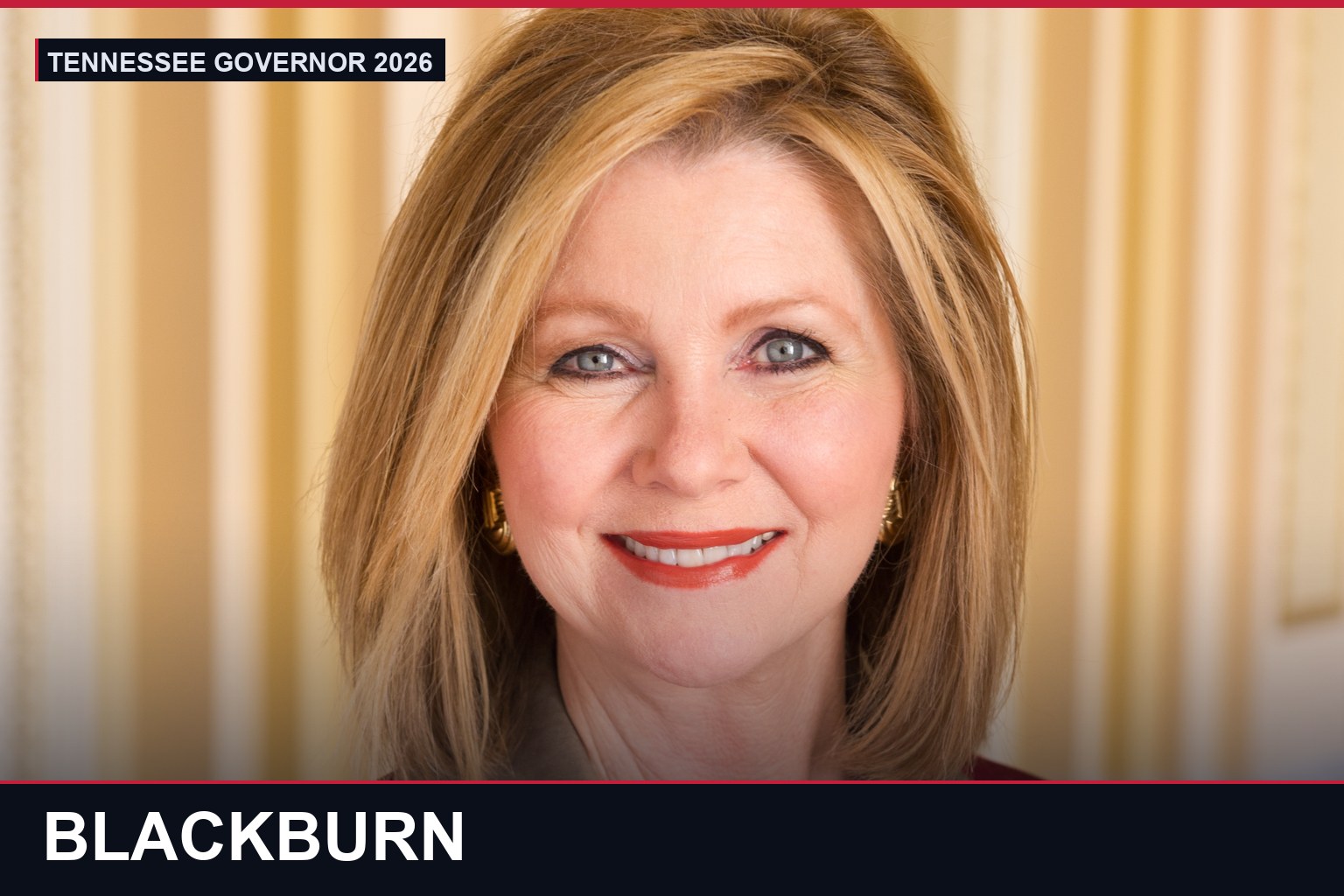
Tennessee voters head to the polls tomorrow, August 6, to choose nominees for governor and U.S. Senate in what is shaping up as the state's most consequential Republican primary in years. The marquee contest — a three-way race for governor between U.S. Sen. Marsha Blackburn, U.S. Rep. John Rose, and State Rep. Monty Fritts — has narrowed to the point where two competing polls released in the final days of July produced headline numbers separated by nearly 14 points, leaving observers genuinely uncertain who will emerge the nominee.
The race carries stakes beyond Tennessee's borders. If Blackburn wins the governorship, she vacates a Senate seat she was just reelected to in November 2024 — and the question of who fills that vacancy, and how, is the kind of second-order political calculation that prediction markets were built to price.
An Open Seat, Two Decades in the Making
The 2026 Tennessee governor's race exists because Republican Gov. Bill Lee cannot seek a third consecutive four-year term under the state's term-limit rules. A Democrat has not won a statewide election in Tennessee since Phil Bredesen won reelection as governor in 2006. Trump carried the state by nearly 30 points in 2024, and Lee won his 2022 reelection by 32 percentage points. In that environment, the Republican primary is, for all practical purposes, the general election.
The winner of today's Republican primary will advance to face the Democratic nominee on November 3. Five Democratic candidates are competing in their own August 6 primary, led by Marquita Bradshaw, a Memphis environmental activist and the party's 2020 Senate nominee. Others in the Democratic field include Jerri Green, a Memphis City Council member; Carnita Atwater, a community advocate; Tim Cyr, a Gallatin businessman; and Kevin Lee McCants, a pastor. No independent polling has identified a clear frontrunner among them, and the eventual Democratic nominee enters the general as a heavy underdog regardless.
The Republican Primary: Three Candidates, Two Polls, No Consensus
Marsha Blackburn
Blackburn, 74, is Tennessee's junior U.S. senator and the first woman to represent the state in the Senate. She was first elected to the Senate in 2018 and was reelected in November 2024, meaning she would leave four years remaining on her term if she wins the governorship and is sworn in. She officially entered the governor's race in August 2025, according to reporting by PBS NewsHour and Nashville Public Radio (WPLN).
Blackburn's campaign has centered on continuing Tennessee's economic growth, combating illegal immigration, protecting women's sports, and supporting law enforcement. She has also heavily emphasized her alignment with President Trump's agenda — an asset in a Tennessee Republican primary — though Trump himself publicly lamented her decision to run, saying at a U.S. Treasury event in January: "Marsha Blackburn is an incredible person. Unfortunately, she is running for governor. I'd love her not to, I begged her, I said Marsha, 'Don't, we don't want to lose you in the Senate.'" The president did not endorse either Republican candidate in the primary.
The race did not unfold as smoothly as Blackburn's campaign initially projected. Her early leads of 30 to 50 points eroded over the summer, according to the Nashville Banner, for several identifiable reasons. First, she refused to debate her opponents at any point in the primary, a decision that political scientists at Vanderbilt University told WPLN was high-risk in a race where all three candidates broadly agree on policy. Second, The Tennessean reported on July 30 that a U.S. Senate ethics investigation had determined Blackburn's office violated Senate ethics rules by using government resources to bolster her 2024 Senate reelection campaign. Blackburn denied wrongdoing. Third, Tennessee Lookout reported on August 3 that Blackburn transferred $4.8 million from her Senate campaign account to her gubernatorial campaign in what the outlet described as an "apparent legal 'workaround,'" a move that generated criticism from her opponents.
John Rose
Rose, the U.S. representative for Tennessee's 6th Congressional District and a former state agriculture commissioner, entered the race in March 2025. He largely bankrolled his own campaign, with Tennessee Lookout reporting on August 4 that Rose had reached $13 million in self-funding — a figure that made his operation the most independently financed in the race.
Where Blackburn ran a more traditional campaign focused on name recognition and television advertising, Rose took a retail-politics approach: by the night before the primary, he had held more than 85 town halls across the state, according to the Chattanooga Times Free Press. His campaign message has emphasized conservative credentials while highlighting concerns about whether Blackburn was fully focused on the governor's race — attendees at Rose's events voiced objections to Blackburn leaving the Senate mid-term to run for governor, per the Times Free Press.
Rose's campaign manager, Chris Devaney, argued that voters were gravitating toward Rose because of his executive experience and his willingness to engage directly with Tennesseans at the local level.
Monty Fritts
Fritts, a state representative from the 32nd district in Kingston, positioned himself as a political outsider untouched by Washington. His campaign centered on constitutional rights, limited government, state sovereignty, and opposition to what he characterized as federal overreach. Both late polls showed him between 22 and 26 percent — a surge from earlier in the cycle — raising the possibility that he could influence the outcome even without winning.
Two Polls, Two Very Different Stories
The closing days of the campaign produced a polling war that became its own story.
On July 31, OnMessage Public Strategies released a survey of 800 likely Republican primary voters showing Blackburn at 34.5 percent, Rose at 31 percent, and Fritts at 25.6 percent — with 9 percent undecided. The margin of error was 3.5 percentage points, meaning Rose was statistically within reach. OnMessage's founding partner, Wes Anderson, told WKRN News 2: "If I were a betting man, I would abstain from taking a bet on this one. It's too close."
Blackburn's campaign dismissed the poll and released its own internal numbers the following day. Conducted by Fabrizio, Lee & Associates — the polling firm that handles presidential surveys for the Republican National Committee — the survey of 800 Republican primary voters found Blackburn at 42 percent, Rose at 25 percent, and Fritts at 22 percent, with 11 percent undecided, according to the Nashville Banner. Campaign manager Abigail Sigler called the OnMessage poll "a desperate attempt by political consultants" to boost Rose's fundraising.
Rose's campaign pointed to a 2020 parallel: his campaign manager ran communications for Manny Sethi's Senate bid that year, and Sethi's internal polling showed a similarly close race against Bill Hagerty. Hagerty ultimately won by 11.4 points. The Blackburn campaign invoked the same episode as evidence that aggressive late polling by a trailing campaign rarely converts into votes.
A third survey, commissioned by Believe in Tennessee and conducted by Cygnal between July 9 and 11, found Blackburn leading with a double-digit margin. OnMessage founder Wes Anderson told the Tennessean it was the closest gubernatorial primary he had seen in three decades of polling in Tennessee.
Primary polling is notoriously difficult to model under the best of circumstances; in a three-way low-turnout statewide primary with no comparable recent precedent, the uncertainty around any of these numbers is considerable.
What the General Election Looks Like
Regardless of which Republican prevails, the general election is a steep climb for Democrats. Tennessee has not elected a Democrat to statewide office in 20 years. Trump's 2024 margin in the state was approximately 29.7 percentage points. Lee won his 2022 reelection by 32 points. Cook Political Report rates the seat Solid R.
The Democratic nominee — whoever emerges from today's primary — will be running against those structural headwinds with minimal institutional financial support and little time to build name recognition before November 3.
The Senate Seat: Appointment, Not Election
The more consequential downstream question for prediction-market observers is what happens to Blackburn's Senate seat if she wins.
Blackburn was reelected to the Senate in November 2024, giving her a term that runs through January 2031. If she is inaugurated as governor, approximately four years of that term would be unfilled. Under Tennessee state law, the governor has the authority to appoint a replacement to fill a vacant Senate seat until the next regular November election can be held, as the Chattanooga Times Free Press confirmed in its August 4 reporting.
Critically, the power to make that appointment would rest with Blackburn herself — should she win. She declined to name a potential appointee when asked at campaign events, saying the question was for after inauguration. Nashville Banner reporting from March 2025 noted that Blackburn could "cherry-pick her own replacement" and that the appointed senator would carry the advantage of incumbency into any future election for the seat.
The net effect on Senate arithmetic is neutral in the near term: a Republican governor appointing a Republican replacement keeps the seat in Republican hands. But the question of which Republican, and what that person does with the seat, is a live political variable with longer-term implications.
For context on where Senate control stands heading into the November cycle:
Republicans currently hold a 53-47 majority in the Senate, with 22 Republican-held seats and 13 Democratic-held seats up for election in November 2026, according to Ballotpedia.
Tennessee's Other August 6 Race: The Senate Seat Already on the Ballot
While the governor's primary draws the most attention, Tennessee also holds its U.S. Senate primary today. Incumbent Republican Sen. Bill Hagerty ran unopposed in the Republican primary and enters the general as a massive favorite. He was first elected in 2020 with 62.2 percent of the vote and has built a cash-on-hand reserve of approximately $5.67 million, according to Federal Election Commission filings, according to the Knoxville News Sentinel.
Five Democrats competed in the August 6 primary, led by Marquita Bradshaw — the party's 2020 Senate nominee, who lost to Hagerty by roughly 14 points that year. The seat is rated Solid R by Cook Political Report and Inside Elections.
What to Watch
Whether Blackburn's structural advantages hold. Despite months of turbulence, Blackburn entered primary day with more name recognition, a broader statewide profile, and the institutional advantage of a two-term senator who had won her most recent race by 29 points. Her internal polling and earlier surveys supported a comfortable lead.
Whether Fritts's late surge changes the math. Fritts at 22 to 26 percent in late polling represents a substantial bloc of voters. If he pulled disproportionately from either Blackburn or Rose, the margin between the top two could tighten further. No major polling outlet offered a prediction on Fritts's ceiling.
Turnout composition. In a low-turnout Republican primary — early voting was already trending above the 2022 cycle, per Hamilton County election officials — the geographic distribution of votes matters enormously. Blackburn traditionally draws strength from West Tennessee, while Rose concentrated his town-hall schedule across the eastern and middle parts of the state.
The Senate vacancy question. If Blackburn wins, the political world in Nashville will immediately pivot to speculation about Senate appointment. That secondary race — more appointment theater than election — may itself attract attention from markets and political observers watching the broader Senate landscape.
Sources: PBS NewsHour / AP (August 2025) • WPLN Nashville Public Radio (July 16, 2026) • WKRN News 2, Nashville (July 31, 2026) • Nashville Banner (July 30–August 1, 2026) • Chattanooga Times Free Press (August 4, 2026) • Tennessee Lookout (March–August 2026) • The Tennessean (July 31, 2026) • Nashville Scene (July 31, 2026) • Ballotpedia, Tennessee gubernatorial election, 2026 • Knoxville News Sentinel / USA TODAY Network–Tennessee (July 17, 2026)