

Paxton Confirms He'll Debate Talarico — and the Texas Senate Market Still Hasn't Moved
Ken Paxton confirmed debate plans to The Eagle on July 31. The Texas Senate market at 53/47 is unmoved — here’s what that tells you.
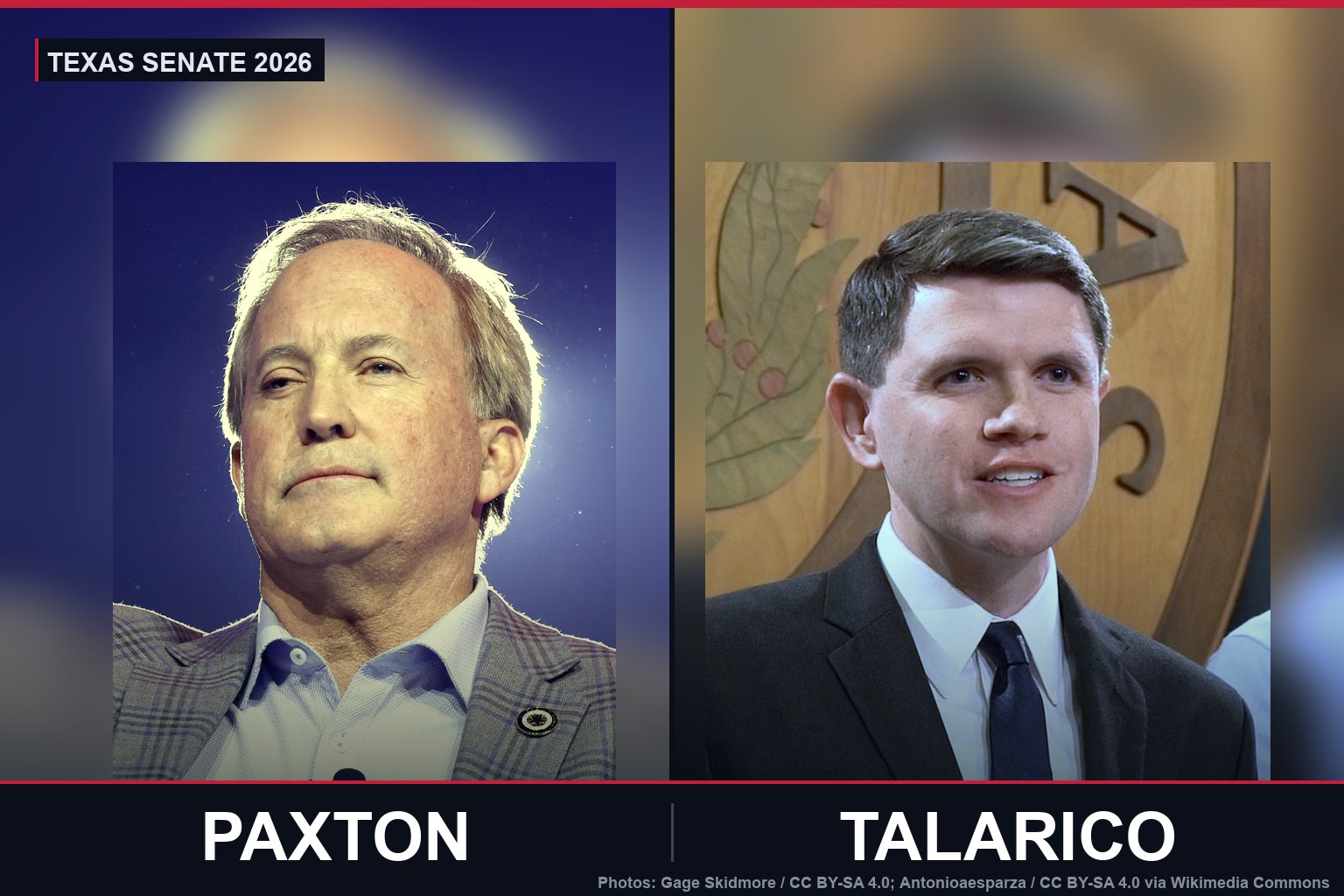
Ken Paxton's campaign confirmed to The Eagle on July 31 that the Republican Senate nominee plans to debate Democratic challenger James Talarico — a statement that sounds routine until you consider that Paxton hasn't shared a debate stage with a statewide opponent since before he was first elected attorney general in 2014. Three fall debate dates have been set by Talarico's campaign with major Texas media groups: September 22 in the Rio Grande Valley (NBC/Telemundo/Hearst), October 6 in Dallas (WFAA/TEGNA), and October 13 in Austin (KXAN/Nexstar). Paxton's team has not formally committed to any specific date.
The prediction market's reaction: nothing. Cross-platform consensus pricing across Kalshi, Polymarket, and PredictIt shows Paxton at 53 cents, Talarico at 47 cents, across $7.66 million in volume. Texas has been locked in this 6-cent range for several days running.
The Paxton Debate History
The reason the market isn't moving on "Paxton confirms plans to debate" is embedded in that word: plans. Paxton has a well-documented pattern of agreeing to debate opponents and then not appearing.
"In almost every campaign that he has run for statewide office, he's pledged to debate, and it has not come true," University of Texas at Austin political scientist Brandon Rottinghaus told the Houston Chronicle on July 29. "A promise to debate isn't necessarily the same thing as a debate transpiring."
Talarico's team has made the same calculation. "Ken Paxton's handlers claim he's willing to debate, but every time a reporter asks a question, he literally runs away," Talarico said in a statement after setting the three dates. "He hasn't set foot on a debate stage in over a decade."
Paxton's senior adviser Nick Maddux pushed back: "Texans deserve a fair side-by-side comparison, not political theater. There will be a debate in this race, and it will be must-watch television." But Maddux declined to commit to Talarico's proposed schedule, saying the campaign is "close to terms with one outlet" and an announcement is forthcoming. That's an identical position to where the campaign stood July 29 when Fox 7 Austin reported Paxton had not accepted the proposed dates.
Why 53 Cents Is Holding
The 6-cent Paxton edge in the prediction market reflects a structural thesis the polling hasn't fully dislodged. Texas has not elected a Democrat to statewide office since 1994 — a 32-year streak that has survived wave elections, strong Democratic challengers, and substantial national headwinds. Paxton won re-election as attorney general in 2022 despite a federal indictment and a bruising GOP primary against the incumbent governor's preferred candidate.
Recent polling shows a genuinely competitive race. A Fox News survey conducted July 23-27 gave Talarico a narrow lead. A TPOR poll gave Talarico a 5-point edge with 14 percent undecided. But prediction markets weight more than polls — they price the structural partisan environment, the fundraising gap, and the historical pattern of Texas Democrats outperforming surveys without ultimately winning statewide.
On fundraising, the gap is substantial. Talarico has run a nationally visible, grassroots-funded campaign, but faces a well-financed Republican incumbent. The Texas Tribune has reported on the wide financial disparity in the race, a factor market traders weigh against favorable polling for Democrats.
The New York Times noted on July 16 that Paxton's camp accepted the concept of debates "within hours" of Talarico's initial challenge — but the paper also flagged that "the campaigns have not settled on specifics, leaving open the possibility that debate plans could fall through." That caveat remains operative as of August 1.
What September 22 Changes
The market is essentially saying: the structural Texas lean outweighs both the current polling and the unknown quantity of a Paxton debate performance. At 53/47, this is the tightest Senate race on the board by raw spread — tighter than Maine (64/36), tighter than anything outside Michigan's still-unsettled general picture.
The September 22 debate in the Rio Grande Valley — if it happens — is the next genuine catalyst. Talarico is a former debate coach who has debated extensively. Paxton is an experienced politician who hasn't been challenged on a live stage in over a decade. Those asymmetries don't show up in polls. They could show up in a two-hour televised confrontation.
There's also the question of audience geography. The Rio Grande Valley is heavily Hispanic and has trended Democratic in recent cycles — though Trump made significant inroads there in 2024. A debate held there, hosted by NBC and Telemundo, reaches a voter pool that could be decisive in a close general election.
The market is pricing September 22 as a potential event, not a certain one. If Paxton shows up and performs poorly, the 53-cent edge narrows. If Paxton doesn't appear, that absence becomes a campaign story with its own momentum. If Paxton shows up and holds the structural advantage — the 53-cent thesis survives intact.
"A promise to debate isn't necessarily the same thing as a debate transpiring," Rottinghaus said. The market, for now, agrees.
Sources: The Eagle (July 31, 2026); Texas Tribune (July 16 and July 29, 2026); Houston Chronicle (July 29, 2026); Fox 7 Austin (July 30, 2026); New York Times (July 16, 2026); USA Today (July 29, 2026); KXAN/Nexstar (July 29, 2026). Market pricing from Kalshi, Polymarket, and PredictIt as of August 1, 2026, 7:15 p.m. ET.