

Virginia Senate 2026 Race Guide: Mark Warner Seeks a Fourth Term as Republicans Head to the Polls
Mark Warner’s fourth Senate campaign: a $25M war chest, a Solid D rating, and Virginia’s first competitive Republican primary in years. Full 2026 race guide.
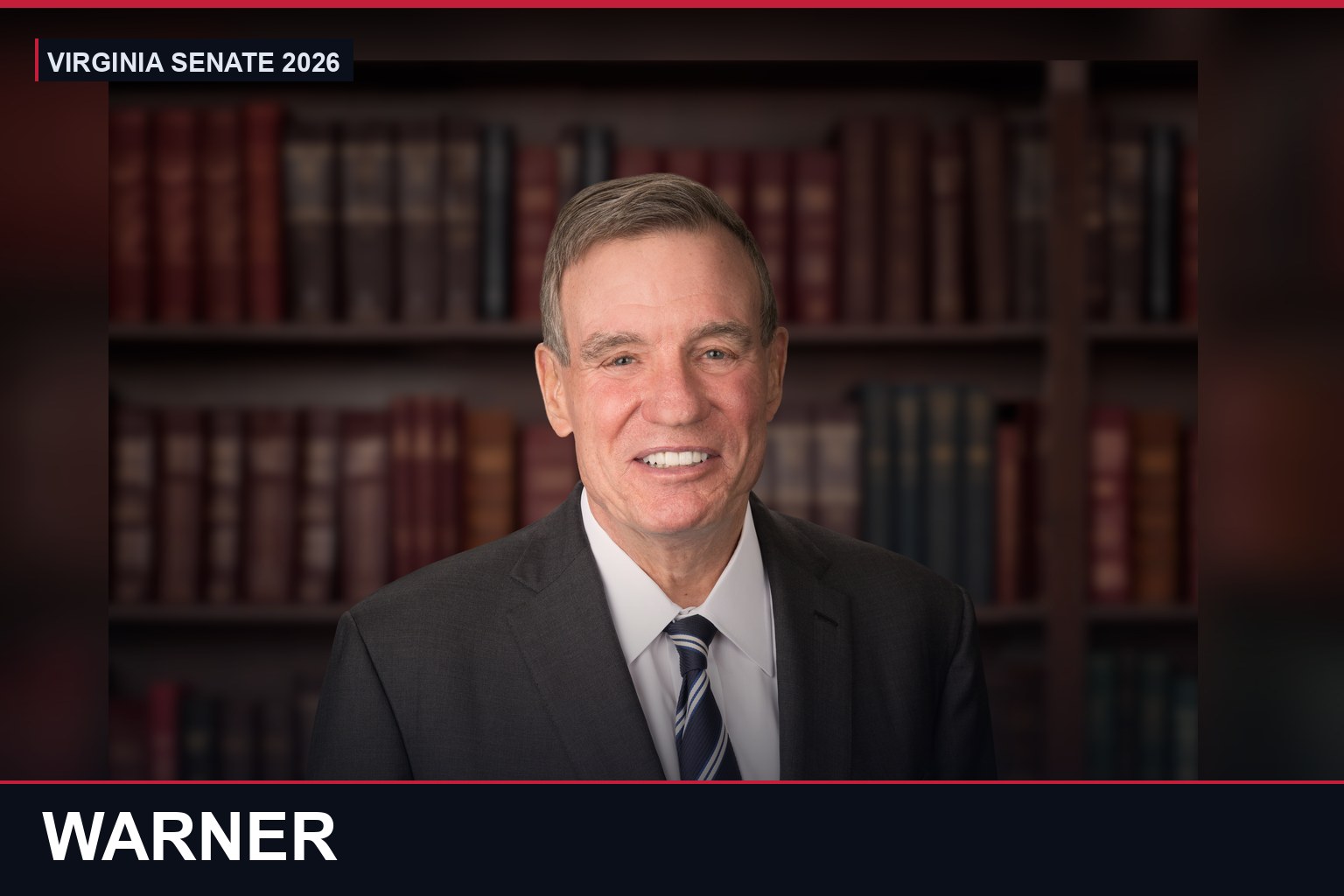
Virginia Republicans vote in a U.S. Senate primary on August 4 — but whoever emerges from that three-way contest will face one of the most formidable incumbents in American politics and one of the most daunting financial gaps in the 2026 cycle.
Senator Mark Warner is running for a fourth term, and he has declared it will be his last. He is doing so with more than $25 million in his campaign account, a Solid Democrat rating from the Cook Political Report, and a record that stretches back more than two decades in Virginia statewide politics. The Republican field — retired Army Major General Bert Mizusawa, Northern Virginia businesswoman Kim Farington, and former State Department and CIA officer David Williams — has combined to raise a little more than $620,000.
But Virginia has surprised before. And with Senate control markets showing Republicans at 54% and Democrats at 46% heading into November, every competitive race — and even some that look uncompetitive — carries weight for the balance of power.
The Incumbent: Warner's Record and the Stakes of a Final Campaign
Mark Warner has been a fixture in Virginia public life for a quarter century. He was elected governor in 2001, the first Democrat to win the office in twelve years, and served a single term before Virginia's prohibition on consecutive gubernatorial terms ended his tenure. He won a U.S. Senate seat in 2008 by more than 30 percentage points over former Governor Jim Gilmore — a margin that suggested Virginia was cementing its transformation into reliably Democratic territory at the federal level.
Warner's Senate career has been defined by a brand of centrist, deal-making politics. He has served on the Senate Intelligence Committee and the Senate Finance Committee, and in this Congress assumed the chairmanship of neither — the Republican majority controls those gavels. He has staked his identity on bipartisanship and fiscal pragmatism, positioning himself as the kind of Democrat who could win in Virginia before it was easy to win in Virginia.
This will be his final campaign, according to reporting from the Petersburg area's Progress-Index, which noted Warner has publicly declared the November race will mark the end of his Senate career. That framing adds an unusual quality to what would already be a significant moment: a rare chance for Republicans to pick up a Democratic incumbency in a large, increasingly blue state, and equally, a Democratic effort to retain a seat that would otherwise become an open contest.
Warner's fundraising position is extraordinary by midterm standards. Federal Election Commission records through June 30, 2026 showed the three active Republican primary candidates had collectively raised roughly $620,000 — Mizusawa leading with $376,213 raised and $52,964 cash on hand, Farington at $148,369 raised and $16,159 on hand, and Williams at $97,044 raised and $7,187 on hand. Warner's campaign, by contrast, had raised more than $25 million, according to WSET's reporting on Virginia primaries in late July. In a Senate race, that gap is near-impossible to close in a single cycle.
The Republican Primary: Three Candidates, One Chance
Bert Mizusawa is the Republican candidate with the most unusual biography in the field. A Hampton, Virginia native who graduated first in his class at the United States Military Academy at West Point in 1979, he went on to earn a law degree and a master's in public policy from Harvard, was twice selected as a MacArthur Fellow in International Security, and earned a Silver Star for his actions during a firefight at the Korean Demilitarized Zone in 1984, when he led a Soviet defector to safety under fire from roughly thirty pursuing North Korean soldiers. He rose to the rank of Major General, commanded a Combined Joint Interagency Task Force in Afghanistan, and later served as Senior Advisor to the Director of the Central Intelligence Agency. He was a foreign policy advisor to Donald Trump's 2016 campaign and authored what he called the "Trump doctrine" for foreign policy. He has raised the most money in the Republican field and leads available general-election polling. Political analyst Dr. David Richards, quoted in WSET's coverage, assessed Farington and Mizusawa as roughly even in the primary, with Williams trailing.
Kim Farington is a Northern Virginia businesswoman and former public accountant who worked for several federal agencies and the White House. Her campaign emphasizes inflation, government spending, border security, and federal waste reduction. According to Virginia Mercury reporting, she has centered her pitch on fiscal reform and what she frames as the cost-of-living failures of the current administration. She is the least credentialed of the three candidates on traditional Republican primary metrics — no military record, no prior electoral history — but Northern Virginia's proximity to the federal bureaucracy gives her a natural base for message amplification.
David Williams is a U.S. Marine Corps Reserves colonel and former State Department and CIA official who launched his campaign in late 2025 aligned with Trump's agenda. He has raised the least money and has struggled to break through in a field crowded with national-security credentials. He was noted by Richards as the candidate most hampered by a "fairly vague" platform.
A notable subplot: State Senator Bryce Reeves and several other original Republican candidates dropped out before the primary, leaving this reduced field. None of the three remaining candidates secured a high-profile endorsement from Trump or any Virginia Republican figure with statewide standing.
The Independent Wildcard
Mark Moran is running as an independent. He polls in the low single digits and poses no serious electoral threat to Warner, though he adds an unusual note to a race that already features a three-way Republican primary in what forecasters treat as a non-competitive general contest.
On the Democratic side, Warner is unopposed — no Democratic challengers appeared on the primary ballot.
Virginia's Political Math: Blue, but Not Without a Floor
Virginia has not elected a Republican to the U.S. Senate since John Warner — no relation to the incumbent senator — won his fifth term in 2002. That streak spans seven Senate contests. The state's structural shift accelerated after 2009, driven primarily by the growth of Northern Virginia's federal workforce, the DC-adjacent suburbs of Loudoun, Fairfax, and Prince William counties, and the continuing diversification of the Richmond and Hampton Roads electorate.
Presidential margins in Virginia tell a consistent story of Democratic strength: in 2020, the Democratic presidential candidate carried the state by 10.1 points; in 2024, the margin was 5.9 points — a significant narrowing, concentrated in rural and exurban areas, but still a comfortable statewide win. The trend line shows Democratic presidential margins compressing, but nothing that yet puts a well-resourced, well-known incumbent at serious risk.
For context: Tim Kaine, Virginia's junior senator, won re-election in 2024 against Republican Hung Cao, a Navy veteran backed by Trump, by 54.4% to 45.4% — a nearly 9-point margin.
Warner's Cook Political Report rating is Solid Democrat. Sabato's Crystal Ball rates it Safe Democrat. Neither forecasting outfit has indicated any competitive movement in the race.
The 2014 Warning Nobody Forgot
Every conversation about Virginia Senate races eventually returns to 2014. Warner entered that cycle as the most popular politician in Virginia, running for his second term against Ed Gillespie — a lobbyist and former Republican National Committee chairman who entered the race with almost no financial backing from national party committees. Warner was projected to win easily. He won by 0.8 percentage points.
Final certified results showed Warner at 49.15% to Gillespie's 48.34%, a margin of fewer than 18,000 votes out of more than 2.1 million cast. The race was so close that Gillespie was entitled under Virginia law to request a recount — he declined. The outcome was a national embarrassment for Democrats who had not prepared for a competitive race, and a lesson Warner has carried into every subsequent cycle.
The conditions that enabled that near-loss — a Republican midterm wave nationally, a Democratic president with low approval ratings, a complacent incumbent who spent significant time on a rural outreach strategy that his own base found puzzling — do not perfectly replicate in 2026. The national environment matters, but so does candidate quality and financial preparation. Warner, who has spent the past two years building a formidable war chest, appears to have internalized the 2014 lesson.
Still, the scenario is not impossible: midterm environments often punish the party in power at the federal level, Virginia's presidential margins have been narrowing, and the state's federal workforce — historically a Democratic floor in Northern Virginia — has been reshaped by workforce reductions that could cut against turnout assumptions in either direction.
What It Would Take: A Republican Path in 2026
For any Republican to be competitive in Virginia's November Senate race, the following conditions would need to hold simultaneously:
- A strong national wave. The 2014 environment allowed an under-funded, under-staffed Republican to nearly defeat a popular incumbent. Without a comparable wave, the financial gap is simply too large to overcome.
- High-profile consolidation. None of the three primary candidates have Trump's endorsement or significant outside spending support. A nominee would need to rapidly attract national party money and unified Republican enthusiasm after August 4.
- Warner's turnout machinery failing to fire. The 2014 near-miss partly reflected low Democratic turnout. Warner and the Virginia Democratic Party know exactly how to read those warning signs now.
- Independent erosion. If the race tightened, Moran's low single-digit share becomes a conversation — Virginia runs state-administered partisan primaries in which voters choose a single party's ballot, and ballot access is straightforward for established party nominees.
None of these conditions is present at the moment. The race is rated non-competitive. The Republican primary is taking place with a field that has raised, collectively, a fraction of what a competitive general-election campaign would require.
The Senate Control Picture
Virginia is not among the handful of seats that forecasters identify as pivotal to Senate control. The competitive map in 2026 runs through states like Georgia, Texas, North Carolina, Iowa, and New Hampshire — seats where the polling, fundraising, and race ratings show genuine two-way competition. Senate control markets currently price Republicans at 54% and Democrats at 46%, according to cross-platform consensus data aggregated from Kalshi and Polymarket.
Virginia would need to become a genuine toss-up for it to figure in Senate math — which would mean, by definition, that the overall environment was devastating enough for Democrats that many of those other seats were already gone. It is a scenario that cannot be ruled out in theory; it is not one that current data supports.
The primary on August 4 will settle the Republican nominee. After that, watch the September and October FEC fundraising reports to see whether national Republicans invest in the race — or look elsewhere.
Sources:
- Virginia Mercury, "GOP Senate hopefuls face long odds in race to challenge Mark Warner," July 15, 2026: virginiamercury.com
- Virginia Mercury, "Virginia votes Tuesday: Everything you need to know about the 2026 primary elections," August 3, 2026: virginiamercury.com
- WTOP, "GOP Senate hopefuls face long odds in race to challenge Virginia's Mark Warner," July 15, 2026: wtop.com
- WSET, "Millions raised ahead of primaries as key Congressional, Senate races draw attention," July 30, 2026: wset.com
- The Virginian-Pilot / Pilot Online, "2026 Virginia Senate Republican primary: Meet the candidates," July 7, 2026: pilotonline.com
- WSLS, "Virginia Primary Election results for U.S. Senate on Aug. 4, 2026," July 31, 2026: wsls.com
- The Progress-Index, "VA primary 2026 election candidates, polling places in Petersburg area," August 3, 2026: progress-index.com
- WVVA, "Retired general seeks Republican Senate nomination in Virginia," August 1, 2026: wvva.com
- Federal Election Commission campaign finance records, as of June 30, 2026: fec.gov
- New York Times, "Republican Beats Expectations but Concedes Virginia Senate Race," November 8, 2014: nytimes.com
- NPR, "Republican Ed Gillespie Concedes Virginia Senate Race," November 7, 2014: npr.org