Wisconsin Governor 2026: David Crowley, Tom Tiffany, and the Open-Seat Toss-Up That Could Define the Midterm Mood
A complete guide to Wisconsin's 2026 governor's race: Crowley vs. Tiffany polling, fundraising, forecasts, and what each candidate needs to win November 3.
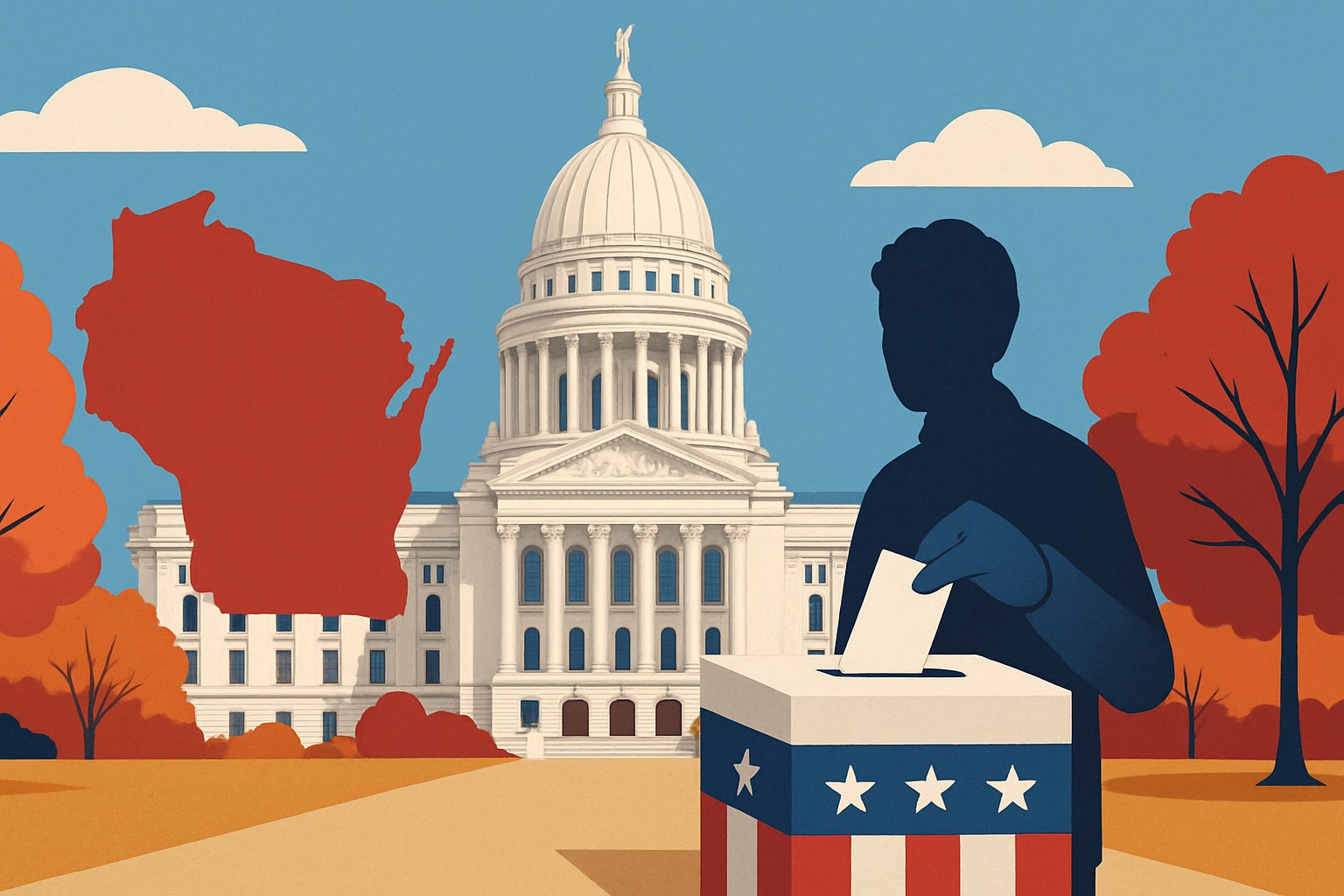
Wisconsin's 2026 governor's race was not supposed to look like this.
For most of the summer, the Democratic primary was Francesca Hong's to lose. The Madison state representative led every major poll by double digits, commanded the progressive energy in a fractured field, and entered August as the strong market favorite. Her Republican opponent, U.S. Rep. Tom Tiffany, spent much of the primary cycle building a massive cash advantage backed by billionaire megadonors, consolidating GOP support, and studying the matchup he expected to face.
Then came August 11. The results came in — and nothing about them matched the projections.
David Crowley, the Milwaukee County Executive who had withdrawn from the race on July 8 and re-entered 10 days later after Sara Rodriguez's candidacy collapsed under campaign finance problems, won the Democratic nomination by fewer than 4,000 votes. His 39.8% to Hong's 39.4% finish was the biggest polling miss of the primary cycle. A State Navigate survey taken just three days before the election had Crowley at 22%, trailing Hong by 22 points. His own campaign's internal poll showed him down 18.
Now Crowley is the Democratic nominee for governor of the most consequential swing state in the Midwest. He faces Tiffany — who won his primary easily, per Marquette Law School's final pre-primary survey — in a November 3 general election that all three major forecasters rate a Toss-Up.
This is the complete race guide for what comes next.
Why This Seat Matters
Wisconsin hasn't elected a Republican governor since Scott Walker lost to Tony Evers in 2018. Evers won two close terms — defeating Walker by 1.2 points, then defeating Tim Michels by 3.4 points in 2022 — before declining to seek a third term. The 2026 race is the first open Wisconsin governor's seat since Evers's initial run.
But the state's presidential math is moving in a different direction. Donald Trump carried Wisconsin in 2024 by approximately 0.9 percentage points — the narrowest presidential margin in the country that cycle. Democrats have continued to overperform at the state level compared to presidential results, but that gap is narrowing.
The governor's office controls school funding formulas, redistricting commissions after the 2030 census, and Wisconsin's regulatory environment for industries ranging from dairy and manufacturing to the data centers now generating fierce public debate. Whoever wins in November will serve a four-year term beginning January 5, 2027, with structural influence over how the state's voters and policies are shaped heading into the next presidential cycle.
The Nominees: How They Got Here
David Crowley (D)
Crowley, 39, is the Milwaukee County Executive, a position he's held since January 2021. A former Wisconsin state assemblyman first elected in 2016, he grew up in Milwaukee and built his County Executive record around expanded mental health services and public transit investment. Republicans have attacked him over Milwaukee County's property and sales tax increases under his tenure — a line of attack Tiffany's campaign launched within 24 hours of his primary victory, in a TV ad titled "Geez, That's Crazy."
His path to the nomination is the most unlikely of the 2026 cycle. Crowley entered the governor's race in 2025 but withdrew on July 8 to endorse Sara Rodriguez, viewed by establishment Democrats as more electable. After Rodriguez's campaign finance problems became public — including disclosures showing just $34,991 cash on hand and reports of "hundreds of thousands of dollars" in reporting errors — Crowley re-entered the race on July 18.
He trailed Francesca Hong by 18 points in his own internal polling at re-entry. He won the primary by 0.4 points, per Wisconsin Public Radio.
His running mate is Sarah Godlewski, Wisconsin's state treasurer.
Tom Tiffany (R)
Tiffany, 68, represents Wisconsin's 7th Congressional District — a vast northern and western Wisconsin seat he's held since a 2020 special election. He entered the governor's race in September 2025 after months of pre-campaign infrastructure building. Per Marquette Law School's July survey, he held 67% in the Republican primary field. He won the August 11 primary easily.
He is Trump-endorsed, backed by every Republican member of Congress from Wisconsin, and carries the support of major state law enforcement groups including the Milwaukee Police Association and Kenosha Professional Police Association. His fundraising base was built heavily through the Republican Party of Wisconsin's pass-through structure, which allowed megadonors Richard and Elizabeth Uihlein and Diane Hendricks to funnel $6.5 million through the state party to his campaign in the January–June period alone, per the Wisconsin Examiner.
His platform centers on education outcomes, property tax relief, electricity rates, and reducing state bureaucracy. He framed his candidacy explicitly as a break from what he called the Evers era's failures on schools, costs, and government size.
His running mate is David Varnam.
The Polling Landscape
Four independent public surveys of the general election matchup exist as of August 23. All four show Crowley with a narrow lead:
- TIPP Insights (R-aligned, Aug. 14–18, 1,199 likely voters, ±3.1%): Crowley 47%, Tiffany 43% — D+4
- Platform Communications/Badger Battleground (R-aligned, Aug. 12–13, 500 likely voters, ±4.4%): Crowley 48%, Tiffany 44% — D+4
- GBAO/Protect Our Wisconsin (D-aligned, Jul. 30–Aug. 3, 800 likely voters, ±3.5%): Crowley 47%, Tiffany 44% — D+3
- RMG Research/Institute for Reforming Government (R-aligned, Jul. 20–24, 800 registered voters, ±3.5%): Crowley 46%, Tiffany 43% — D+3
The 270toWin aggregate through August 18 shows Crowley at 47.0%, Tiffany at 43.3% — a D+3.7 margin. Critically, three of the four polls were conducted by firms with Republican clients. That makes the consistent Crowley lead more analytically significant: it isn't being driven by partisan D-aligned polling.
The Platform Communications/Badger Battleground survey contains notable crosstabs, first reported by Wisconsin Public Radio on August 17. Among independent voters, Crowley leads Tiffany 42% to 30% — a 12-point advantage. In competitive State Assembly districts, Crowley leads 54% to 35%. Crowley's net favorability is +17 (43% favorable, 26% unfavorable); Tiffany's is negative at -5 (38% favorable, 43% unfavorable), with 31% of respondents lacking a formed opinion of Crowley — a sign that awareness-building remains a strategic priority.
One important caveat: the Marquette Law School poll — widely regarded as Wisconsin's gold-standard statewide survey — has not published a Crowley-vs.-Tiffany general election test. Previous Marquette surveys compared Tiffany to candidates no longer in the race. The absence of a Marquette general-election read is the most significant current information gap in the Wisconsin picture.
What the Forecasters Say
As of August 2026, the three major rating services diverge slightly:
- Cook Political Report: Toss-Up
- Inside Elections: Toss-Up (Inside Elections has a separate "Tilt" designation for races with a definable lean; it has not applied it here)
- Sabato's Crystal Ball: Shifted from Toss-Up to Leans Democratic following Crowley's primary victory, per Wisconsin Public Radio's August 14 reporting
The divergence between Cook/Inside Elections (Toss-Up) and Sabato (Leans D) reflects genuine uncertainty. Cook and Inside Elections weight the structural Republican lean in Wisconsin's 2024 presidential result and Tiffany's cash advantage. Sabato's move suggests the polling fundamentals — Crowley's consistent 3–4 point leads, his independent voter advantage, and his favorability edge — tip the structural math toward the Democrat.
The Money Race
The fundraising picture is sharply asymmetric heading into the fall air war:
Tom Tiffany: More than $10 million raised total since campaign launch, per his July 15 campaign announcement. The January–June 2026 reporting period showed $8.7 million raised, including $6.1 million transferred from the Republican Party of Wisconsin. Heading into the general election, Tiffany reported approximately $5 million cash on hand, according to August 4 reporting from the Milwaukee Journal Sentinel — 10 times more than any Democratic opponent had at the same point.
David Crowley: Crowley's campaign was cash-constrained relative to his primary opponents. He reported approximately $800,949 raised in the second half of 2025 (Wisconsin Examiner, January 2026). After his primary win, his campaign announced raising more than $1 million in the first 24 hours, per Wisconsin Public Radio. The Democratic Party of Wisconsin is expected to be the equalization mechanism: technology investor Reid Hoffman reportedly contributed $10 million to the DPW, which the party can deploy to Crowley's campaign through Wisconsin's state law pass-through structure — the same mechanism that built Tiffany's war chest.
The Tiffany campaign launched a "seven-figure" statewide ad campaign immediately after the primary, framing Crowley as a failed county executive. The fall air war is expected to be competitive once Democratic party money flows to Crowley's campaign.
Structural Factors
Wisconsin is the archetypal purple state — one that voted for presidential candidates from both parties in consecutive elections and has repeatedly produced split-ticket results in the same election year. The structural data:
- 2024 presidential: Trump +0.9% (closest state in the country)
- 2022 governor: Evers +3.4% over Michels
- 2022 Senate: Ron Johnson +1.3% over Mandela Barnes (same day as Evers's win)
- Governor's office: Democrats have held it since January 2019
- State Legislature: Republicans control both chambers
Wisconsin voters have repeatedly split the ballot — backing Trump at the top of the ticket while electing or re-electing Democratic statewide officers. That structural pattern is the foundation of Crowley's electoral path.
Tiffany's path runs through the rural and small-city northwestern Wisconsin he represents in Congress — areas that have shifted sharply Republican over the past decade. His challenge is suburban Milwaukee and Madison's collar counties, which have moved steadily toward Democrats since 2016. Crowley's 12-point independent voter lead in the Badger Battleground poll suggests he's currently winning the terrain that typically decides Wisconsin statewide races.
Key Issues
Education and school funding dominate Tiffany's critique of the Evers years. He's framed the race around declining statewide test scores, electricity rates, and property taxes — themes designed to peel away suburban and exurban voters concerned about household costs. His campaign slogan, "Common-Sense Leadership," reflects the pitch to swing voters who want functional governance over ideological warfare.
Crowley's campaign is positioning him as a pragmatic bridge-builder after a bruising primary. His Milwaukee County record on mental health services and transit investment anchors his urban base; his post-primary "unity" messaging is aimed at the progressive Hong voters he needs to consolidate.
Data centers are an emerging battleground across multiple 2026 governor's races, and Wisconsin is no exception. Concerns about power grid strain, water use, and land use in rural communities have created friction that both campaigns are navigating carefully.
The Hong Question
Crowley's most immediate challenge isn't Tiffany — it's unifying the Democratic coalition after a divisive primary. Hong received 39.4% of Democratic primary votes, and her supporters turned out for a candidate with a distinct ideological profile. Per Wisconsin Watch's August 17 reporting, attendees at Crowley's primary night watch party raised concerns about whether he can persuade Hong voters to support him in the general.
Crowley's post-primary message has centered explicitly on unity: "This is not about establishment versus progressives," his campaign statement read. The structural pull toward Crowley from Hong's base — the alternative being a Trump-endorsed congressman — provides a natural gravitational force. But enthusiasm gaps and turnout differentials are distinct from vote intention, and the fall campaign will test whether Crowley can fully consolidate the Democratic coalition.
Live Market Context
The Wisconsin governor race is active on electionpredictions.us. Broader midterm context:
The House control market (87% Democratic, $33.6M volume on electionpredictions.us) and Senate control market (52% Republican) reflect the national political environment shaping Wisconsin's race. A competitive, polling-D toss-up governor's race in a state Trump narrowly won is consistent with a broader midterm environment where Democrats are overperforming downballot relative to the 2024 presidential baseline.
Frequently Asked Questions
Who is favored to win the 2026 Wisconsin governor's race? Available polling shows Democrat David Crowley with a narrow lead of 3–4 percentage points across four surveys, though all results fall within their margins of error. Cook Political Report and Inside Elections rate the race a Toss-Up; Sabato's Crystal Ball rates it Leans Democratic following Crowley's primary victory.
When is the Wisconsin governor election? November 3, 2026. The winner takes a four-year term beginning January 5, 2027.
Who is David Crowley? David Crowley is the Milwaukee County Executive, serving since January 2021. He is 39 years old, a former state assemblyman, and won the Democratic primary on August 11 by fewer than 4,000 votes over state Representative Francesca Hong — one of the biggest polling misses of the 2026 primary cycle.
Who is Tom Tiffany? Tom Tiffany, 68, is the Republican congressman representing Wisconsin's 7th Congressional District across northern and western Wisconsin. He is endorsed by President Donald Trump and entered the general election with approximately $5 million cash on hand, funded substantially by megadonors channeled through the Republican Party of Wisconsin.
Why is the seat open? Two-term Democratic Governor Tony Evers declined to seek re-election to a third term in 2026, creating the first open Wisconsin governor's seat since Evers himself ran in 2018.