Wisconsin Governor 2026 Race Guide: Tom Tiffany, Francesca Hong, and the Open Seat Both Parties Are Fighting For
Tony Evers is out. The first open Wisconsin governor's race since 2010 pits Tiffany vs. a Democratic primary — Toss-Up from every major forecaster.
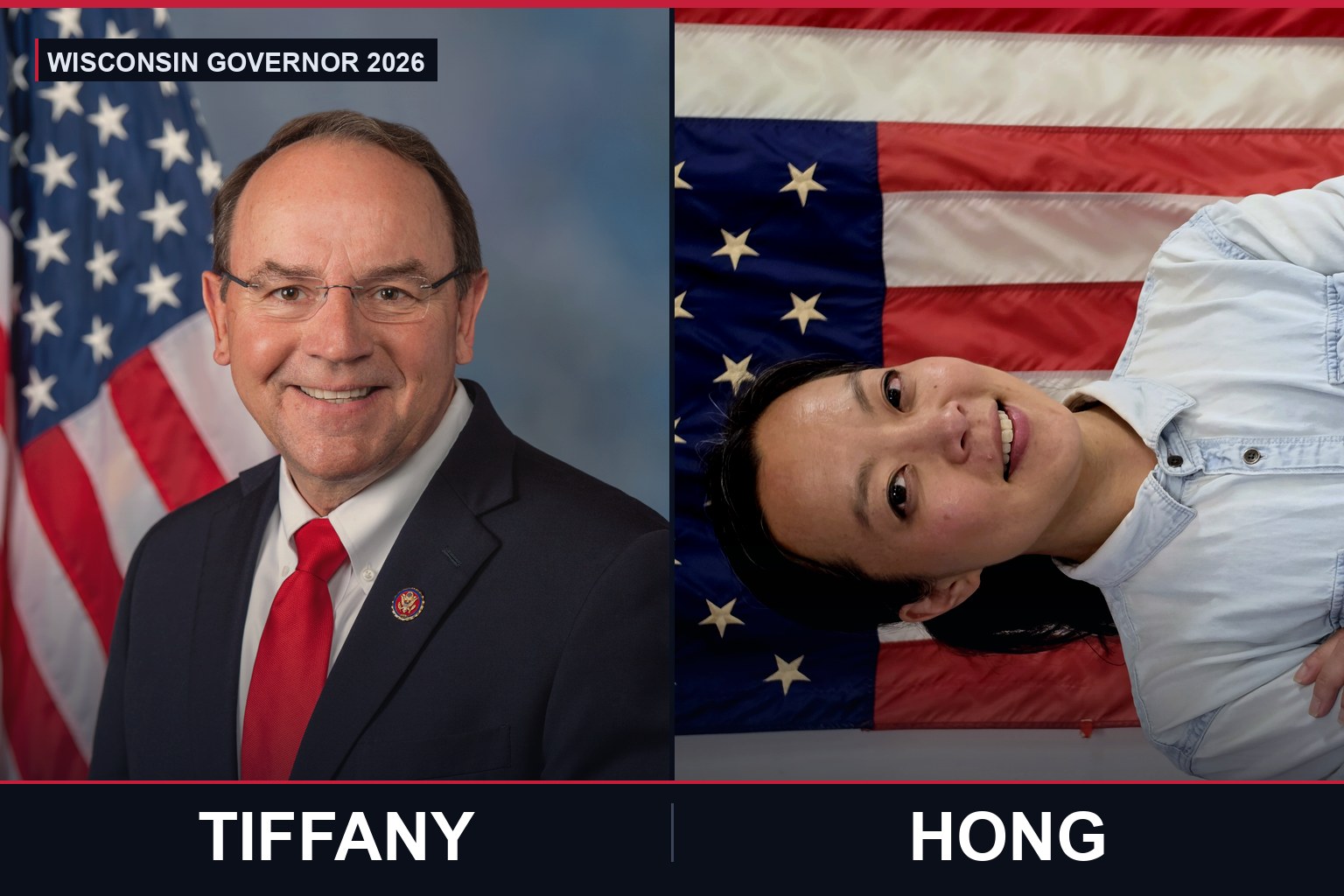
Wisconsin is holding its first open governor's race since 2010 — and prediction markets are pricing November as one of the closest gubernatorial contests in the country. Democratic Gov. Tony Evers declined to seek a third term, handing both parties a clean shot at the state's executive office for the first time in sixteen years. Cook Political Report, Sabato's Crystal Ball, and Inside Elections all rate the race a Toss-Up. The Democratic primary to determine who faces Republican Rep. Tom Tiffany is four days away, on August 11.
For a state that has split its tickets with remarkable consistency — Republicans have held both chambers of the Legislature since 2011, while Democrats have held the governor's office since Evers' 2019 inauguration — the 2026 race is a genuine reset. Whichever party wins will hold the governor's veto pen heading into the 2030 redistricting cycle, making the stakes longer than a single term.
Background: The Open Seat That Changed Everything
Evers announced in July 2025 that he would not seek a third term, Wisconsin Public Radio reported. The move was widely described as the state's first wide-open governor's contest since Scott Walker defeated incumbent Democratic Gov. Jim Doyle in 2010. Evers, 74, said he was proud of his tenure in public service but that it was time to focus on his family.
His exit removed the most formidable Democratic incumbent from the equation. In his two election victories, Evers beat Walker in 2018 by 49.5% to 48.4% — a margin of roughly 29,000 votes — and beat Republican businessman Tim Michels in 2022 by 51.1% to 47.8%, per certified Wisconsin Elections Commission results. Both wins came in a state that has defined American political competitiveness: Trump won Wisconsin in 2024 by 0.9 percentage points, while Biden carried it in 2020 by 0.6 points.
With no incumbent on the ballot, both parties started fresh. The Republican field consolidated quickly. The Democratic field, as detailed below, did not.
The Republican Nominee: Tom Tiffany
Rep. Tom Tiffany represents Wisconsin's 7th Congressional District, a sprawling northern Wisconsin district that stretches from the UP border through the Northwoods. He entered the governor's race in September 2025 and has faced only token primary opposition — medical services technician Andy Manske is on the August 11 Republican ballot but has barely registered in polling or fundraising.
The Republican Party of Wisconsin officially endorsed Tiffany at the May 2026 state convention, unlocking a direct financial pipeline from the state GOP to his campaign. Per campaign finance filings reported by Wisconsin Public Radio, the Wisconsin Examiner, and WMTV15, Tiffany raised over $8.7 million in the first half of 2026, with more than $6.1 million transferred from the Republican Party of Wisconsin, which itself received major contributions from megadonors including Richard and Elizabeth Uihlein of Uline ($4 million) and Diane Hendricks, CEO of ABC Supply ($2.5 million). He raised an additional $4.6 million in July — again largely through a state party transfer of roughly $4 million, per the Wisconsin State Journal. He will enter the November general election with nearly $5 million cash on hand, according to the most recent filings reported by the State Journal.
Tiffany received an endorsement from President Trump. On the stump, he has campaigned on tax cuts, deregulation, rolling back state spending, and what he characterizes as restoring "common-sense leadership" to Madison after years of Democratic executive control. His critics point to the concentration of megadonor money behind his campaign as a general election vulnerability; Democratic outside group A Better Wisconsin Together released an August 5 report arguing that more than 65% of Tiffany's total fundraising haul traces to billionaire-connected contributions.
Tiffany's structural challenge in the general: his congressional district is one of the most Republican in the state. Winning statewide requires strong performance in the Fox Valley, suburban Milwaukee, and the competitive Waukesha and Washington County collars that have historically decided Wisconsin statewide contests.
The Democratic Primary: Four Candidates, One Frontrunner, a Lot of Drama
The Wisconsin Democratic gubernatorial primary has been, to put it charitably, eventful. A field that began with more than ten declared candidates has contracted to four active contenders by primary day.
Two prominent candidates withdrew before the finish line. Lt. Gov. Sara Rodriguez exited in mid-July after campaign finance irregularities were exposed in her official filings. Wisconsin Public Radio reported that her original H1 2026 report showed just $34,991 in cash on hand and $152,276 in debts — figures that contradicted earlier campaign statements and triggered questions about "hundreds of thousands of dollars" in contributions that had not been properly tracked. Rodriguez said she was suspending her campaign. Former Lt. Gov. Mandela Barnes, who had led early polls and carried the most name recognition from his 2022 Senate campaign, withdrew on July 30 and called for Democrats to unite. His exit came after questions from the Milwaukee Journal Sentinel about his conduct in the party, per The Fulcrum's reporting.
Four candidates remain:
Francesca Hong is a 37-year-old state representative from Madison who describes herself as a democratic socialist. She rose from single digits in early polls to a commanding lead through the final weeks of the primary. The Marquette University Law School poll conducted July 22–29 (n=407 Democratic primary voters, ±6.6%) showed her at 38% among declared preferences and 46% when undecided voters were asked to choose. A State Navigate poll conducted July 23–26 (n=1,085 likely voters, ±3.0%) put her at 44%, nearly 30 points ahead of her nearest rivals. A Public Policy Polling survey from August 4–5 showed her at 52% to Milwaukee County Executive David Crowley's 33%. Prediction markets on our platform currently price her as the strong favorite to win the Democratic nomination.
David Crowley, the Milwaukee County Executive, ran an unusual primary journey: he initially entered the race in September 2025, then suspended his campaign in early July to endorse Rodriguez, then re-entered the race days later when Rodriguez's campaign collapsed — this time with an endorsement from outgoing Gov. Tony Evers. Crowley's gamble has not produced the polling movement he needed. The Marquette survey conducted after his re-entry placed him at 7%, while the State Navigate poll had him at 15%, and the most recent PPP poll showed him at 33%. The Marquette research team noted that his re-entry appeared to scramble the contest for second place more than it dented Hong's lead.
Kelda Roys (state senator, Madison) and Joel Brennan (former Evers cabinet secretary and president of the Greater Milwaukee Committee) have each polled consistently in the low single digits through the final weeks of the primary.
The Electability Debate
The most contested question of the Democratic primary's final week was not whether Hong would win it, but whether she could win November in a state that swung Republican at the presidential level in 2024.
A mid-July Marquette poll found that, in head-to-head general election matchups conducted at the time, only Barnes led Tiffany among the Democrats tested — 44%–40%. Hong trailed Tiffany by 3 percentage points in the same survey; Roys trailed by 4 points. (The matchup did not include Crowley, who had briefly exited the race when the poll was fielded.)
Outgoing Gov. Evers made the electability argument explicit when he endorsed Crowley. "We need a candidate at the top of the ticket who will not only beat Tom Tiffany, but help us deliver a Democratic Assembly and Senate," Roys argued in similar terms, per PBS Wisconsin reporting. The Hill noted that some Democratic Party officials in competitive suburban districts expressed "nervous energy" about Hong's nomination and its potential effect on down-ballot races.
Hong's campaign and her supporters counter several points: democratic socialists have been winning primaries across the country; the electability critique was also raised against Evers in 2018 before he narrowly defeated a two-term incumbent governor; and Hong's second-choice numbers among Barnes supporters — 43% in State Navigate polling, per The Fulcrum — suggest the party coalition can consolidate behind her once the primary ends. Her polling strength with younger voters and very liberal voters reflects an enthusiasm advantage that some analysts believe could generate turnout offsetting the head-to-head deficit.
General Election Landscape
History: Democrats have won Wisconsin's governorship in four of the last five elections. The last Republican to hold the office was Walker, who won in 2010 and 2014 before losing to Evers in 2018. Republicans have been out of the executive branch for eight years; regaining the governor's mansion would end the legislative-executive split that has defined Wisconsin state government since 2019 and remove the Democratic veto pen from the budget process.
Money: The fundraising gap heading into November is stark. Tiffany is entering the general with roughly $5 million cash on hand, according to the Wisconsin State Journal. The likely Democratic nominee, Hong, carried approximately $410,000 cash on hand at the close of H1 2026, per WMTV15's reporting on official filings; her fundraising has accelerated since the primary consolidated around her, but she starts November from a dramatically different financial position than Tiffany. National Democratic committee investment and outside spending from groups like the Democratic Governors Association will be critical in closing that structural gap.
State partisan lean: Wisconsin is genuinely split. Trump won the state by 0.9 points in 2024 and lost it by 0.6 in 2020, per certified election results. But the governor's race and the presidential race regularly diverge in Wisconsin — Evers outran Biden by more than 4 points in his 2022 victory. The key variables in November will be turnout in Milwaukee and Dane Counties (reliably Democratic), suburban Milwaukee (competitive, trending Democratic for governor), and the rural northern tier (reliably Republican). The difference between a Democratic win and a Republican win in most recent Wisconsin statewide contests has been less than 100,000 votes.
For national context, the Wisconsin governor's race sits within a broader midterm environment in which Republicans currently hold a slight edge in Senate control markets:
No active Wisconsin-specific governor general election market is currently available on our platform.
Key Dates
- August 11, 2026: Democratic and Republican primaries
- November 3, 2026: General election
What to Watch
On August 11, turnout patterns in Milwaukee County — Crowley's home base and the state's largest Democratic population center — will signal whether the establishment's late consolidation behind him found any traction. A narrow Hong margin in Milwaukee paired with a dominant performance in Dane County and college-town precincts would confirm her coalition profile and clarify how she needs to expand it in November.
After the primary, watch for whether national Democrats open their wallets. The Democratic Governors Association will need to make a significant investment to offset Tiffany's cash advantage. The pace and scale of that outside spending will determine whether the Toss-Up rating holds through Labor Day or whether the race shades toward one party based on resources alone.
Ultimately, Wisconsin's governor's race in 2026 is a test of a familiar question in American battleground politics: can a party hold an office its candidate won twice when the incumbent steps aside, the national environment is mixed, and the opposition has a money advantage? Democrats have done it here before. Whether they can do it again — and with which nominee — is what August 11 sets in motion.
Sources
- Associated Press / PBS NewsHour, "Wisconsin Democratic Gov. Tony Evers won't seek third term next year" — pbs.org/newshour
- Wisconsin Public Radio, "Tony Evers won't seek reelection, setting up wide-open race for Wisconsin governor" — wpr.org
- Ballotpedia, "Wisconsin gubernatorial and lieutenant gubernatorial election, 2026" — ballotpedia.org
- Wisconsin Public Radio, "Hong leads Democratic primary for governor once again in new Marquette poll" — wpr.org
- Wisconsin Public Radio, "Ahead of Democratic debate, poll finds Francesca Hong up in primary for governor" (State Navigate poll coverage) — wpr.org
- WMTV15 News, "Wisconsin governor's race fundraising: Where candidates stand" — wmtv15news.com
- Wisconsin Examiner, "Tiffany reports over $8 million haul for gov race, while Barnes leads Dem field in fundraising" — wisconsinexaminer.com
- Wisconsin State Journal / Madison.com, "Tiffany, Crowley are the lead fundraisers in Wisconsin governor race" — madison.com
- Wisconsin Public Radio, "Barnes, Hong lead Democratic fundraising as Rodriguez stumbles" — wpr.org
- Wisconsin Watch, "Wisconsin's Democratic primary for governor: a look at the 5 candidates" — wisconsinwatch.org
- PBS Wisconsin, "Wisconsin's 2026 primary for governor hits the home stretch" — pbswisconsin.org
- The Fulcrum, "Is Wisconsin ready for a democratic socialist governor? Why Francesca Hong is surging" — thefulcrum.us
- The Hill, "Democratic socialists turn to Hong in Wisconsin with hopes for next big win" — thehill.com
- USA Today, "Your full voter guide to the Wisconsin governor primary election" — usatoday.com